SMM, September 7:
In the metals market:
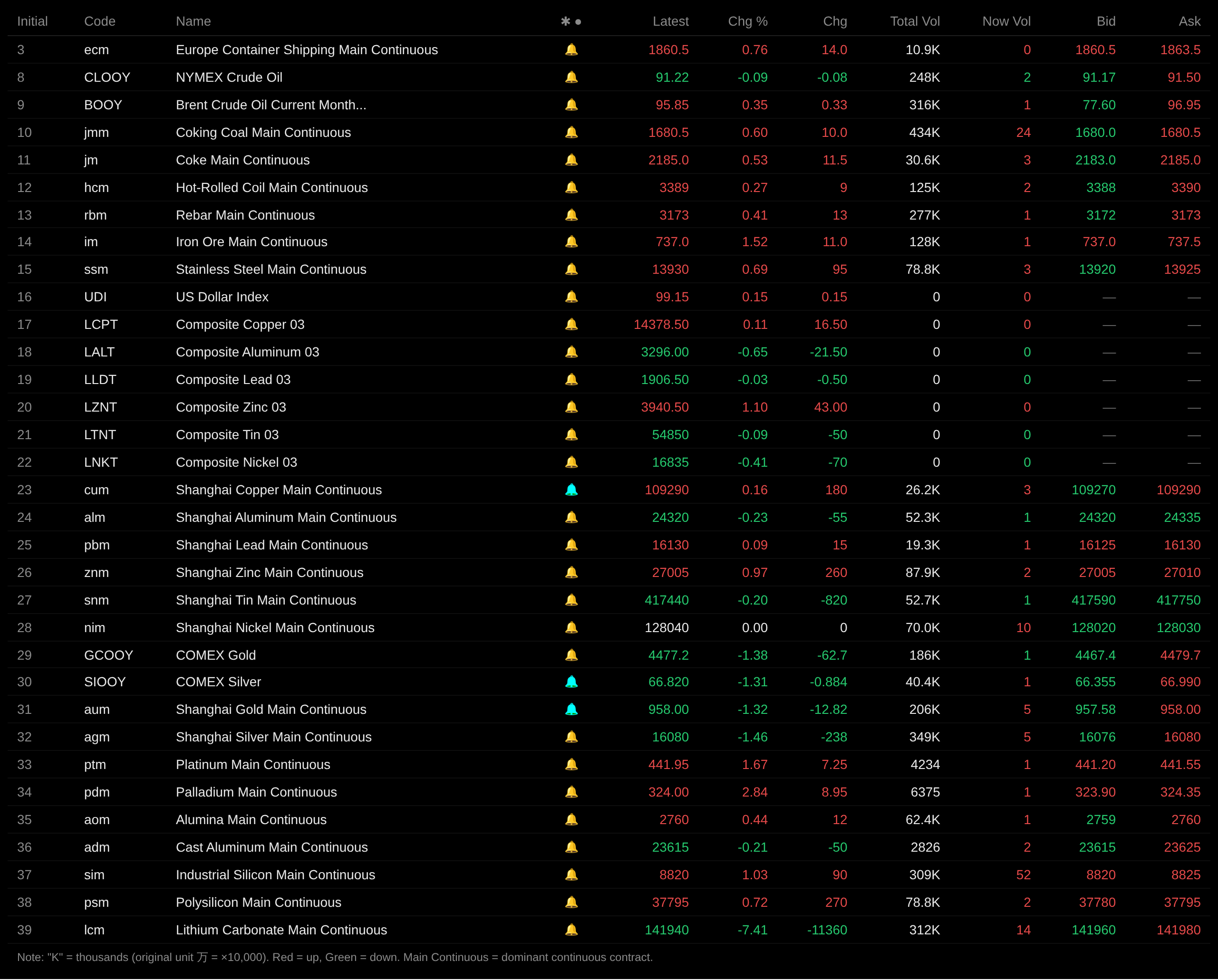
Last Friday overnight, base metals on both domestic and overseas markets showed mixed performance. LME zinc led the gains with a 1.1% increase, SHFE zinc rose 0.97%, SHFE nickel closed flat at 128,040 yuan/mt, LME aluminum led the declines with a 0.65% drop, and the remaining metals saw relatively small fluctuations. The alumina main contract rose 0.44%, while the cast aluminum main contract fell 0.21%.
Last Friday overnight, ferrous metals broadly rose, with iron ore leading the gains at 1.52%, stainless steel up 0.69%, and rebar up 0.41%. In coking coal and coke, coking coal rose 0.6% and coke rose 0.53%.
Last Friday overnight in precious metals, COMEX gold fell 1.38% and COMEX silver fell 1.31%. On the weekly chart, COMEX gold fell 1.16% and COMEX silver fell 1.43%, both recording a second consecutive weekly decline. Domestically, SHFE gold fell 1.32% and SHFE silver fell 1.46%. On the weekly chart, SHFE gold fell 2.8% and SHFE silver fell 3.38%.
As of 8:22 on September 5, last Friday's overnight closing prices:
Macro front
Domestically:
[PBOC to conduct 500 billion yuan outright reverse repo operation on Monday] People's Bank of China: On September 7, 2026, the People's Bank of China will conduct a 500 billion yuan outright reverse repo operation through fixed-quantity, rate-based tender, and multiple-price bidding, with a term of 3 months (89 days), maturing on December 5, 2026.
[Seven departments including the Cyberspace Administration of China jointly issue the Implementation Plan for Promoting the Coordinated Transformation and Development of Digitalization and Greenization (2026-2030)] Seven departments including the Cyberspace Administration of China jointly issued the Implementation Plan for Promoting the Coordinated Transformation and Development of Digitalization and Greenization (2026-2030). The plan states that by 2030, AI's advantages of low cost and high efficiency will be further demonstrated, deeply empowering green and low-carbon technology innovation and industrial development. Energy efficiency in emerging fields such as computing power facilities and 5G base stations will be significantly improved, driving renewable energy electricity consumption in key areas such as computing power facilities to reach the renewable energy consumption responsibility weight level of their respective provinces. Digitalization and greenization in key areas such as agriculture, manufacturing, trade, consumption, and urban operations will be further advanced. Digital and intelligent technologies will continue to enhance ecological and environmental governance capabilities, and the coordinated development model of digitalization and greenization will strongly support the comprehensive green transformation and high-quality development of the economy and society. (Jin10 Data APP)
[MIIT issues the AI Support Plan for Small and Medium-sized Enterprise Entrepreneurship (2026-2028)] The General Office of the Ministry of Industry and Information Technology issued a notice on the AI Support Plan for Small and Medium-sized Enterprise Entrepreneurship (2026-2028). Over three years, in key areas such as industry applications, data services, and intelligent computing power, we will cultivate and form a large number of AI startups with strong innovation vitality and great growth potential, newly cultivate more than 10,000 technology-based and innovative small and medium-sized enterprises, exceed 2,000 specialised and sophisticated "little giant" enterprises, and see the emergence of a number of gazelle enterprises and unicorn enterprises. Focusing on the field of artificial intelligence, we will build 10 high-standard technology enterprise incubators and 10 national public service demonstration platforms (bases) for SMEs, newly cultivate 10 national-level SME clusters with distinctive industries, continuously unleash the innovation and entrepreneurship vitality of AI SMEs, and initially form a pattern of high-quality development of SMEs empowered by artificial intelligence. (Jin10 Data APP)
US dollar:
As of last Friday's overnight close, the US dollar index rose 0.15% to 99.15, with a weekly decline of 0.53%. The August non-farm payrolls report came in better than expected, prompting the market to increase bets on a Fed rate hike in September. On the data front, US job growth in August was better than expected, and the unemployment rate remained unchanged, indicating that momentum in the US labour market may be stronger than previously thought. According to data released by the US Bureau of Labor Statistics on Friday, on the basis of upward revisions to employment data for the previous two months, US non-farm payrolls increased by 162,000 in August, exceeding all economists' expectations. Non-farm payroll growth was mainly driven by a rebound in leisure and hospitality employment and an increase in government sector employment. At the same time, construction and manufacturing also recorded relatively strong job growth. The unemployment rate held at 4.1%. This report shows that the US labour market is withstanding the uncertainty brought by the Iran war and inflationary pressures. Fed officials may view this report as evidence supporting the case for a rate hike, although the US CPI data to be released this week will be key to the Fed's interest rate decision later this month. (Jin10 Data APP)
US President Trump posted: The employment data just released is fantastic, beating all expectations (except mine!), with growth reaching two or even three times the expected level, and you haven't seen the full picture yet! US employers added 162,000 jobs in August. Cut interest rates, because America's credit standing is much better than it was not long ago! A strong country means lower interest rates because its credit standing is better... It's that simple! We should have the lowest interest rates in the world, just like in the "old days." If the US does not agree to allow them to have huge trade surpluses (which we can stop immediately), then they should no longer be regarded as financial "elite" countries!Cut interest rates, or I will stop dealing with countries that we have trade deficits with. The US Supreme Court, in its absurd and costly tariff ruling, clearly acknowledged that the "President" has the absolute right to do so. This is far better than tariffs! The Federal Reserve Board, under this outstanding new leadership, must become sensible, think from a different angle, and be a patriot for once. High interest rates put the US at a grossly unfair disadvantage, and I will never allow this to happen! (Jin10 Data APP)
Jeff Rosenberg, portfolio manager at BlackRock, said US job growth in August far exceeded expectations, highlighting the importance of the Consumer Price Index (CPI) data released this week. Fed policymakers are weighing whether to raise interest rates based on this. He said: "This in some ways confirms what we know about the labour market and shifts the focus and pressure back to the inflation question. The key is whether inflation is rising, or whether it is not falling fast enough, which will determine whether the Fed raises rates at the September meeting." He said that if the CPI report released on September 11 continues to show improvement in inflation, "I think they will keep rates unchanged." (Jin10 Data APP)
"Fed mouthpiece" Nick Timiraos noted that ahead of the September 15-16 policy meeting, Fed officials have made clear that inflation data will be the most important factor in deciding whether to raise rates, after the Fed has kept rates unchanged all year. Even though the strong August jobs report will not change this framework, it does clear one obstacle to a rate hike. If August employment data had continued to weaken on top of July's negative growth, the case against tightening monetary policy might have been more compelling: why raise rates when the labour market shows no signs of growth? However, after Friday's jobs report reversed July's negative employment growth and pushed the six-month average hiring pace to its highest level in more than two years, that argument no longer exists. (Jin10 Data APP)
Citigroup on Friday pushed back its forecast for the Fed's next interest rate cut from October 2026 to June 2027, citing stronger-than-expected nonfarm payroll growth in August and overall stability in the labour market. The brokerage had previously forecast that the Fed would cut rates by 25 basis points each in October 2026, December 2026, and January 2027, but now expects the Fed to cut rates by 25 basis points each in June, September, and December 2027. (Jin10 Data APP)
According to CME "FedWatch": the probability that the Fed will keep rates unchanged in September is 39.7%, and the probability of a cumulative 25-basis-point rate hike is 60.3%. The probability of the US Fed keeping interest rates unchanged through October is 28.7%, the probability of a cumulative 25bp hike is 54.6%, and the probability of a cumulative 50bp hike is 16.7%. (Jin10 Data App)
Other currencies:
Eurozone retail sales fell 0.6% in July, signaling weak consumer spending; overall retail sales declined 0.4% in July after rising 0.2% in the previous month. However, compared with July 2025, Eurozone retail sales rose 0.6%, and overall EU retail sales grew 1.0%. The monthly decline was driven mainly by weak non-food sales, with Germany particularly weak. Despite the monthly drop in retail sales, they remained slightly above year-earlier levels, suggesting consumer demand is slowing but has yet to contract sharply. In addition, automotive fuel sales also fell 0.8%, while food, beverages and tobacco consumption rose 0.4%, providing some support to retail sales. These data have no impact on the ECB, and the market widely expects the ECB to raise rates by 25bp at its upcoming meeting, lifting the policy rate to 2.50%. (Jin10 Data App)
Economists at BNP Paribas noted in a report that persistent energy price shocks, combined with the resilience of the Eurozone economy, mean the ECB may hike once each in September and December. Economists expect the ECB to raise rates this week and may also revise up growth and inflation expectations, which would further support the case for tighter monetary policy. Continued high energy prices and a strong economy will make second-round effects more likely, although relevant signs remain limited for now. Economists said policymakers will still see risks to the inflation outlook as tilted to the upside. (Jin10 Data App)
On the macro front:
This week in China, data including China's August foreign exchange reserves, August trade balance, August import and export annual rates, and August CPI annual rate will be released; in the US, data including the US August NFIB Small Business Optimism Index, US August New York Fed 1-year inflation expectations, US ADP employment change for the week ending August 22, US 10-year Treasury auction high yield for September 9, US 10-year Treasury auction bid-to-cover ratio for September 9, US initial jobless claims for the week ending September 5, US August PPI annual rate, US August PPI monthly rate, US August existing home sales annualized, US July wholesale sales monthly rate, US August unadjusted CPI annual rate, US August seasonally adjusted CPI monthly rate, US August seasonally adjusted core CPI monthly rate, US August unadjusted core CPI annual rate, US September preliminary one-year inflation expectations, and US September preliminary University of Michigan consumer sentiment index will be released; in the Eurozone, data including the Eurozone September Sentix investor confidence index, Eurozone Q2 revised GDP annual rate, Eurozone Q2 preliminary seasonally adjusted employment quarterly rate, Eurozone ECB deposit facility rate as of September 10, and Eurozone ECB main refinancing rate as of September 10 will be released; in the UK, data including the UK July three-month GDP monthly rate, UK July manufacturing output monthly rate, UK July seasonally adjusted goods trade balance, and UK July industrial output monthly rate will be released; in Germany, data including the German July seasonally adjusted industrial output monthly rate, German July seasonally adjusted trade balance, and German August final CPI monthly rate will be released; Switzerland's August seasonally adjusted unemployment rate, Switzerland's August consumer confidence index, France's July trade balance, France's July industrial output monthly rate, and Japan's July trade balance will also be released.
Note that on Monday, September 7, US markets are closed for Labour Day: the NYSE is closed, the Toronto Stock Exchange in Canada is closed, CME Group's precious metals and US crude oil futures trading ends early at 02:30 Beijing time on September 8, equity index futures trading ends early at 01:00 Beijing time on September 8, and ICE's Brent crude oil futures trading ends early at 01:30 Beijing time on September 8 due to Labour Day.
In addition, Apple held its autumn product launch event with the theme "It's Glowtime," ECB President Lagarde delivered a speech at the Bundesbank's official dinner, the ECB announced its interest rate decision, and ECB President Lagarde held a monetary policy press conference.
Crude oil:
Oil prices showed mixed performance in overnight trading last Friday, with WTI down 0.09% and Brent up 0.35%. On a weekly basis, WTI surged 9.38% and Brent jumped 8.8%, driven mainly by renewed Middle East conflict.
As the war between the US and Iran intensifies concerns over energy supply disruptions, hedge funds' bullish sentiment on Brent crude rose to the highest level since May. ICE data showed that in the week ended September 1, speculators increased their net long position in ICE Brent crude by 37,837 contracts to 261,435 contracts, a 14-week high. Net long bets on gasoline soared to 89,263 contracts, the highest since last December, as gasoline prices hovered near record highs for September. Net long position in Robusta coffee fell to 15,588 contracts, a 12-week low. Net short position in London cocoa fell to 1,315 contracts, a 7-week low. (Wall Street CN)
US Treasury Secretary Bessent said oil prices could pull back sharply to $40 per barrel after the Iran conflict ends, and increased crude supply would push US Treasury yields lower. Bessent said the oil market would see oversupply after the Iran conflict ends, and "you could see $50, $40 crude prices" as a large amount of supply enters the market in the future. Driven by the recent US-Iran military conflict, Brent crude rose above $95 on Friday, while WTI approached $90. Bessent said the recent rise in energy prices has heightened market concerns about inflation and pushed up global benchmark bond yields, with the US 10-year Treasury yield rising this week to its highest level since 2023. Bessent also downplayed the impact of Norway's sovereign wealth fund's plan to reduce its US Treasury holdings, saying the fund simply wants to allocate to other US assets, including Fannie Mae and Freddie Mac-related bonds. (Jinshi Data APP)
Also note that this week, the EIA released its monthly Short-Term Energy Outlook, OPEC released its monthly crude oil market report (the exact release time of the monthly report is to be determined, generally published around 18-21 Beijing time), the IEA released its monthly crude oil market report, and China will open a new round of refined oil price adjustment window (to be determined).