A Fresh High After Three Months on a Plateau
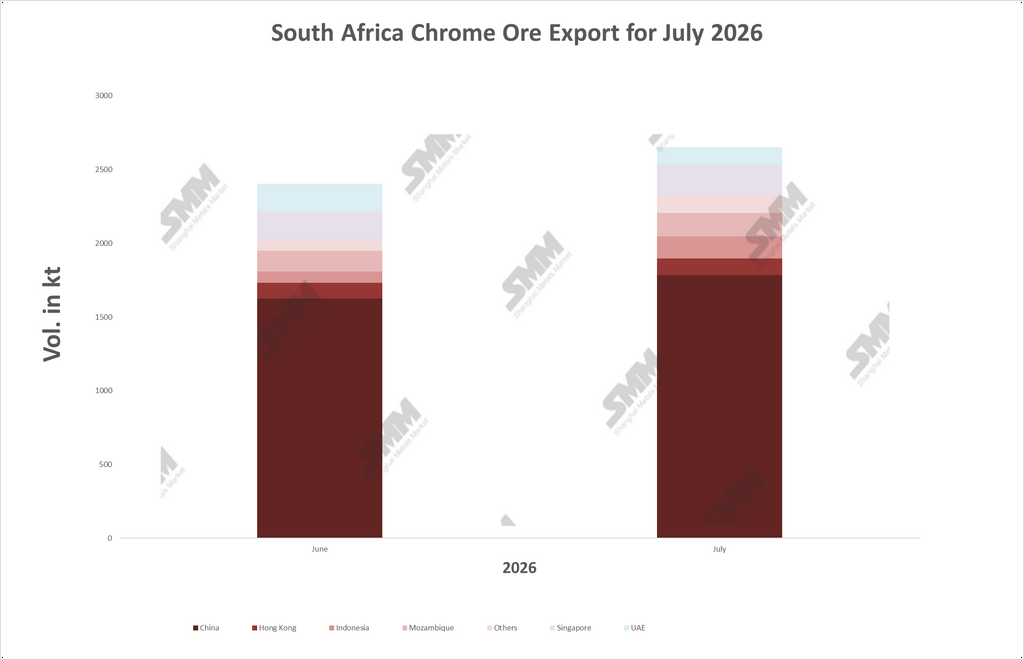
South Africa's chrome ore exports rose to approximately 2.65 million tonnes in July 2026, up 10.3% month-on-month from June's 2.40 million tonnes, breaking decisively out of the narrow band that had held for three straight months. April, May and June had traced a mild, incremental slide — 2.47 million tonnes, then 2.43 million tonnes, then 2.40 million tonnes — a pattern that looked, at the time, like a market settling into a plateau after an extended run of outsized growth. July's rebound overturns that reading: at 2.65 million tonnes, it is the highest monthly export volume recorded so far in 2026, surpassing even April's total.
China Still Dominant, But Its Share Eases
China remained overwhelmingly the largest destination, absorbing 1.784 million tonnes in July, up 9.8% from June's 1.624 million tonnes. In absolute terms, China's offtake grew almost exactly in line with the market as a whole. But because several smaller destinations grew faster in percentage terms, China's share of total exports eased marginally, from 67.6% in June to 67.3% in July. This is a subtle shift rather than a structural one — China's demand anchor remains intact, underpinned by high operating rates at Chinese ferrochrome smelters and continued growth in stainless steel output — but it is a reminder that the destination mix is not static even when the dominant buyer keeps growing.
Indonesia and the UAE Move in Opposite Directions
The more striking story sits among the secondary destinations, where Indonesia and the UAE moved in sharply opposite directions. Indonesia's imports of South African chrome ore nearly doubled, rising 92.8% month-on-month from 77.8 thousand tonnes to 150.0 thousand tonnes, lifting its share of total exports from 3.2% to 5.7% and overtaking the UAE as a secondary buyer. The UAE, by contrast, fell 38.3%, from 188.1 thousand tonnes to 116.1 thousand tonnes, with its share of the export basket dropping from 7.8% to 4.4%.
Two Very Different Kinds of Secondary Buyers
These two moves likely reflect different underlying dynamics rather than a single common cause. Indonesia's chrome ore imports track its own build-out of domestic ferrochrome and stainless steel processing capacity, concentrated around its nickel-and-stainless industrial parks; as that capacity continues to expand, direct ore imports for local smelting are a more plausible growth driver than re-export activity. The UAE's role in the chrome trade, on the other hand, is structurally different: Dubai in particular functions as a re-export and trading hub for bulk metal ores rather than as an end-use market, with free-zone trading houses positioned to move cargo on to buyers elsewhere rather than consume it domestically. A destination with that profile is inherently more exposed to month-to-month swings in trading and blending flows than to underlying industrial demand, which is a reasonable explanation for why its volumes can halve in a single month without signaling anything about genuine consumption. Singapore and Hong Kong, which play similar trading-hub roles, posted only modest gains in July (+7.8% and +4.1% respectively), suggesting the UAE's decline was destination-specific rather than part of a broader pullback across trading centers. Mozambique, which continues to reflect volumes routed through the Maputo corridor, rose 15.2% to 159.2 thousand tonnes, consistent with the corridor's ongoing role as an alternative to Transnet's rail and port network.
A Supply Base That Keeps Expanding
On the supply side, July's volumes arrived against a backdrop of continued growth in ore output from South Africa's platinum-group-metals producers, for whom chromite is an increasingly deliberate by-product rather than an incidental one. Sibanye-Stillwater has outlined expansion plans that could lift its chrome volumes by as much as 75%, while Eastern Platinum's Crocodile River Mine chrome concentrate output climbed 353% in 2025 to 82,120 tonnes, and Southern Palladium's Bengwenyama project has more than tripled its projected chrome output. This supply growth is arriving into a market that was already running a surplus: SMM data show South African 40–42% chrome concentrate (CIF China) prices sliding from around $319 per tonne in late March/early April to roughly $280 per tonne by the end of June, alongside national chromite port inventories in China that hit a record 4.7 million tonnes as of end-June. Softer prices and swelling stockpiles have not, so far, discouraged South African exporters from shipping — if anything, thinner margins appear to be reinforcing the incentive to move volume rather than hold it.
Policy Catches Up on Power, Not Yet on Ore
The policy backdrop is essentially unchanged from June. The proposed ITAC export-permit system for chrome ore, and the associated export tax discussed at rates of up to 25%, remain in the same position they have occupied since public consultation closed: approved in principle by Cabinet, but not yet gazetted or enacted. One piece of the puzzle did move forward, however: NERSA formally approved the concessionary 62 cents/kWh electricity tariff for Samancor Chrome and the Glencore-Merafe venture on May 29, with the framework taking effect from June 1. That relief is now live rather than merely proposed — yet July's export data shows no sign that cheaper power has begun redirecting ore away from export and toward domestic smelting. Furnace restarts typically require 12 to 24 months of lead time, so a one-month lag is not surprising, but it does mean the structural pattern behind this data series — more ore reaching the market, less of it converted to ferrochrome before it leaves the country — remains firmly in place for now.
|
Outlook: July's rebound to a fresh 2026 high confirms that South Africa's chrome ore export engine has not lost momentum, even as the destination mix continues to shift in ways worth watching closely. China's dominance is intact but no longer the only story — Indonesia's steady climb points to a genuine, capacity-driven buyer emerging alongside China, while the UAE's volatility is a reminder that not every destination in the data represents end-use demand. With PGM by-product supply still growing, prices soft, and the export-control and tax framework still unimplemented, the conditions that have driven this export surge through 2026 show little sign of reversing in the near term. |
![[SMM Chromium Flash] China's High-Carbon Ferrochrome Output Drops 3.17% MoM in September as Cost Inversion Bites](https://imgqn.smm.cn/usercenter/NPpAM20251217171723.jpeg)