SMM News on September 2:
Metals market:
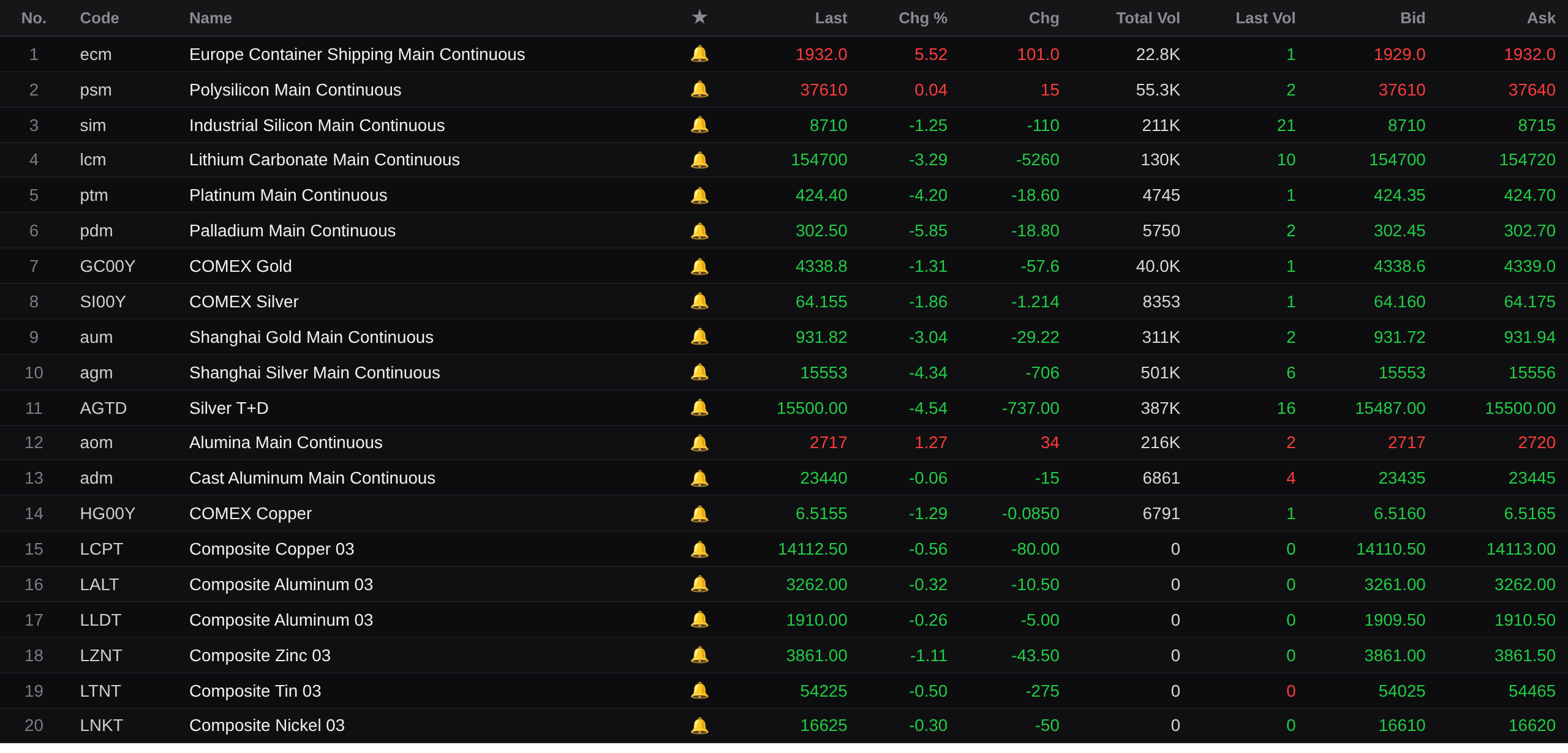
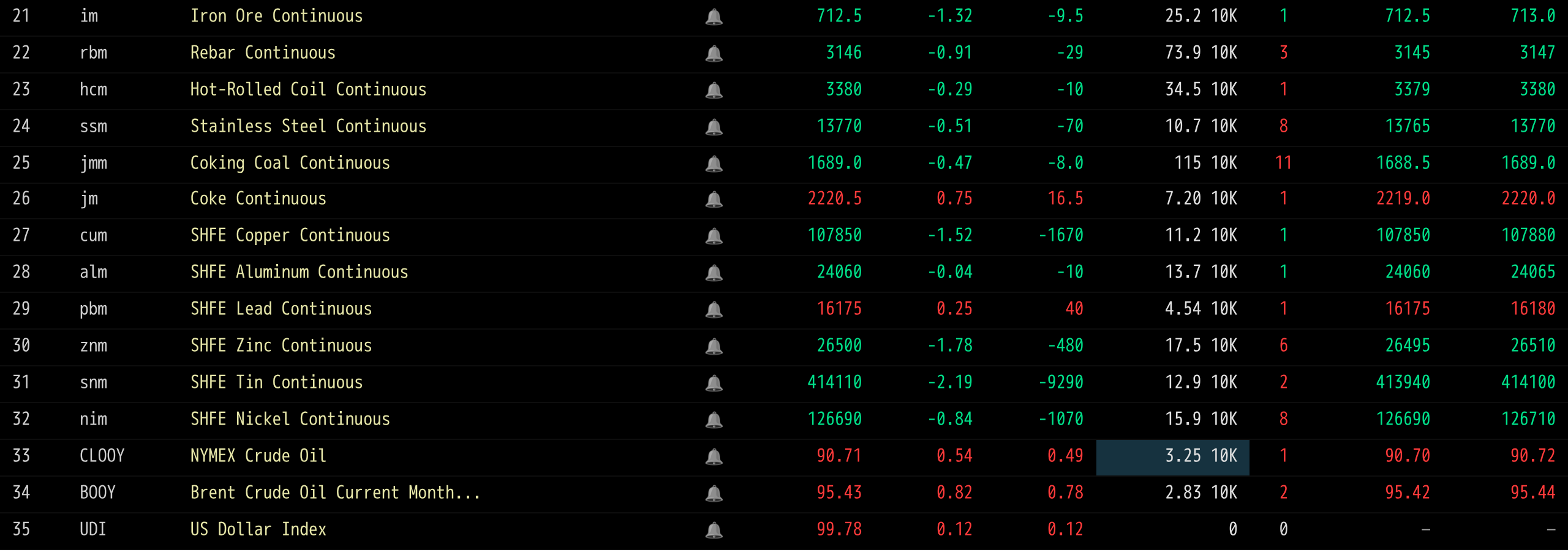
As of the midday close, base metals in the domestic market mostly fell. SHFE copper fell 1.52%, and SHFE aluminum edged down. SHFE lead rose 0.25%. SHFE zinc fell 1.78%. SHFE tin fell 2.19%. SHFE nickel fell 0.84%.
In addition, the most-active cast aluminum futures contract edged down, while the most-active alumina contract rose 1.27%. The most-active lithium carbonate contract fell 3.29%. The most-active silicon metal contract fell 1.25%. The most-active polysilicon futures contract edged up.
Ferrous metals mostly fell. Iron ore fell 1.32%, rebar fell 0.91%, and hot-rolled coil fell 0.29%. Stainless steel fell 0.51%. For coking coal and coke: the most-traded coking coal contract fell 0.47%, while the most-traded coke contract rose 0.75%.
Overseas base metals: as of 11:41, LME metals fell across the board. LME zinc fell 1.11%. LME copper fell 0.56%, and LME aluminum fell 0.32%. LME lead fell 0.26%. LME tin fell 0.5%. LME nickel fell 0.3%.
Precious metals: as of 11:41, COMEX gold fell 1.31% and COMEX silver fell 1.86%. Domestic precious metals: SHFE gold fell 3.04%, and the most-active SHFE silver contract fell 4.34%.
In addition, as of the midday close, the most-active platinum futures contract fell 4.2%, and the most-active palladium futures contract fell 5.85%.
As of the midday close, the most-traded European shipping container futures contract rose 5.52% to 1,932 points.
As of 11:41 on September 2, midday moves in some futures:
Spot and fundamentals
Copper:Guangdong spot #1 copper cathode prices against the front-month contract: high-quality copper was quoted at a premium of 260 yuan/mt, down 30 yuan/mt from the previous trading day; standard-quality copper was quoted at a premium of 180 yuan/mt, down 10 yuan/mt from the previous trading day; SX-EW copper was quoted at a premium of 110 yuan/mt, down 20 yuan/mt from the previous trading day. The average price of Guangdong spot #1 copper cathode was 108,665 yuan/mt, down 1,595 yuan/mt from the previous trading day, while the average price of SX-EW copper was 108,555 yuan/mt, down 1,595 yuan/mt from the previous trading day. Spot market: Guangdong inventory had declined for 12 consecutive trading days and had now fallen to below 10,000 mt...
Macro front
China:
[PBOC reverse repo operations resulted in a net withdrawal of 598.5 billion yuan on the day]The PBOC did not conduct reverse repo operations today. As 239.5 billion yuan of 7-day reverse repos and 359 billion yuan of overnight reverse repos matured today, it resulted in a net withdrawal of 598.5 billion yuan on the day. (Jinshi Data APP)
[Coke options officially began trading today]Today (the 2nd), coke options officially began trading on the Dalian Commodity Exchange. Coke is an indispensable core raw material for steel smelting and the coal chemical industry. After the listing of coke options, they will work in coordination with coke futures, coking coal futures and options, and iron ore futures and options to build a more comprehensive risk management tool system covering steel raw materials and fuels, better meeting the refined and portfolio-based price hedging needs of enterprises along the industry chain. (CCTV News)
On the US dollar front:
As of 11:41, the US dollar index rose 0.12% to 99.78. Oil prices climbed, and the market bet that the US Fed may need to raise interest rates to curb inflation, supporting the dollar. According to CME "FedWatch": the probability that the US Fed will keep rates unchanged by September is 33.1%, and the probability of a cumulative 25-basis-point hike is 66.9%. The probability that the US Fed will keep rates unchanged by October is 22.5%, the probability of a cumulative 25-basis-point hike is 56.0%, and the probability of a cumulative 50-basis-point hike is 21.5%.
US Fed Governor Michael Barr said that if inflation fails to pull back, the US Fed should be prepared to raise rates. He warned that inflation has exceeded the target for more than five years, and there is a risk that price pressures become entrenched. Barr said that if upcoming data show inflation is cooling, policymakers can remain patient. In a speech prepared for an event in Washington on Tuesday, Barr said: "If the data trend gives me confidence that inflation is moderating toward the 2% target, then I think we can take some more time to assess the policy stance. But if inflation does not appear to be cooling by enough, then I think we should act decisively and raise rates." (Jin10 Data APP)
On other currencies:
The Reserve Bank of New Zealand unanimously decided to raise the Official Cash Rate (OCR) by 25 basis points to 2.75%. The RBNZ said that due to higher fuel prices caused by the Middle East conflict, inflation rose to 4.1% in the June quarter. Core inflation, expected wage growth, and inflation expectations remain in line with inflation falling back to the 1% to 3% target range by mid-2027 and returning to the 2% target midpoint later next year. New Zealand's economy has likely resumed its recovery after weak growth in the June quarter, but the recovery remains uneven. The economic recovery is expected to strengthen further and broaden. The global economy faces significant risks that could affect commodity prices and export demand. The strength of New Zealand's economic recovery could be stronger or weaker than expected, and price pressures could also cause inflation to persist longer than expected. The Committee will remain vigilant and act as necessary to ensure inflation returns sustainably to the 2% midpoint target over the medium term. The Committee believes that gradually withdrawing monetary policy stimulus will help bring inflation back to the 2% midpoint target while supporting economic growth and employment. This decision reduces the risk of needing larger rate hikes in the future. Future policy decisions will depend on the Committee's assessment of the balance of medium-term inflation risks. (Jin10 Data APP)
Bank of Japan Governor Ueda Kazuo said he will consider upside price risks when deciding monetary policy, a remark that may further fuel market speculation about a rate hike at the BOJ's policy meeting later this month. Ueda said after the G20 finance ministers and central bank governors meeting that the BOJ will hold thorough discussions on monetary policy at its next meeting, as it does at every meeting. Ueda declined to comment on the market's strong expectations for a September rate hike.But he said recent economic data are consistent with the BOJ's previous outlook. This key phrasing suggests the BOJ is on track to raise rates further as planned.The BOJ has previously said future policy discussions will focus on upside price risks. Ueda's remarks came as US Treasury Secretary Scott Bessent this week further called on the BOJ to take appropriate policy action, reinforcing market expectations that the BOJ is about to raise rates. Overnight index swaps show the market sees a roughly 99% probability of a BOJ rate hike in September. (Jin10 Data APP)
On the data front:
Today will see the release of Australia's Q2 GDP annual rate, New Zealand's Reserve Bank rate decision as of September 2, US August ADP employment change, Canada's central bank rate decision as of September 2, and US July factory orders monthly rate, among other data. In addition, watch for: the Reserve Bank of New Zealand's rate decision and monetary policy statement; the Bank of Canada's rate decision; and a monetary policy press conference by Bank of Canada Governor Macklem and Senior Deputy Governor Rogers.
On the crude oil front:
As of 11:41, oil prices rose on both exchanges, with WTI up 0.54% and Brent up 0.82%. Escalating Middle East conflicts have raised market concerns about supply disruptions, supporting oil prices.
Preliminary shipping data showed that on Tuesday, a total of 4 commodity carriers passed through the Strait of Hormuz, down from 10 the previous day and below the daily average of about 13 over the past 10 days. Preliminary data released Wednesday by vessel-tracking firm Kpler showed that the 4 ships passing through the strait included 1 very large crude carrier, 1 Panamax tanker, 1 Kamsarmax bulk carrier, and 1 medium-range tanker. Of these four vessels, one entered the Strait of Hormuz and three departed. As some ships typically switch off their transponders during voyages, the above data may still change. Meanwhile, on Tuesday, a total of 18 commodity carriers passed through the Bab el-Mandeb Strait, another key maritime chokepoint in the Middle East, with seven entering and 11 exiting. By comparison, the daily average number of vessels passing through the Bab el-Mandeb Strait over the past 10 days was about 24. The vessels passing through the strait included two Aframax tankers and one Suezmax tanker.
US Treasury Secretary Bessent noted during a fireside chat at the G20 meeting that the US energy sector's "3-3-3" plan targets crude oil equivalent, and that since Trump took office, US daily average oil production has increased by 1.6 million to 2.2 million barrels. He said risks must be reduced, and that the Strait of Hormuz will achieve "bypass passage" within two years, at which point the strait will become "worthless waters," with oil transported via land pipelines rather than through the Strait of Hormuz. On the Iran issue, he mentioned that 85%-90% of Iranian factories have reconstruction capability, and that Iran may possess the world's third-largest energy resources. In addition, the US may announce bank sanctions this week and next week, and has already secured strong support from the EU, the European Central Bank, the UK, the UAE, and Bahrain, with zero tolerance toward Iran and a plan to strangle its development economically; the US will also focus on aviation leasing companies linked to Iran. Bessent said: "We know about accounts in the British Virgin Islands linked to Iran. Funds stolen from the Iranian people can be returned to them, or Iranian funds can be used to help victims of terrorism." (Jin10 Data APP)
US Energy Secretary Wright said on Tuesday after arriving in Venezuela that agreements to be signed by US and other countries' oil companies in Caracas on Wednesday will drive Venezuela's crude oil production to more than double in the coming years. Venezuela's crude oil production exceeded 3 million barrels per day in the late 1990s, but has since fallen sharply due to underinvestment, poor management, and US sanctions. In recent months, the country's crude oil production has been around 1.1 million to 1.2 million barrels per day. Wright said the investment involved in these agreements will "substantially increase" the oil supply available and exert downward pressure on oil prices. He also noted that the biggest bottleneck currently facing gasoline and diesel prices is refining capacity. Wright also said that thanks to the Trump administration's measures to ease refinery regulations, US gasoline prices are expected to decline in the coming weeks. (Jin10 Data APP)
Spot Market Overview:
►
►
►
►
►
►
►
►
►
►
►
►
![Fundamentals show both bullish and bearish factors, SHFE zinc consolidates at highs [SMM Zinc Futures Brief]](https://imgqn.smm.cn/usercenter/TeRBO20251217171754.jpg)
![Dollar weakens, metals broadly rise; SHFE copper and coking coal up over 1%, lithium carbonate and polysilicon up over 2% [SMM midday comment]](https://imgqn.smm.cn/usercenter/JYbQQ20251217171736.jpg)