 August 2026 marked a critical juncture for the solid‑state battery industry, with multiple signals converging.
On the policy front, the world’s first international standard for solid‑state batteries was successfully approved project at the IEC, while the exemption from consumption tax officially took effect on 1 September, elevating the institutional framework from “national standard” to “international yardstick.”
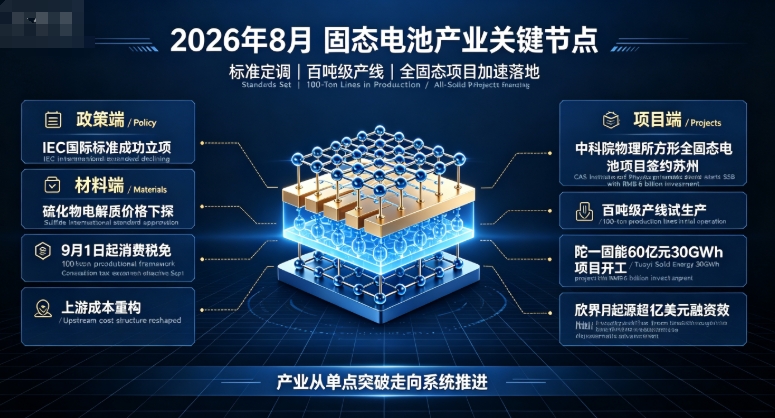
On the materials side, sulfide electrolyte prices continued to decline, and hundred‑ton‑scale production lines entered trial production, restructuring upstream costs and removing barriers to industrialisation.
On the project side, key milestones included the signing of the Chinese Academy of Sciences’ Institute of Physics square‑cell all‑solid‑state battery project in Suzhou, the groundbreaking of Tuoyi Guneng’s RMB 6 billion 30 GWh project, and the closure of over USD 100 million in financing for Xinjie Energy – capital and capacity resonating in tandem.
August thus featured three defining characteristics: standard‑setting, concentrated commissioning of hundred‑ton‑level lines, and accelerated execution of all‑solid‑state projects. The industry is moving from “breakthroughs in isolation” to “systematic progress.”
Preface: Materials Price Analysis
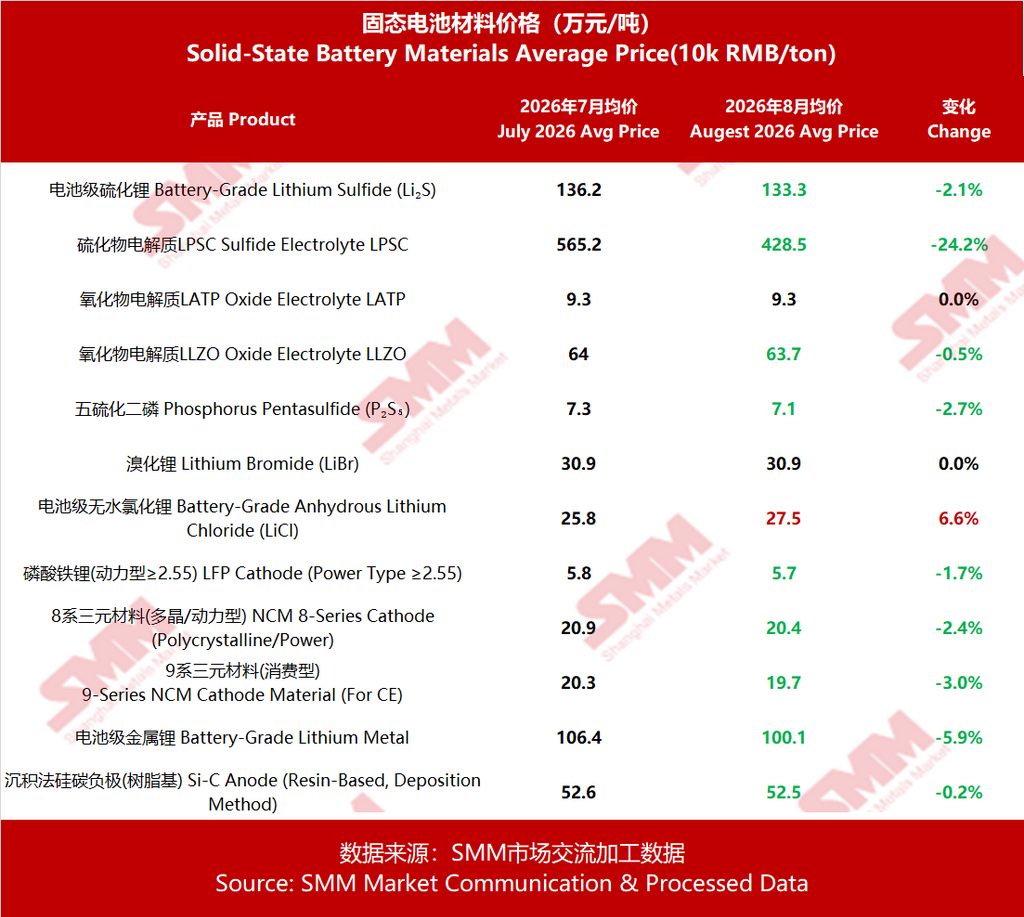
In August 2026, prices of solid‑state battery materials generally declined. The sole exception was battery‑grade anhydrous lithium chloride (LiCl), which rose 6.6% month‑on‑month, driven by temporary supply tightness in upstream lithium concentrates and lithium chloride.
The sharpest drop was seen in sulfide electrolyte LPSC, down 24.2% month‑on‑month, mainly due to cost‑reduction expectations from the sulfide route and slower downstream procurement.
The 9‑series NCM cathode material (consumer type) averaged RMB 197,000/ton in August, down 3.0% month‑on‑month – slightly more than the 8‑series (‑2.4%), reflecting greater price pressure on high‑nickel consumer cathodes amid weak end‑market demand. Battery‑grade lithium metal fell 5.9%, continuing its downward trend. Other materials, such as LFP and silicon‑carbon anodes, saw smaller fluctuations, with declines within 2% or remaining largely flat.
Overall, the solid‑state battery materials market in August underwent a weak correction, with high‑nickel cathodes and sulfide electrolytes leading the declines, while lithium chloride stood out as a rare gainer due to supply‑side disruptions.
I. Solid‑State Battery Materials
1.1 Electrolytes
In August, upstream material prices continued to show structural divergence.
Sulfide electrolyte LPSC (Li₆PS₅Cl) prices gradually corrected from RMB 4,400/kg to RMB 4,300/kg, a weekly decline of about 2.27%. Battery‑grade lithium sulfide was quoted at around RMB 1,320/kg, down only 0.8% month‑on‑month, suggesting the decline is narrowing and a near‑term bottom may be forming. Oxide electrolyte LLZO remained steady at RMB 638/kg, and LATP at RMB 93/kg, having been flat for several consecutive weeks.
The core logic behind the price divergence lies in differing supply rhythms: the sulfide route is on the cusp of concentrated hundred‑ton‑scale capacity release – Tianci Materials’ hundred‑ton‑class pilot line is expected to start trial production in Q3, with economies of scale pushing the price centre lower; oxide electrolytes, with more mature technology and a more stable competitive landscape, have already bottomed out.
Capacity build‑out:
Tianci Materials’ hundred‑ton‑class lithium sulfide (50 t/a) and sulfide solid‑state electrolyte (100 t/a) pilot lines have been fully completed and are entering trial production in Q3.
Sinocera Materials has built an automated production line for sulfide solid‑state electrolytes, establishing initial mass‑production capability.
Tianqi Lithium’s 50 t/a lithium sulfide pilot project is under construction and expected to be completed in the second half of the year; the preparation of argyrodite‑type sulfide electrolytes has achieved glove‑box‑free operation for most processes.
Ronbay Technology’s 10 t/a solid‑state electrolyte project in Xiantao (RMB 50 million investment) is undergoing environmental impact assessment (EIA) publicity.
The Dalian Institute of Chemical Physics’ high‑performance solid‑state battery core material pilot platform (total investment RMB 55 million) is also in the EIA stage, planning an annual output of 5 tonnes of solid‑state electrolyte materials.
Technical breakthroughs:
The team of Tu Jiangping and Zhong Yu at Zhejiang University reported in Nature Communications a kilogram‑scale liquid‑phase suspension synthesis platform, achieving a room‑temperature ionic conductivity of 5.42 mS·cm⁻¹ for LSPS₀.₄₅.
An undergraduate team from Lanzhou University developed an oxynitride halide solid‑state electrolyte, LZCONx, which is simultaneously compatible with 4V‑class LCO cathodes and low‑voltage Li₁₃Si₄ anodes.
1.2 Cathodes
Easpring has cumulatively shipped 50 tonnes of all‑solid‑state cathode materials and passed testing by multiple leading all‑solid‑state battery companies, with vehicle‑level validation underway; its dual‑phase composite solid‑state cathode material has achieved monthly stable shipments exceeding 100 tonnes.
Ronbay Technology expects its solid‑state cathode material market demand to approach the hundred‑ton level this year, with small‑batch production commencing in 2027.
GEM has joined forces with Professor Sun Xueliang (fellow of both Canadian and US academies) to establish a joint laboratory for solid‑state battery cathode materials.
Tianhua New Energy’s subsidiary Jiangsu Yili has officially started its solid‑state battery cathode material mass‑production line, planning to form a 10,000‑ton‑class high‑nickel NCM cathode material capacity.
1.3 Anodes
The Yibin Smart Solid‑State Battery Innovation Centre (led by Professor Zhang Qiang’s team from Tsinghua University) has achieved a leap from gram‑scale laboratory trials to kilogram‑scale roll‑to‑roll production of composite lithium metal anode materials, capable of boosting energy density to 400‑500 Wh/kg, targeting low‑altitude economy and embodied intelligence applications.
Putailai’s silicon‑carbon anode and lithium metal anode products are applicable to solid‑state / semi‑solid battery fields; it has delivered dry‑electrode and solid‑state battery electrode equipment to leading domestic and overseas customers, with cumulative orders exceeding RMB 200 million.
Dow Technology’s silicon‑carbon anode has achieved large‑scale production capability, with its 300‑ton capacity gradually ramping up.
1.4 Other Materials
Senior Material and Ruigu New Materials have formed a strategic cooperation to jointly develop high‑performance solid electrolyte membranes; the “Gurui” series is compatible with semi‑solid, quasi‑solid and all‑solid routes.
Mingguan New Material has completed client sample trials of its solid‑state battery aluminum‑plastic film, which shows significantly improved high‑temperature performance.
Zhidongli is strategically positioning in solid‑state battery materials and plans to build a 5,000 t/a high‑purity lithium sulfide production base.
II. Solid‑State Battery Technology
2.1 Technical Breakthroughs
In August, the most eye‑catching progress came from both fundamental research and applied engineering.
Fundamental research:
A joint team from Stanford University and SLAC National Accelerator Laboratory published a study in Nature showing that applying planar biaxial mechanical compressive stress to garnet‑type solid electrolytes forces lithium dendrites to propagate horizontally rather than vertically, preventing short‑circuiting. Compressed cells operated stably for thousands of cycles even with extensive internal dendrite formation. Using synchrotron X‑rays, the team confirmed for the first time that dendrites nucleate at nano‑defects at the interface between pores and grain boundaries inside the electrolyte – ending a long‑standing debate. This means “bulk defect control + cell pre‑stress packaging” could become a second battleground beyond material formulation.
Professor Sun Xueliang’s team published an analysis in Nature Energy, systematically revealing that the electronic conductivity of current mainstream inorganic solid electrolytes is generally in the 10⁻⁸–10⁻⁹ S/cm range – 6‑7 orders of magnitude higher than that of commercial polymer separators (10⁻¹⁵–10⁻¹⁸ S/cm). When electrolyte thickness is reduced from 1,000 μm to 20 μm, the capacity loss of a cell stored for one month soars from 3.9% to 94.5%.
Baima Lake Laboratory, using a borohydride electrolyte route, developed a solid‑state battery that operates stably across a wide temperature range of ‑20°C to 120°C, with an energy density of 400 Wh/kg and cycle life exceeding 2,000 cycles.
Applied engineering:
High‑energy Digital Manufacturing successfully passed nail penetration tests on a 20 Ah sulfide‑based all‑solid‑state cell using self‑developed equipment and processes; a 4‑mm steel needle (stricter than the national military standard’s 3‑mm limit) was inserted through the cell, and no thermal runaway was observed for one hour with the needle retained.
GAC’s Giant Charge self‑developed all‑solid‑state battery cells passed the GB38031‑2025 national standard nail penetration test; after puncture, a 40 Ah cell continued to power an external LED sign.
Zhongke Yuanben’s sulfide‑based all‑solid‑state battery pack completed real‑vehicle road testing – the first publicly reported vehicle installation in China.
2.2 Product Progress
Ganfeng Lithium has achieved small‑batch production of the world’s first 500 Wh/kg‑class 10 Ah product; its 400 Wh/kg battery has exceeded 1,100 cycles in cycle life and completed engineering validation.
Farasis Energy disclosed two generations of sulfide‑based all‑solid‑state battery specifications: Gen‑1 400 Wh/kg (high‑nickel NCM + high‑silicon anode), Gen‑2 500 Wh/kg (lithium‑rich manganese‑based / high‑nickel NCM + lithium metal anode).
Sunwoda’s 0.2 GWh solid‑state battery sample line is now operational; pilot production is to start within the year, with 320 Wh/kg and 360 Wh/kg semi‑solid batteries already in small‑batch production.
Gotion High‑Tech’s “Jinshi” all‑solid‑state battery has passed multiple authoritative safety tests, and its mass‑production line design has been completed.
EVE Energy’s “Longquan No.3” and “Longquan No.4” all‑solid‑state batteries (60 Ah) have been successfully rolled off the production line, focusing on power applications.
Jinlongyu’s 20 Ah all‑solid‑state pouch cells have passed third‑party performance tests, achieving 400 Wh/kg.
III. Solid‑State Battery Projects
August saw a dense cluster of project announcements, featuring “large‑scale project starts, centralised delivery of pilot lines, and regional clustering.”
3.1 All‑Solid‑State Battery Projects
The Institute of Physics, Chinese Academy of Sciences (CAS) signed an advanced square‑cell all‑solid‑state battery industrialisation project in Suzhou, with an initial 219‑mu (approx. 14.6 ha) site in Suzhou Industrial Park, led by Professor Li Hong. The project adopts a polymer‑oxide composite route (oxygen‑polymer all‑solid‑state) and focuses on five key processes: dry electrode, solid‑state processing, pre‑lithiation, interfacial thermal lamination, and centre‑liquid‑cooled cell design. Target product energy density is 400‑600 Wh/kg. The first phase will build a 0.2 GWh cell pilot line and a 4 GWh PACK line, aiming for mass production within two years. The project adopts a dual‑site model: “R&D & pilot in the park, mass production in Wuzhong.”
Tuoyi Guneng officially broke ground on 13 August on a RMB 6 billion, 30 GWh solid‑state battery project in Hohhot, Inner Mongolia. Covering 1,000 mu (66.7 ha), the project is built in three phases, each with a RMB 2 billion investment and 10 GWh annual capacity. Phase I, occupying about 371 mu, is scheduled for construction from June 2026 to June 2028.
Shen’an Lithium Energy invested approximately RMB 200 million in its Shaoxing intelligent manufacturing base, building a 500 MWh high‑standard cell production line with a planned annual output value of RMB 1 billion.
3.2 Pilot Lines and R&D Platforms
The Sichuan Advanced Battery Innovation Centre (a key platform under Yibin’s “Jiangyuan Action”) is scheduled for delivery by end‑August, with a total floor area of over 8,600 m² and an investment of RMB 210 million. Phase I will set up two cell laboratory lines; Phase II will build a 0.2 GWh cell pilot line.
Yibin has already established six high‑level solid‑state battery R&D platforms, covering composite lithium anodes (Tsinghua Zhang Qiang), sulfide electrolytes (Ouyang Minggao workstation), cathode materials and cells (Nankai Chen Jun), electrolytes (CAS Cui Guanglei), cathode materials (BIT Su Yuefeng), and lithium‑rich manganese‑based cathodes (BJUT Wei Haijun) – spanning various technical routes.
The Dalian Institute of Chemical Physics high‑performance solid‑state battery core material pilot platform (EIA stage) plans annual outputs of 50 tonnes of high‑energy‑density cathode materials, 5 tonnes of solid‑state electrolyte materials, and 10 tonnes of high‑capacity composite anode materials.
3.3 Equipment Side
Lyric Robot has delivered and achieved milestone acceptance on a full all‑solid‑state battery line for a leading automotive OEM, bridging the gap from lab technology to pilot scale; it has also received orders for key solid‑state battery equipment and pilot lines from two leading battery customers.
United Winners Laser has delivered its all‑solid‑state battery assembly line to a top‑tier customer, which has now entered trial production.
Putailai has delivered dry‑electrode and solid‑state battery electrode equipment to leading customers at home and abroad, with cumulative orders exceeding RMB 200 million.
IV. Solid‑State Battery Financing and Collaboration
Financing activity in the solid‑state battery space remained robust in August, with multiple large‑ticket deals closed.
Xinjie Energy completed a Series B round of over USD 100 million (approx. RMB 670 million), led by Puhua Capital, to fund lithium‑metal solid‑state battery mass production and a new 3 GWh production line, expected to come online by end‑2026 to early‑2027. Its existing 2 GWh Phase I plant in Hangzhou (10 GWh total) is already in production, and a new 3 GWh base in East China has started construction.
Saike Power raised hundreds of millions of RMB in a Series A round, co‑led by Saike Investment and CICC Capital, with participation from Dingfeng KeChuang and Qihang Investment, to fund pilot lines for solid‑state electrolyte materials and all‑solid‑state battery R&D.
Weilan New Energy is advancing a RMB 2 billion Pre‑IPO financing at a pre‑money valuation of RMB 20 billion, targeting a listing on the ChiNext.
Ruizhi New Energy completed a multi‑ten‑million RMB Pre‑A+ round, exclusively invested by the Shanghai Chenyao Yichuang Investment Fund (jointly established by Shanghai Guotou Kechuang and Yixing Economic Development), to expand its Yixing production base.
Guxin Energy secured a RMB 100 million‑level round, led by Toukong Donghai with follow‑on from Jianyuan Fund.
Collaborations:
Guansheng Dongchi signed a strategic framework agreement with CNNC Haihui to jointly advance the deployment of semi‑solid batteries in wind‑solar‑storage and industrial/commercial energy storage applications.
The China Electronics Standardisation Institute, JD.com, and Sunwoda jointly established a robot battery joint laboratory focused on standards development and product innovation for robot batteries.
Tianneng and Weilan New Energy have achieved large‑scale batch delivery of their jointly produced 314 Ah semi‑solid cells, which have been first deployed in grid‑side energy storage.
V. Overseas Solid‑State Battery Progress
In August, overseas solid‑state battery companies entered a critical phase of engineering validation. According to the latest TrendForce quarterly report, the all‑solid‑state battery industry in 2026 is moving into engineering validation; Toyota, Honda, Nissan, Samsung SDI, and others are slightly ahead in small‑scale trial production, with Japanese automotive‑grade products having already verified certain performance metrics.
Samsung SDI visited Tianci Materials’ Jiujiang base in August, inspecting the lithium sulfide and sulfide solid‑state electrolyte production lines (50 t Li₂S + 100 t sulfide electrolyte, Q3 trial production). Samsung SDI itself targets all‑solid‑state mass production around 2027, with urgent demand for high‑purity lithium sulfide – the visit is seen as a signal of willingness to outsource supply.
Solid Power reported H1 revenue of USD 2.805 million and is progressing its continuous electrolyte pilot line as planned, continuing cooperation with Samsung SDI, BMW, and SK On. The company plans to establish a joint venture in South Korea with a targeted maximum capacity of 20,000 t/a of sulfide solid‑state electrolytes; initial facility scale is about 500 tonnes, with a partner announcement expected by end‑2026.
QuantumScape generated USD 21.8 million in customer revenue in H1, already exceeding its full‑year 2025 figure; GAAP net loss was USD 199 million. The company reorganised into three business units – QSEV (automotive), QSDC (AI data centres), and QSAS (advanced solutions). Its all‑solid‑state lithium‑metal cells (QSE‑5) have been shipped to a major US defence contractor, and it has established a new partnership with Honda.
Factorial Energy received its first commercial battery order (aerospace) in Q2 and is collaborating with Tulip Tech to advance commercial deployment of drone batteries.
LG Energy Solution announced it will establish an all‑solid‑state battery pilot line using dry‑electrode technology in the second half of this year.
Performance divergence is clear: domestic material suppliers have seen profits surge on price rebounds (Tianci Materials +900% YoY), while overseas start‑ups continue to suffer deep losses (QuantumScape half‑year net loss of USD 199 million).
VI. Industry Voices
Summit consensus: “Oxide first, sulfide later.”
At the 6th Global Solid‑State Battery Annual Summit held in Chicago in August, the industry reached a clear consensus: oxide electrolytes will be prioritised for deployment over the next 2‑3 years, while sulfide‑based all‑solid‑state mass production will be pushed back to 2028‑2030.
Company perspectives:
Sunwoda’s Liang Rui stated that the industry has entered a stage of “true competition”, and the company will not engage in price wars.
Gotion High‑Tech’s Zhou Fu noted that the battery consumption tax adjustment will accelerate industry consolidation, and the tax‑exempt window for solid‑state batteries will amplify the advantages of early technology leaders.
VII. Policies and Regulations
August saw landmark progress on the regulatory front.
International standard:
The Chinese‑proposed international standard proposal, “Secondary lithium‑ion batteries for electric vehicle propulsion – Guide to application, test items and conditions for solid‑state batteries,” was successfully立项 at the IEC, becoming the world’s first international standard for solid‑state batteries, with experts from France, South Korea, Japan and others participating. This standard will form a dual‑layer system with the national standard GB/T 43568‑2026 (effective 1 July).
Consumption tax policy:
According to Announcement No. 20 of 2026 issued by the Ministry of Finance, the General Administration of Customs, and the State Taxation Administration, lithium‑ion batteries will be subject to a consumption tax of 2% from 1 September 2026, rising to 4% from 1 September 2027. Sodium‑ion batteries, solid‑state batteries, and fuel cells are exempt until 31 December 2028. To qualify for the exemption, products must meet corresponding national standards; before the first declaration, a test report from a CMA‑accredited inspection body confirming compliance is required. The State Taxation Administration further clarified that semi‑solid batteries and hybrid cells that do not meet the standards are not eligible for the exemption. The policy is seen as using tax leverage to preferentially support new technology routes like solid‑state batteries, accelerating the elimination of lagging capacity.
Summary
August 2026 marked a month in which the solid‑state battery industry accelerated simultaneously across four dimensions: standards, materials, projects, and capital.
The successful launch of an international standard and the consumption tax exemption cleared institutional hurdles for industrialisation; the concentrated commissioning of hundred‑ton‑level sulfide electrolyte production lines is restructuring upstream costs; and the groundbreaking of landmark projects such as the CAS Institute of Physics square‑cell all‑solid‑state project and Tuoyi Guneng’s 30 GWh facility signal that all‑solid‑state batteries are moving from the laboratory to scaled production.
The industry has formed a clear consensus on the technical roadmap – “oxide first, sulfide later” – and the period of 2026‑2027 will be a critical window for pilot‑line deployment and vehicle‑level validation.


**Note:** For further details or inquiries regarding solid-state battery development, please contact:
Phone: 021-20707860 (or WeChat: 13585549799)
Contact: Chaoxing Yang. Thank you!
![[Solid-State Battery: Ganfeng Lithium's 500 Wh/kg-Class 10 Ah Product in Small-Batch Mass Production]](https://imgqn.smm.cn/usercenter/IpglC20251217171727.jpg)