[SMM Analysis] A Brief Analysis of Ammonium Perrhenate Imports and Ex-China Supply and Inventory Situation

Published: Aug 28, 2026 20:39

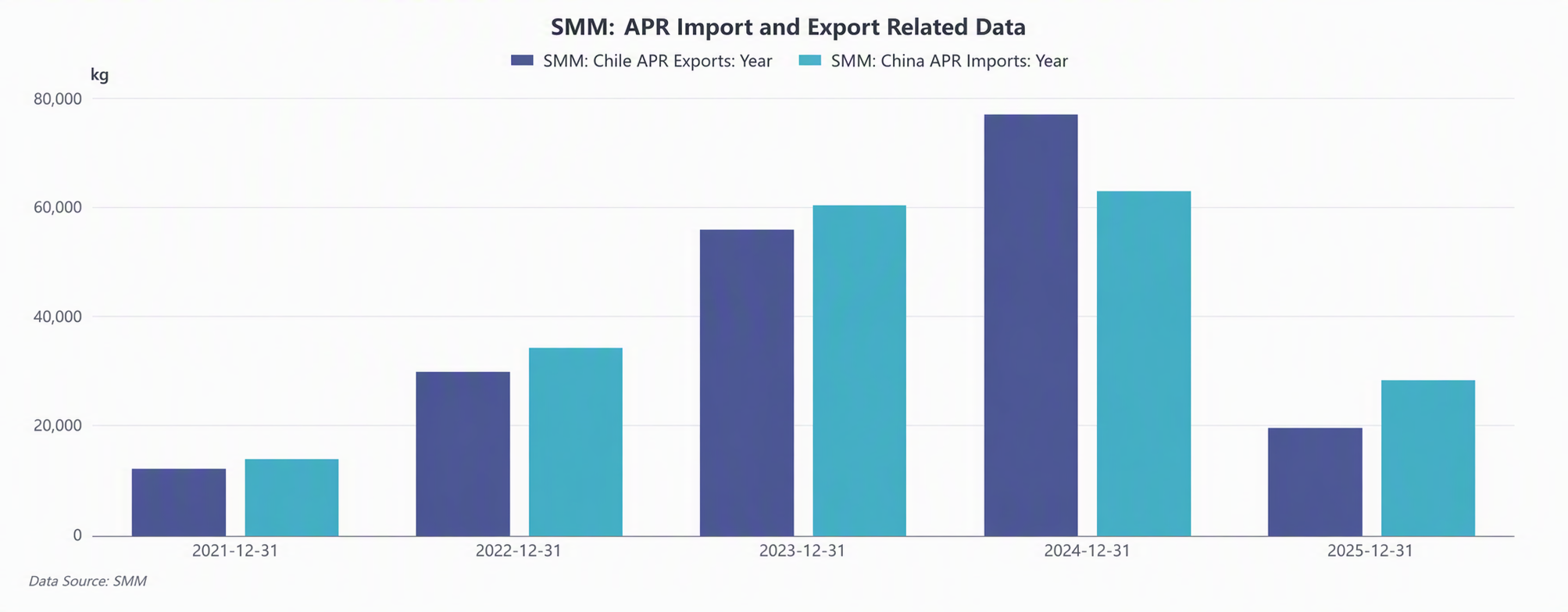
Based on China’s ammonium perrhenate import data in recent years and Chile’s ammonium perrhenate export data, Chile, as a core global supply source of ammonium perrhenate, has largely depleted its available inventory after a previous period of large-scale shipments overseas. From 2020 to 2024, Chile’s exports of ammonium perrhenate to China showed a sustained upward trend, rising from only several thousand kg in the early stage to tens of thousands of kg in peak years, continuously supplying cargoes to the global market; however, in 2025, Chile’s shipments overseas pulled back markedly, spot supply tightened significantly, indirectly indicating that its market-circulating inventory has largely exited the market, and that spot resources available for immediate release in the short term are relatively limited.
In addition to Chile, Kazakhstan and Uzbekistan are China’s other two major import sources of ammonium perrhenate. As China’s National Mineral Resources Plan (2021–2025) formally included rhenium in the list of strategic minerals, rhenium’s strategic attributes have been clarified, and ensuring rhenium resources has received high-level attention domestically. Meanwhile, outside China, a rhenium “Project Vault” independent of the US Department of Defense’s existing stockpiling system has been introduced; major countries worldwide have begun to strengthen controls and stockpiling arrangements for minor metal resources such as rhenium, further disrupting globally circulating cargoes.

According to a June 15 report by Chile’s Diario Financiero, Chile’s state-owned copper producer Codelco primarily recovers and extracts rhenium from copper-molybdenum concentrates from four major mines—Chuquicamata, El Teniente, Andina, and Salvador—and then hands it over to its subsidiary Molyb for processing in Mejillones to produce ammonium perrhenate. The destinations of its output are clearly differentiated: nearly half is sold to the North American market, about 30% flows to China, and the remaining 20% supplies the European market. Against the backdrop of depleted inventory within Chile, Codelco’s rhenium output has become an important supply base for the global market; however, this production is dependent on by-product output from copper-molybdenum smelting, and the growth elasticity of capacity is limited.

Looking ahead, rhenium is regarded by many countries as a critical strategic mineral, with rising demand for strategic stockpiles; coupled with declining inventory in major supply regions, the global spot supply landscape for ammonium perrhenate will continue to draw broad attention. On the one hand, Chile’s spot inventory has largely been depleted, and short-term growth will depend more on the release of by-product smelting capacity; on the other hand, the export willingness of other supplier countries such as Kazakhstan and Uzbekistan, the pace of capacity release, and countries’ strategic positioning actions will all continue to affect globally circulating ammonium perrhenate cargoes. Going forward, supply security for rhenium resources will become a key focus across the industry chain.

Data Source Statement: Except for publicly available information, all other data are processed by SMM based on publicly available information, market communication, and relying on SMM's internal database model. They are for reference only and do not constitute decision-making recommendations.

Images in this article contain AI-translated captions for reference only.

For any inquiries or for more information, please contact: lemonzhao@smm.cn
For more information on how to access our research reports, please contact:service.en@smm.cn
Related News
[SMM Chromium Flash] Chrome Ore Outshines Broader SA Mining Sector on Sales Value in June, Stats SA Shows
9 hours ago
[SMM Chromium Flash] Chrome Ore Outshines Broader SA Mining Sector on Sales Value in June, Stats SA Shows
Read More
[SMM Chromium Flash] Chrome Ore Outshines Broader SA Mining Sector on Sales Value in June, Stats SA Shows
[SMM Chromium Flash] Chrome Ore Outshines Broader SA Mining Sector on Sales Value in June, Stats SA Shows
South Africa's mining production fell 4% year-on-year in June 2026, according to Statistics South Africa, with platinum group metals (PGMs) the largest drag, down 8.4% YoY and subtracting 2.4 percentage points from the headline figure. Coal production declined 6.6% (-1.7pp) and iron-ore output fell 10.2% (-1.5pp). On a seasonally adjusted basis, production edged up 0.3% month-on-month in June, following a 5.2% drop in May and a 3% gain in April, leaving second-quarter production down 2.7% quarter-on-quarter. Against that backdrop, chromium ore stood out on the sales side of the report. Mineral sales at current prices rose 27.2% YoY in June, and chromium ore was the third-largest positive contributor, with sales value up 49% YoY, adding 3.7 percentage points to the headline gain. Only gold (+125.7% YoY, contributing 17.1pp) and PGMs (+27% YoY, contributing 7.3pp) contributed more. Iron-ore sales value fell 16.1% YoY (-1.7pp) and other non-metallic minerals dropped 35.5% (-1.3pp), the only negative contributors in the sales breakdown. The divergence is worth noting precisely: Stats SA's report does not break out chromium ore within its production-volume figures for June, meaning the sector's standout performance this month is a sales-value story rather than a confirmed rise in physical output. Combined with firmer chrome ore and ferrochrome pricing through H1 2026, the data points to a chrome segment that continues to generate disproportionate revenue for South Africa's mining sector even as broader production volumes soften, reinforcing chrome's role as a relative bright spot within an otherwise contracting mining base.
9 hours ago
Brief Analysis of Ammonium Rhenate Imports and Overseas Supply‑Inventory Dynamics
11 hours ago
Brief Analysis of Ammonium Rhenate Imports and Overseas Supply‑Inventory Dynamics
Read More
Brief Analysis of Ammonium Rhenate Imports and Overseas Supply‑Inventory Dynamics
11 hours ago
[SMM Chromium Flash] ARM's Low-Energy SmeltDirect Technology Reaches Commercial Phase
11 hours ago
[SMM Chromium Flash] ARM's Low-Energy SmeltDirect Technology Reaches Commercial Phase
Read More
[SMM Chromium Flash] ARM's Low-Energy SmeltDirect Technology Reaches Commercial Phase
[SMM Chromium Flash] ARM's Low-Energy SmeltDirect Technology Reaches Commercial Phase
African Rainbow Minerals' SmeltDirect smelting technology has entered its commercial phase, Mining Weekly editor Martin Creamer confirmed, following recognition at a recent Minerals Council South Africa modernization showcase. The technology, which had previously been described by ARM as ready for deployment following completion of a fully fundable feasibility study, now moves beyond that stage into actual commercial rollout. SmeltDirect uses composite conglomerates, fine anthracite ore blended with slimes, in place of the lumpy ore and expensive coke required by conventional smelting furnaces. ARM says the process cuts electricity consumption by more than 70% and carbon emissions by roughly 60%, lowering the power needed to produce one mt of alloy from about 4MW under conventional methods to approximately 1.2MW. The technology's progression to commercial phase carries particular weight for South Africa's ferrochrome sector, where high Eskom energy tariffs have driven repeated smelter suspensions in recent years. ARM has indicated the process can be retrofitted to existing smelters, positioning it as a potential lever for producers seeking to restore competitiveness without waiting solely on further electricity tariff relief.
11 hours ago
Register to Continue Reading
Gain access to the latest insights in metals and new energy
Already have an account?Sign in here