Brief Analysis of Ammonium Rhenate Imports and Overseas Supply‑Inventory Dynamics

Published: Aug 28, 2026 20:44

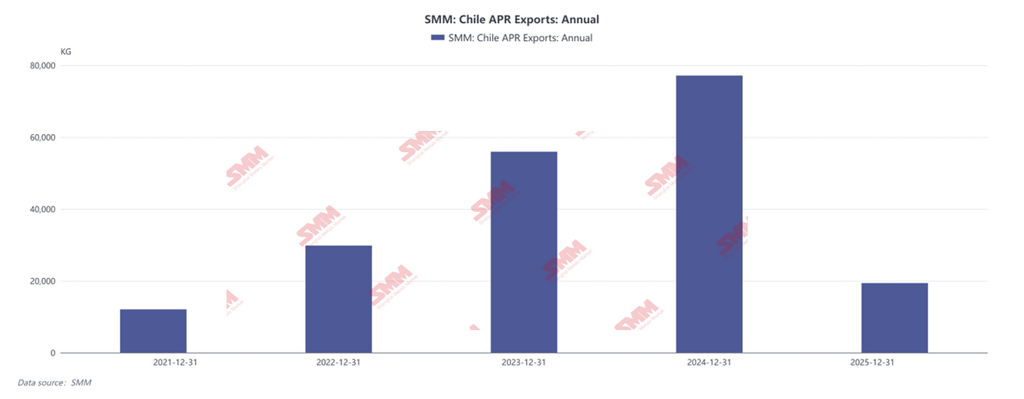
According to China’s ammonium rhenate import statistics and Chile’s export data, Chile, the world’s core supplier of ammonium rhenate, has largely depleted its tradable inventories following large‑scale overseas shipments in previous years. From 2020 to 2024, Chile’s ammonium rhenate exports to China trended upward: volumes stood at several thousand kilograms in the early stage and climbed to tens of thousands of kilograms at the peak, feeding ample material into global markets. However, Chile’s export volumes fell markedly in 2025, with a sharp contraction in spot supply. This indicates that its commercial inventories have been mostly drawn down, leaving limited readily‑available spot material in the short term.
Apart from Chile, Kazakhstan and Uzbekistan represent China’s other major import sources for ammonium rhenate. Rhenium was officially listed as a strategic mineral in the National Mineral Resources Plan (2021‑2025) issued by the Ministry of Natural Resources of China, which underscored its strategic importance and elevated domestic attention to rhenium supply security. Meanwhile, an overseas Rhenium Vault Program has been launched, operating independently from the existing U.S. Department of Defense stockpile. Major economies across the globe have stepped‑up regulation and stockpiling for this minor metal, adding further volatility to globally‑traded material flows.

According to a June 15 report from Chile’s Diario Financiero, Codelco extracts rhenium from copper‑molybdenum concentrates produced at four major mines: Chuquicamata, El Teniente, Andina and Salvador. Its subsidiary Molyb processes the material at the Mejillones facility to produce ammonium rhenate. Geographically, nearly half of the output goes to North America, around 30% is shipped to China, and the remaining 20% supplies Europe. With Chile’s commercial inventories nearly exhausted, Codelco’s rhenium output serves as a key pillar for global supply. Nevertheless, as a by‑product of copper‑molybdenum smelting, its production capacity offers limited upside potential.

Looking ahead, rhenium is recognized as a critical strategic mineral by multiple countries, driving stronger stockpiling demand alongside falling inventories in key producing regions. The global spot supply landscape for ammonium rhenate will remain under close industry watch. On one hand, Chile’s depleted commercial stocks mean near‑term output growth will hinge largely on by‑product smelting capacity expansion. On the other hand, export intentions, production releases from Kazakhstan, Uzbekistan and other suppliers, as well as national strategic initiatives, will continue to shape global tradable supplies. Supply security of rhenium resources will remain a core focus for the industrial chain going forward.

Data Source Statement: Except for publicly available information, all other data are processed by SMM based on publicly available information, market communication, and relying on SMM's internal database model. They are for reference only and do not constitute decision-making recommendations.

For any inquiries or for more information, please contact: lemonzhao@smm.cn
For more information on how to access our research reports, please contact:service.en@smm.cn
Related News
[SMM Analysis] A Brief Analysis of Ammonium Perrhenate Imports and Ex-China Supply and Inventory Situation
38 mins ago
[SMM Analysis] A Brief Analysis of Ammonium Perrhenate Imports and Ex-China Supply and Inventory Situation
Read More
[SMM Analysis] A Brief Analysis of Ammonium Perrhenate Imports and Ex-China Supply and Inventory Situation
[SMM Analysis] A Brief Analysis of Ammonium Perrhenate Imports and Ex-China Supply and Inventory Situation
38 mins ago
[SMM Chromium Flash] ARM's Low-Energy SmeltDirect Technology Reaches Commercial Phase
1 hour ago
[SMM Chromium Flash] ARM's Low-Energy SmeltDirect Technology Reaches Commercial Phase
Read More
[SMM Chromium Flash] ARM's Low-Energy SmeltDirect Technology Reaches Commercial Phase
[SMM Chromium Flash] ARM's Low-Energy SmeltDirect Technology Reaches Commercial Phase
African Rainbow Minerals' SmeltDirect smelting technology has entered its commercial phase, Mining Weekly editor Martin Creamer confirmed, following recognition at a recent Minerals Council South Africa modernization showcase. The technology, which had previously been described by ARM as ready for deployment following completion of a fully fundable feasibility study, now moves beyond that stage into actual commercial rollout. SmeltDirect uses composite conglomerates, fine anthracite ore blended with slimes, in place of the lumpy ore and expensive coke required by conventional smelting furnaces. ARM says the process cuts electricity consumption by more than 70% and carbon emissions by roughly 60%, lowering the power needed to produce one mt of alloy from about 4MW under conventional methods to approximately 1.2MW. The technology's progression to commercial phase carries particular weight for South Africa's ferrochrome sector, where high Eskom energy tariffs have driven repeated smelter suspensions in recent years. ARM has indicated the process can be retrofitted to existing smelters, positioning it as a potential lever for producers seeking to restore competitiveness without waiting solely on further electricity tariff relief.
1 hour ago
[SMM Weekly Manganese Ore Review] Manganese Ore Offers Extended Their Decline, and High Inventory Continued to Suppress the Price Rebound
3 hours ago
[SMM Weekly Manganese Ore Review] Manganese Ore Offers Extended Their Decline, and High Inventory Continued to Suppress the Price Rebound
Read More
[SMM Weekly Manganese Ore Review] Manganese Ore Offers Extended Their Decline, and High Inventory Continued to Suppress the Price Rebound
[SMM Weekly Manganese Ore Review] Manganese Ore Offers Extended Their Decline, and High Inventory Continued to Suppress the Price Rebound
News on August 28: Northern ports: 46% Australian lumps at 40-40.5 yuan/mtu, flat WoW; South African semi-carbonate at 33.9-34.2 yuan/mtu, up WoW; Gabon at 39.1-39.5 yuan/mtu, up WoW; South African high-iron at 28.5-29 yuan/mtu, flat WoW; South African mid-iron at 35-35.5 yuan/mtu, flat WoW. Southern ports: 46% Australian lumps at 42.7-43.2 yuan/mtu, flat WoW; South African semi-carbonate at 36.3-36.8 yuan/mtu, flat WoW; Gabon at 40.6-41.1 yuan/mtu, flat WoW; South African high-iron at 30.2-30.7 yuan/mtu, flat WoW; South African mid-iron at 38-38.5 yuan/mtu, flat WoW. The northern manganese ore market recovered slightly, while transactions in the south China manganese ore market remained sluggish; overall prices continued to move sideways within a range.
3 hours ago
Brief Analysis of Ammonium Rhenate Imports and Overseas Supply‑Inventory Dynamics - Shanghai Metals Market (SMM)