Mine automation and electrification are no longer pilot projects. Rio Tinto runs a fleet of more than 300 autonomous haul trucks across the Pilbara; BHP's Escondida Norte has deployed 33 autonomous haul trucks and 11 autonomous drill rigs; Anglo American's Quellaveco is managed from a remote operations centre running 30 automated (tele-operated) mining trucks; Fortescue has signed a US$2.8 billion green equipment partnership covering 475 units, of which roughly 360 are battery-electric, autonomy-ready haul trucks. The hundreds of autonomous trucks already in service at Rio Tinto, BHP and Anglo are still overwhelmingly diesel-powered. A serious battery-electric order of this size has so far been placed only by Fortescue (around 360 T 264 units). Battery-electric haul trucks globally remain in single-digit trial deployments at Rio Tinto and BHP. Note that Rio Tinto's AutoHaul is an autonomous train system, not a mine-truck AHS.
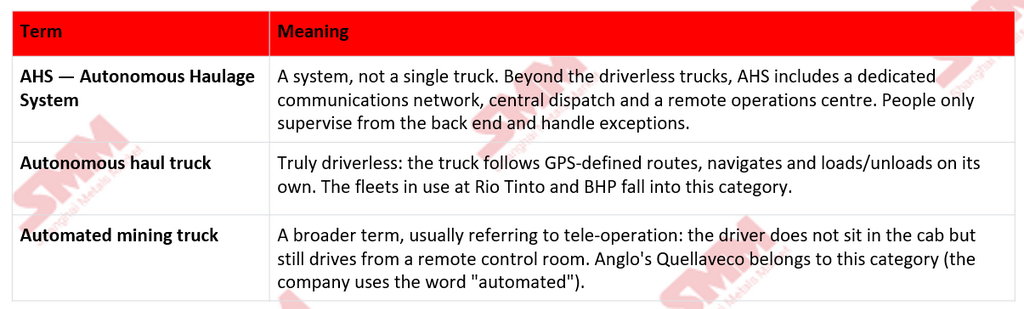
These deployments show that the major miners have moved the technology from trial into core production. The reason they are willing to spend is not just to chase the "smart mine" label. New mines are getting more expensive and slower to deliver. Lifting the uptime, haulage efficiency and safety of existing assets is faster and more controllable than waiting for greenfield supply.
I. Why are miners willing to invest?
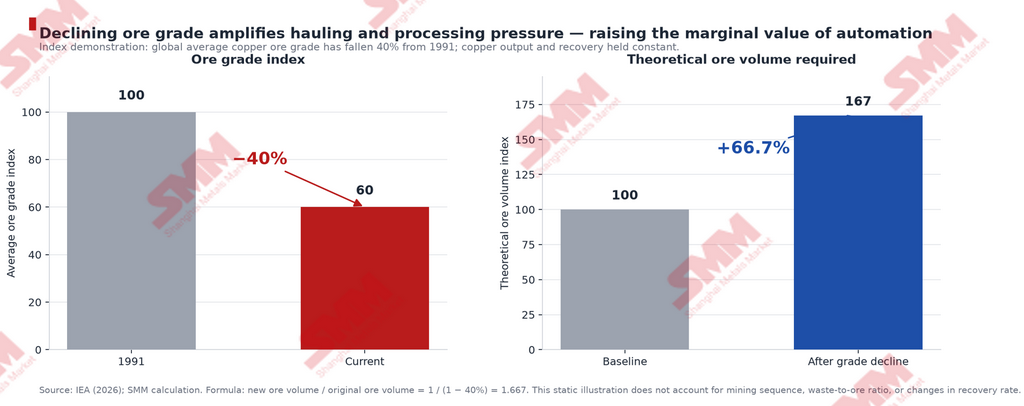
1. Lower grade means more ore must be moved to deliver the same metal tonnage
IEA data show that the global average copper ore grade has fallen 40% from 1991, and that capital intensity for brownfield expansions has risen 65% since 2020. If grade halves, producing the same metal tonnage as before requires moving twice as much ore — the workload at every stage of mining, hauling and concentration doubles. The lower the grade, the more valuable equipment efficiency becomes, and the more cost-effective automation is.
2. Major miners have the conditions to spread the high fixed cost
Why is it the majors that invest first? Because AHS is not just "buy trucks and drive". Operators also need to build dedicated communications networks, control centres and dispatch systems, plus undertake road upgrades, system integration, training and long-term maintenance. These fixed costs are spread over the fleet: the larger the fleet and the longer the mine life, the thinner the per-truck amortisation and the easier it is to earn payback. BHP has, since 2022, planned to refresh the Escondida fleet of more than 160 haul trucks over roughly 10 years; Quellaveco's initial mine life is 36 years. Both cases are well suited to embedding automation into the normal equipment-replacement cycle.
3. Automation strengthens continuous production and reduces incident risk
Autonomous operation cuts shift-change downtime, commute, fatigue and human operating variability. Rio Tinto has disclosed that, since 2018, each autonomous truck runs an average of 700 more hours per year and has a loading-and-hauling cost 15% lower than its conventional equivalent. BHP has disclosed that haul-truck automation at Jimblebar and Newman has cut heavy-vehicle safety incidents by 90%. It is worth noting that automation does not eliminate the driver workforce; the role shifts toward remote dispatch, maintenance, networks and data. At Escondida, more than 5,000 people have already been retrained into these positions.
4. Mining is a setting that is naturally suited to autonomy and electrification
Mining is one of the few places that is both highly dangerous and highly enclosed — the ideal proving ground for autonomous and electric equipment. In mines, slope failures and blind-spot collisions are recurrent major hazards. Letting the truck drive itself, or letting a person drive it remotely, removes the driver from the truck cab and eliminates the corresponding injury risk. In addition, mine roads are enclosed, routes and loading/unloading points are fixed, and speed limits are below 30 km/h, with no pedestrians, no public traffic and no licensing requirements. These are problems that trouble passenger-car autonomy and simply do not exist in mining. At the same time, because loading and dumping points are fixed, chargers can be built right at the work face, so a truck can top up between cycles — there is no "range anxiety" or "charger-hunting anxiety" of the kind seen in passenger BEVs. In underground operations, electrified equipment also removes diesel exhaust, saving on ventilation, cooling and heating cost. In open pits, the trade-off depends more on gradient, haul distance, charging queuing and local power prices.
5. ESG is another invisible driver
Major miners are spending not only to cut cost; ESG is an invisible hand pushing from behind. E — Environment: diesel is the largest source of a miner's own operational emissions — roughly 40% at BHP, roughly 12% at Rio Tinto — and electrification is the most direct way to cut these, while also hedging future carbon-tax and CBAM exposure. S — Social: safety is a miner's number-one KPI, and automation takes the driver out of the danger zone; heavy-vehicle safety incidents can fall 90%, the most quantifiable "S" outcome. G — Governance: a higher ESG score lowers a miner's cost of borrowing; conversely, downstream automakers and grid operators are already demanding "green copper", and high-emission copper may be excluded from major-customer procurement. ESG, then, is not a nice-to-have; it has turned "should we invest?" into "we have to".
II. Progress of AHS and BEV
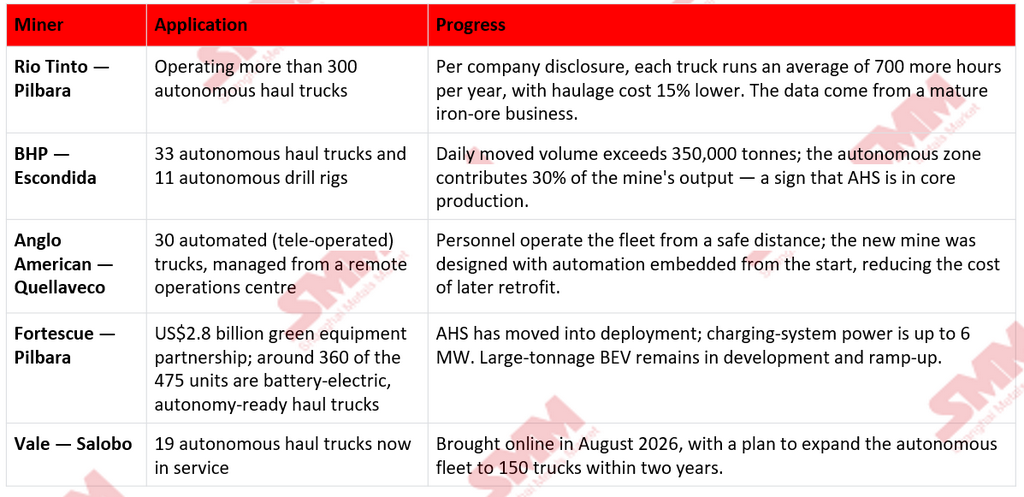
The clearest conclusion at this stage: AHS is running reliably at large mines and is creating value through higher available hours, more stable haul cycles and lower safety risk. Large-tonnage BEV does not yet have an industry-applicable payback. Fortescue's US$2.8 billion contract covers 475 units together with technology development and supporting systems, and is still in deployment. Autonomous operation is also spreading to more copper mines: the world's first commercial AHS was commissioned at Codelco's Gabriela Mistral copper mine in 2008; in August 2026, Vale's Salobo copper mine brought 19 autonomous trucks online, with a plan to scale the autonomous fleet to 150 within two years.
III. Background
Commercial AHS was born in a copper mine
In 2008, the world's first commercial AHS was deployed at Codelco's Gabriela Mistral copper mine (Komatsu FrontRunner). Copper mining is therefore the birthplace of unmanned haulage.
Why copper-mine automation has lagged
In the 18 years since, however, the centre of gravity for AHS scale-up shifted to iron ore — Rio Pilbara with 300+ units, BHP, Fortescue and Vale. On the copper side, Escondida (33 fully autonomous trucks), Quellaveco (30 tele-operated trucks) and Salobo (19 units newly online in 2026) have followed, but the overall scale and pace of deployment remain slower than in iron ore. The root cause lies in the industrial characteristics of copper mining:
① Copper mining is intrinsically more complex. Porphyry pits are deep and the mineralisation is irregular, so road conditions are harder than in iron ore. The ore is also polymetallic — molybdenum, gold, silver and so on — and the concentration circuit is long. Automating the truck alone cannot unlock efficiency across the whole chain.
② The savings from automation are a smaller share of cost in copper. Automation mainly cuts haulage cost. Iron ore sells for only tens of US dollars per tonne and requires moving huge tonnages, so haulage is a large share of cost — a 15% saving shows up immediately. Copper sells for more than US$10,000 per tonne, so the same haulage saving, spread across "tonnes of copper", is much smaller. The cost advantage of automation in copper is therefore structurally less than in iron ore.
③ Codelco in particular carries the heaviest legacy burden. Its flagship mines are old, its fleet is mixed, and major pits such as Chuquicamata have transitioned from open pit to underground, making retrofit expensive and difficult. As a state-owned enterprise, capex is constrained by the government budget, and strong unions push back on any "headcount reduction" angle. So Codelco has moved the most slowly of all.
IV. Outlook and constraints for AHS and BEV
How the next 5–10 years will unfold
The most likely path is not a one-shot conversion of an entire mine to fully autonomous and fully electric, but a phased rollout aligned with the normal equipment-replacement cycle. BHP's plan, from 2022, to refresh the Escondida fleet over roughly 10 years is an example of spreading retrofit risk into the normal truck-replacement cycle. The two paths, however, do not share the same outlook variables. The open question for AHS is not whether the technology is ready but whether the gains can be realised in copper mining. Iron ore has already validated the model — 700 more hours per year, 15% lower cost. Copper mining is more complex; Salobo is still only at 19 trucks. The retrofit burden of older, mixed-brand fleets is a drag, while the falling price of cross-brand autonomous kits is an accelerant. The open questions for BEV are whether large-tonnage batteries and charging will clear the technical bar, whether the mine site can secure green power, and whether carbon pricing will extend to copper. There is also a coupling that is easy to overlook: AHS does not require electrification — a diesel truck can still go autonomous. But BEV is almost inseparable from autonomy — battery range is limited, and when to charge, how long, and how to run frugally all need to be orchestrated by the dispatch system. Autonomy is therefore the base; electrification is an extension on top of it. This is the deeper reason why "AHS matures first, BEV ramps later".
Chinese OEMs: accelerator and cost
One more accelerant deserves attention — Chinese OEMs. Cat and Komatsu have long held the high-priced AHS market, but XCMG and Sany are now entering Latin American copper mines with much cheaper autonomous solutions (most of which start out as electric), and Codelco has already signed with XCMG to introduce the XDE130 autonomous haul truck. This lowers the entry bar for both autonomy and electrification, accelerating uptake. For copper mining, this may be the fastest — and the most uncertain — source of cost reduction over the next decade.
Constraints
In addition to the upside, the following constraints need to be factored in:
① Ongoing operating cost is non-trivial. Software updates, sensor recalibration, dedicated communications-network maintenance — these are all continuing costs after the trucks are delivered.
② High altitude and wide temperature swings challenge battery and sensor life (Chilean Andes, 3,000 m and above). [S14]
③ Payback periods for retrofit are generally 2–5 years, and the financing cost faced by mid-tier miners is much higher than for the majors, which may put the technology out of reach for them.
④ Vendor lock-in. Once an AHS/BEV system is selected, subsequent upgrades, spares and maintenance are tied to a single vendor, eroding the buyer's bargaining power. [S15]
⑤ Cyber security. Haul trucks and remote control centres expand the cyber-attack surface, raising the risk of compromise of critical infrastructure. [S16]
V. Conclusion: miners are buying long-dated cost optionality, not a few new trucks
In short, what major miners are buying is not a few driverless trucks and a few chargers — it is "cost optionality" against long-term trends. Grades will only decline further; new mines will only get harder to develop. Whoever can first compress unit cost, stabilise output and extend asset life will hold the initiative in the next decade of the copper cycle. That is why the majors dare to invest first: AHS has already been validated to add uptime, save cost and cut incidents, and the value is real today; BEV is still in ramp-up, but it locks in the exposure to diesel and carbon cost. The future gap between miners will not be defined by whether they have driverless trucks, but by who can turn the technology into lower unit copper cost, fewer production disruptions and longer asset life.
![Spot premiums fell sharply as downstream plants took holidays over the National Day period, reducing pre-holiday restocking volumes [SMM South China copper cathode spot weekly review]](https://imgqn.smm.cn/usercenter/aMTzL20251217171710.jpg)
![Holiday Approaches, Market Quiet [SMM Yangshan Spot Copper]](https://imgqn.smm.cn/usercenter/ZCsFN20251217171710.jpg)
![Pre-holiday Stockpiling Winds Down; Spot Copper Premiums in North China Continue to Weaken [SMM North China Copper Cathode Spot Weekly Review]](https://imgqn.smm.cn/usercenter/uoTGi20251217171713.jpg)