Ngành thép Malaysia: Dư thừa công suất, tái định hướng thương mại và con đường chậm rãi đến thép xanh
Malaysia không đóng cửa thị trường thép của mình — mà đang thiết kế lại cách thức vận hành của thị trường đó. Thay vì áp đặt các hạn chế bao trùm, nước này đang xây dựng một khung nhập khẩu chọn lọc hơn, trong đó khả năng tiếp cận ngày càng phụ thuộc vào loại sản phẩm, nước xuất xứ, tư cách nhà xuất khẩu và việc tuân thủ chứng nhận. Đối với các nhà máy trong nước, điều này tạo ra dư địa để cạnh tranh. Đối với các nhà sản xuất ống thép, trung tâm dịch vụ và các bên mua hạ nguồn khác, nó làm dấy lên mối lo ngại trái ngược: chi phí nguyên liệu thô cao hơn, ít linh hoạt hơn trong tìm nguồn cung, và rủi ro rằng sự bảo hộ mạnh mẽ hơn chỉ đơn giản cho phép các nhà sản xuất nội địa tăng giá. Hiểu được cách các động lực này tương tác — tăng trưởng sản xuất, nhu cầu, các dòng thương mại và áp lực khử carbon — là chìa khóa để đọc được hướng đi tiếp theo của ngành thép Malaysia.
Sản lượng đang vượt xa tiêu thụ
Tiêu thụ thép biểu kiến của Malaysia vẫn đang tăng trưởng, vì vậy câu chuyện nhu cầu cơ bản là có thật. Vấn đề là sản xuất trong nước đang tăng trưởng nhanh hơn. Trong giai đoạn 2020-2025, sản lượng thép thô mở rộng khoảng 6,4% mỗi năm, so với mức tăng trưởng tiêu thụ khoảng 3,7% mỗi năm. Với xu hướng hiện tại, sản lượng có thể đạt khoảng 9,8 triệu tấn vào năm 2026 trong khi tiêu thụ chỉ đạt khoảng 8,5 triệu tấn.
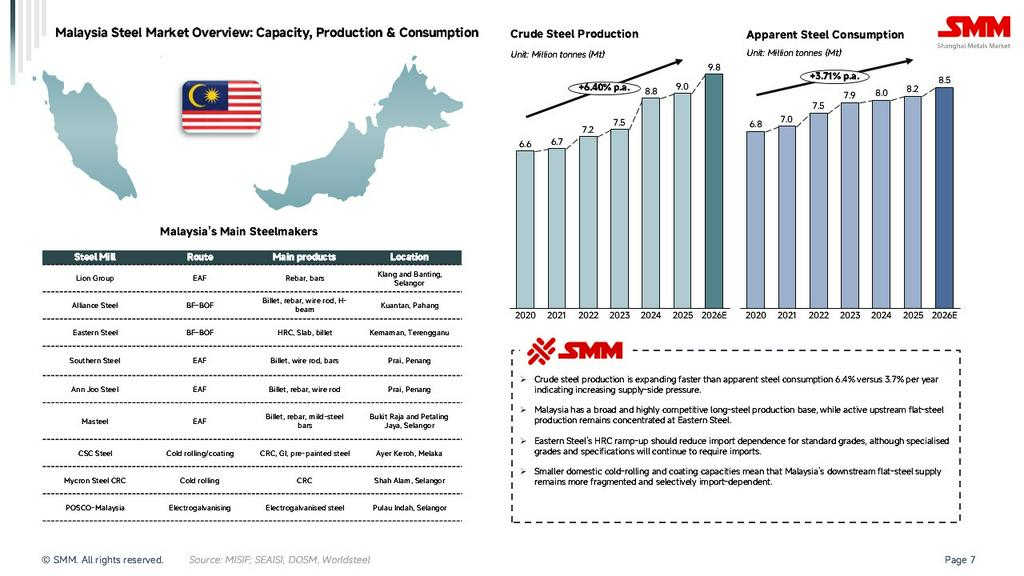


Khoảng cách đó không có nghĩa là Malaysia thiếu nhu cầu — mà có nghĩa là nguồn cung đang mở rộng nhanh hơn khả năng hấp thụ hiện tại của thị trường. Nước này đã có một cơ sở thép dài rộng khắp, có tính cạnh tranh cao, được xây dựng xung quanh các nhà sản xuất như Lion Group, Southern Steel, Ann Joo Steel và Masteel. Về mảng thép dẹt, việc tăng công suất HRC của Eastern Steel sẽ giúp giảm sự phụ thuộc nhập khẩu đối với các mác thép tiêu chuẩn, nhưng các mác thép và quy cách đặc biệt sẽ vẫn dựa vào nhập khẩu, và năng lực cán nguội, mạ phủ hạ nguồn của Malaysia — Mycron, CSC Steel, POSCO-Malaysia — vẫn còn khá phân tán. Kết quả là một môi trường cạnh tranh hơn, trong đó các nhà máy phải đồng thời quản lý công suất nội địa mới, nguồn cung khu vực và áp lực liên tục về giá cả và biên lợi nhuận.
Nguồn cầu tương lai có thể đến từ đâu
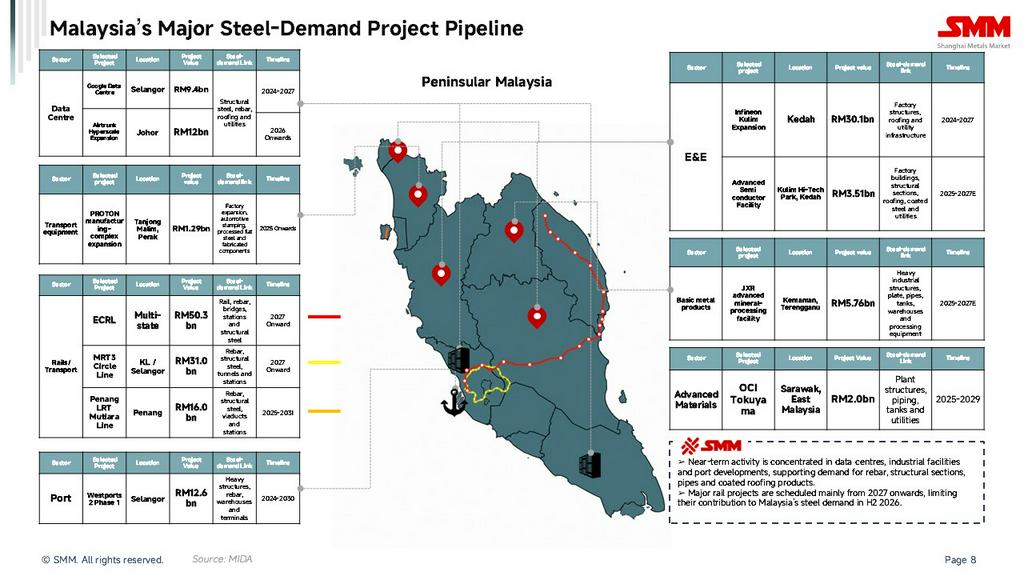
Một loạt các dự án lớn đang chờ triển khai mang lại phần nào sự cứu trợ, nhưng không đồng đều giữa các sản phẩm và tiến độ. Các hoạt động trong ngắn hạn tập trung vào các trung tâm dữ liệu, cơ sở công nghiệp và phát triển cảng — trung tâm dữ liệu Selangor trị giá 9,4 tỷ RM của Google, mở rộng quy mô siêu lớn trị giá 12 tỷ RM của AirTrunk tại Johor, và giai đoạn một trị giá 12,6 tỷ RM của Westports 2 đều thuộc nhóm này, tạo ra nhu cầu tương đối trực tiếp đối với thép cốt bê tông, thép hình kết cấu, ống thép và tấm lợp.
Đầu tư vào điện tử và thiết bị vận tải tạo thêm một lớp nhu cầu chọn lọc về thép dẹt: dự án mở rộng Kulim trị giá 30,1 tỷ RM của Infineon, cơ sở bán dẫn tiên tiến trị giá 3,51 tỷ RM tại Khu Công nghệ cao Kulim, và dự án mở rộng tổ hợp sản xuất trị giá 1,29 tỷ RM của Proton tại Tanjong Malim đều cần các sản phẩm cán nóng, cán nguội và phủ — nhưng lượng thép đến được các nhà máy trong nước phụ thuộc vào yêu cầu kỹ thuật sản phẩm và điều kiện thu mua nội địa. Các dự án công nghiệp nặng hơn, như cơ sở chế biến khoáng sản trị giá 5,76 tỷ RM của JXR tại Kemaman và nhà máy Sarawak trị giá 2,0 tỷ RM của OCI Tokuyama, gia tăng nhu cầu về thép tấm, thép ống và thép bồn chứa.
Những con số đơn lẻ lớn nhất trong kế hoạch thuộc về đường sắt: dự án Đường sắt Bờ Đông trị giá 50,3 tỷ RM, tuyến MRT3 Vòng Tròn trị giá 31,0 tỷ RM và tuyến LRT Mutiara Penang trị giá 16,0 tỷ RM. Nhưng phần lớn chi tiêu sẽ dồn vào từ năm 2027 trở đi, điều này hạn chế đóng góp vào nhu cầu thép cho đến nửa cuối năm 2026. Điểm đáng lưu ý là tăng trưởng nhu cầu của Malaysia là có thật nhưng không đồng đều — tập trung vào các lĩnh vực và năm cụ thể thay vì dàn trải đều trên thị trường.
Cơ cấu thương mại hai mặt
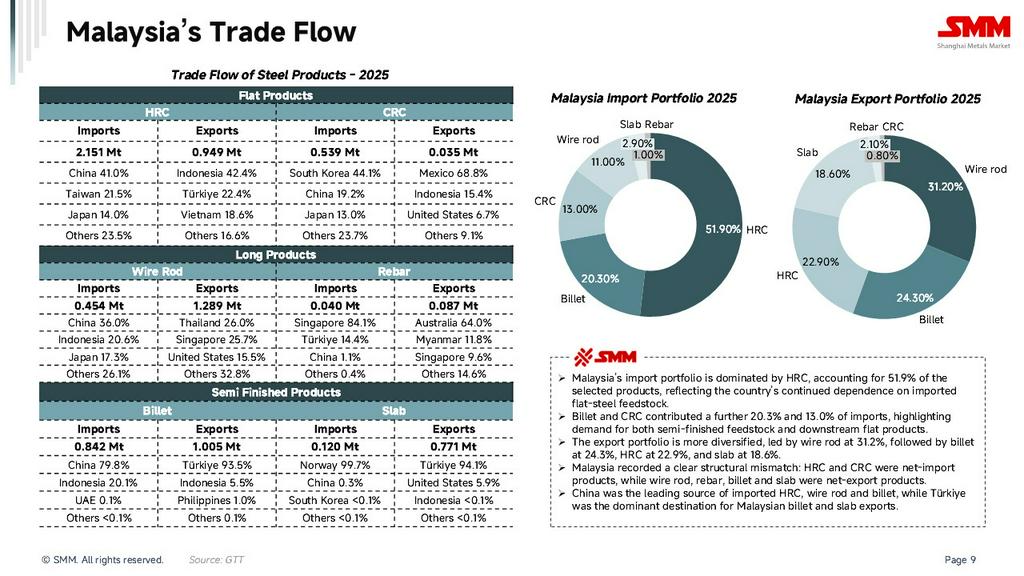
Dữ liệu thương mại năm 2025 của Malaysia cho thấy sự mất cân đối cũng không đồng nhất giữa các sản phẩm. Thép dẹt vẫn phụ thuộc cơ cấu vào nhập khẩu: nước này nhập khẩu 2,151 triệu tấn HRC so với chỉ xuất khẩu 0,949 triệu tấn, trong đó Trung Quốc cung cấp 41% lượng nhập khẩu, tiếp theo là Đài Loan và Nhật Bản. CRC cũng cho thấy mô hình tương tự — nhập khẩu 0,539 triệu tấn, dẫn đầu bởi Hàn Quốc, so với chỉ xuất khẩu 0,035 triệu tấn.
Sản phẩm dài và bán thành phẩm lại cho thấy câu chuyện ngược lại. Malaysia xuất khẩu thép cuộn dây (1,289 triệu tấn, chủ yếu sang Thái Lan và Singapore) nhiều hơn hẳn so với nhập khẩu, và là nước xuất khẩu ròng rõ rệt về phôi vuông (1,005 triệu tấn xuất khẩu, phần lớn sang Thổ Nhĩ Kỳ) và phôi tấm (0,771 triệu tấn xuất khẩu, cũng chủ yếu sang Thổ Nhĩ Kỳ). Thép cây có quy mô giao dịch tương đối nhỏ ở cả hai chiều, phản ánh tính địa phương hóa của thị trường thép xây dựng.
Tổng thể, nhập khẩu nghiêng mạnh về HRC (51,9% số sản phẩm theo dõi) và phôi vuông (20,3%), trong khi xuất khẩu phân bố đều hơn ở thép cuộn dây (31,2%), phôi vuông (24,3%), HRC (22,9%) và phôi tấm (18,6%). Tóm lại, Malaysia không chỉ đơn giản là thiếu thép hoặc sản xuất quá nhiều thép — nước này có thể dư thừa công suất ở một số phân khúc nhưng vẫn phụ thuộc vào nhập khẩu ở phân khúc khác, và sự mất cân đối đó đè nặng lên tỉ lệ sử dụng và biên lợi nhuận toàn ngành.
Tại sao dư thừa công suất đang làm chậm tiến trình thép xanh
Vấn đề tỉ lệ sử dụng đó là nguyên nhân chính khiến thép xanh chưa phải là ưu tiên thương mại hàng đầu. Lộ trình Ngành Thép Malaysia chỉ ra công suất thượng nguồn tiềm năng có thể lên tới gấp khoảng 2,8 lần nhu cầu nội địa dự kiến năm 2030 — khoảng 40,8 triệu tấn công suất so với 14,7 triệu tấn nhu cầu. Tỉ lệ sử dụng trong toàn chuỗi giá trị năm 2023 thay đổi rất nhiều theo từng sản phẩm nhưng nằm thấp hơn nhiều so với mức trung bình toàn cầu 96% năm đó, với một số phân khúc hoạt động thấp hơn hẳn. Tỉ lệ sử dụng thấp làm suy yếu lợi nhuận từ tài sản hiện có và để lại ít vốn hơn cho việc nâng cấp hoặc khử carbon chúng.
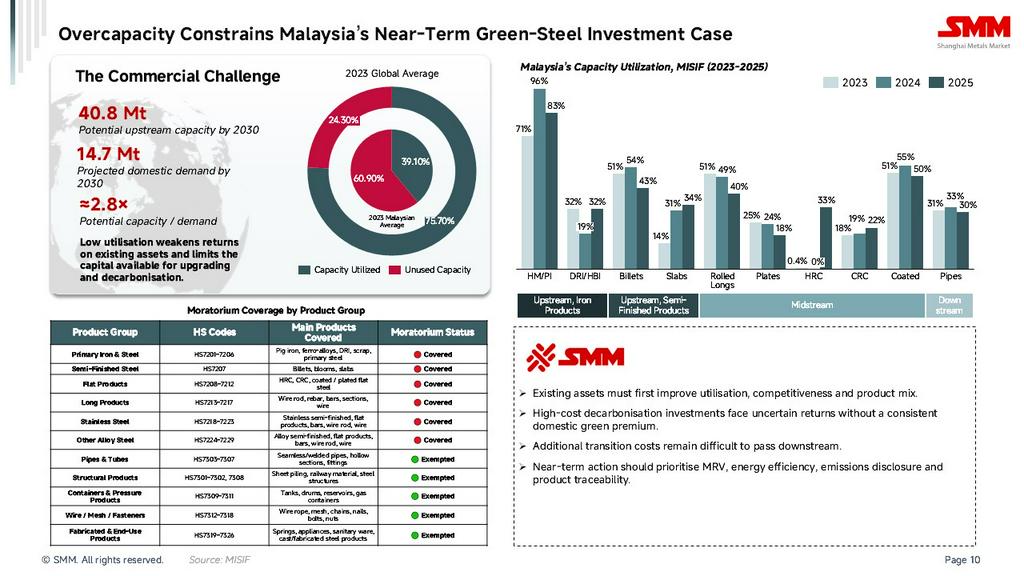
Các nhà hoạch định chính sách đã phản ứng bằng lệnh tạm ngừng cấp phép công suất đối với hầu hết các loại thép sơ cấp và bán thành phẩm (mã HS 7201–7229 — gang, phôi, tấm, thép dẹt và thép dài, thép hợp kim và thép không gỉ), trong khi miễn trừ cho các loại hạ nguồn như ống, sản phẩm kết cấu, container và hàng gia công. Điều này đánh dấu sự chuyển trọng tâm từ mở rộng sản lượng sang cải thiện tỉ lệ sử dụng, khả năng cạnh tranh và cơ cấu sản phẩm.
Hiện tại, ưu tiên ngắn hạn của các nhà máy là tối ưu hóa: cải thiện tỉ lệ sử dụng và cơ cấu sản phẩm, vì đầu tư khử carbon chi phí cao mang lại lợi nhuận không chắc chắn khi chưa có phụ phí xanh nội địa nhất quán, và chi phí chuyển đổi bổ sung khó chuyển xuống hạ nguồn. Các bước thực tế trước mắt thay vào đó tập trung vào đo lường, báo cáo, thẩm định (MRV) và truy xuất nguồn gốc sản phẩm.
Sáu động lực đang thúc đẩy quá trình chuyển đổi
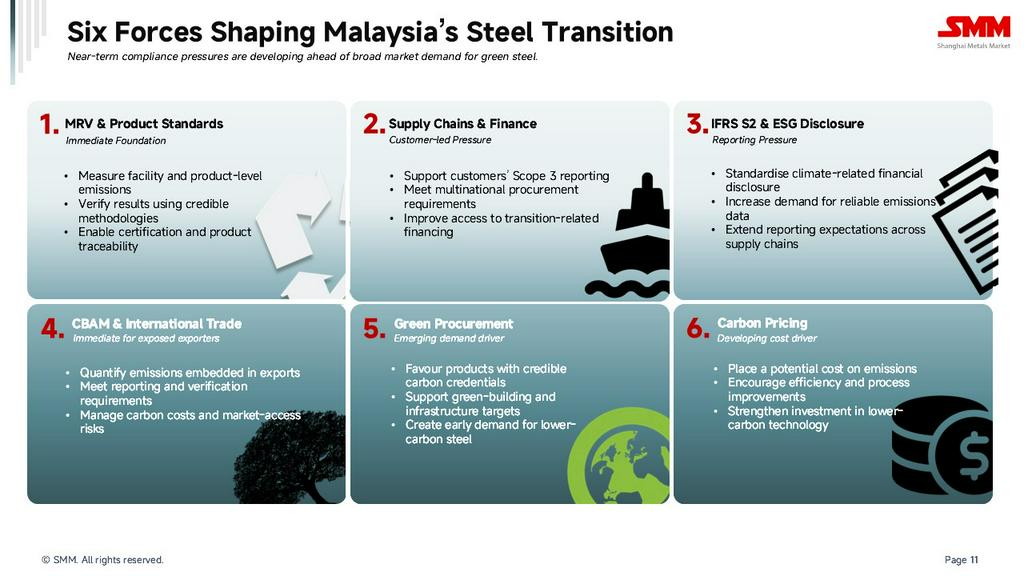
Ngay cả khi không có động lực thương mại tức thời, sáu áp lực đang hội tụ lên các nhà máy Malaysia, đại khái theo thứ tự cấp bách sau:
- Tiêu chuẩn MRV & sản phẩm — nền tảng tức thời. Nếu không có đo lường, thẩm định và truy xuất nguồn gốc phát thải nhất quán, không có tuyên bố carbon thấp nào được khách hàng công nhận.
- Áp lực từ chuỗi cung ứng và tài chính — các khách hàng đa quốc gia ngày càng cần dữ liệu phát thải của nhà cung cấp cho báo cáo Phạm vi 3 của chính họ, và các tổ chức tài chính bắt đầu tính đến hiệu suất khí hậu trong các quyết định cho vay và đầu tư.
- IFRS S2 và công bố thông tin ESG rộng hơn — khi các doanh nghiệp cải thiện báo cáo khí hậu của mình, những kỳ vọng đó lan tỏa xuống chuỗi cung ứng.
- CBAM và thương mại quốc tế — đã tác động ngay đến các nhà xuất khẩu tiếp xúc với EU, và là tín hiệu cho thấy phát thải hàm chứa đang dần trở thành một phần của điều kiện tiếp cận thị trường nói chung, chứ không chỉ là giá cả.
- Mua sắm xanh — một động lực cầu mới nổi, khi các công trình xanh, cơ sở hạ tầng và dự án đa quốc gia bắt đầu ưu tiên vật liệu có chứng nhận các-bon đáng tin cậy.
- Định giá các-bon — vẫn là một yếu tố chi phí đang phát triển, nhưng sẽ trực tiếp củng cố luận cứ tài chính cho các cải thiện hiệu suất và công nghệ các-bon thấp.
Không có lực nào trong sáu lực lượng này tự thân đã hoàn toàn chín muồi, nhưng kết hợp lại, chúng cùng hướng tới một yêu cầu trước mắt: dữ liệu các-bon đáng tin cậy và có thể kiểm chứng. Đó là lý do quá trình chuyển đổi của Malaysia có khả năng bắt đầu bằng đo lường và tuân thủ, với quá trình khử các-bon sâu rộng hơn sẽ được mở rộng sau khi hiệu suất các-bon bắt đầu chuyển thành lợi thế về tài chính, mua sắm và tiếp cận thị trường.
Bức tranh toàn cảnh
Ngành thép Malaysia không thiếu cầu, cũng không đơn thuần là dư cung — mà đang ở trạng thái mất cân bằng không đồng đều, với tăng trưởng thực sự ở một số sản phẩm và dư thừa năng lực mang tính cơ cấu ở một số sản phẩm khác, phụ thuộc nhập khẩu thực sự ở thép dẹt song song với vị thế xuất khẩu ròng ở thép dài và bán thành phẩm. Chính sự phức tạp đó là lý do tại sao việc xây dựng dữ liệu đáng tin cậy, tiêu chuẩn chung và phối hợp liên ngành giữa nhà sản xuất, người dùng hạ nguồn, nhà hoạch định chính sách và nhà tài trợ lại quan trọng hơn bất kỳ quyết định đầu tư riêng lẻ nào của một nhà máy. Các diễn đàn khu vực — bao gồm Hội nghị thượng đỉnh ASEAN về Sắt thép của SMM, dự kiến tổ chức tại Kuala Lumpur vào tháng 11 năm nay — đang nổi lên như một trong những nơi sự phối hợp đó bắt đầu hình thành.
Nguồn dữ liệu tham khảo: MISIF, SEAISI, DOSM, Worldsteel, MIDA, GTT, SMM.

![[SMM Analysis] Phôi thép dẫn dắt tăng trưởng, ASEAN và châu Phi hấp thụ nguồn cung, Trung Đông suy yếu](https://imgqn.smm.cn/usercenter/ENDOs20251217171718.jpg)
![[Chính sách mới về quỹ phúc lợi nhà ở được triển khai tại nhiều địa phương]](https://imgqn.smm.cn/usercenter/Zznfn20251217171716.jpg)