DRC Signs 30-Year Dilolo–Sakania Railway Concession to Advance Lobito Corridor

Published: Aug 27, 2026 15:49

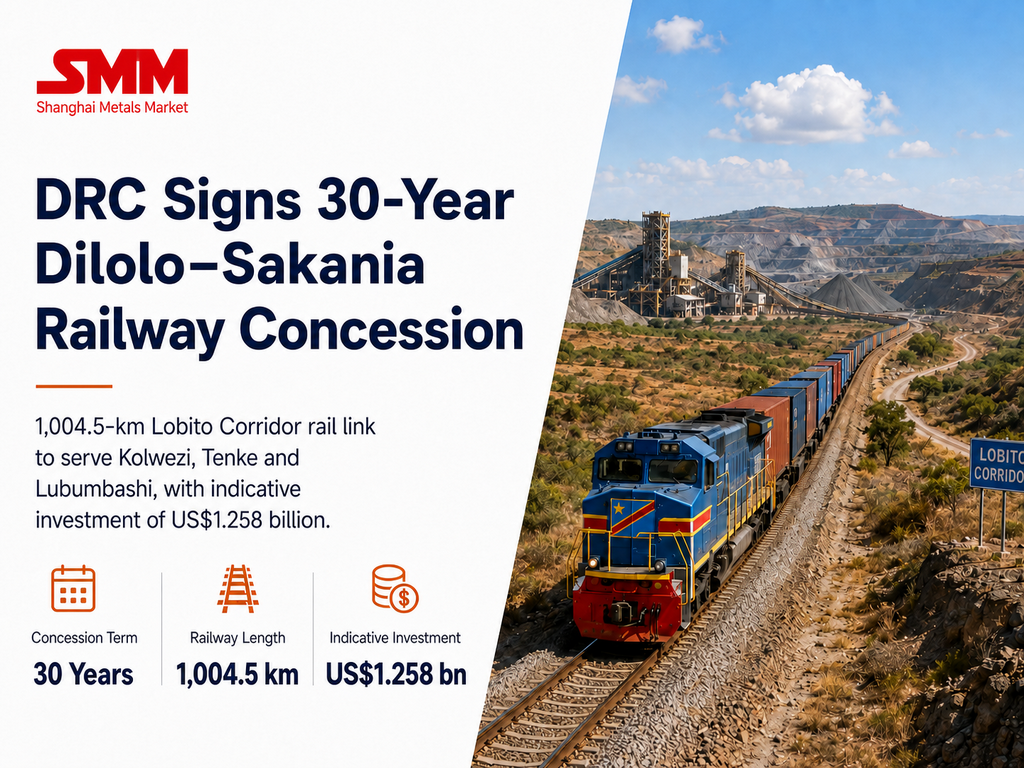
The Democratic Republic of Congo has signed a 30-year concession agreement with Mota-Engil Africa for the Dilolo–Sakania railway, marking a major step in the development of the Congolese section of the Lobito Corridor. The agreement was signed on August 26 in the presence of DRC President Félix Tshisekedi and Angolan President João Lourenço. The 1,004.5-km railway serves Kolwezi, Tenke and Lubumbashi before connecting with the Angolan rail network leading to the Atlantic port of Lobito.​

According to the DRC Presidency, rehabilitation, modernization, extension, operation and maintenance of the railway will require indicative investment of approximately US$1.258 billion. Under the concession structure, the DRC will hold at least a 10% stake in the project company and receive a royalty equivalent to 7.5% of annual gross revenue. Financing and traffic-related risks will be borne by the concessionaire, without a sovereign guarantee, operating subsidy or minimum-revenue guarantee from the Congolese government.​

The railway is expected to support the movement of minerals, agricultural products, industrial inputs, hydrocarbons and other freight, while improving transport connectivity between the DRC and Angola. The two governments also agreed to work toward smoother rail operations between Sakania, Lubumbashi, Kolwezi, Dilolo, Luau and Lobito, including coordinated maintenance, greater tariff transparency and improvements at the Dilolo–Luau border crossing. The DRC government said the project is intended to lower logistics costs while supporting domestic production, processing and value creation rather than functioning solely as a raw-material export route.​

The concession is particularly significant for the copper industry because the railway directly serves Kolwezi, Tenke and Lubumbashi, key centres of the DRC Copperbelt. Rehabilitation of the route could provide copper and cobalt producers with an additional Atlantic export corridor and improve logistics flexibility relative to existing southern and eastern routes. However, the impact on actual copper flows will depend on the pace of rehabilitation, capacity additions and the eventual commercial terms offered to mining companies once the upgraded railway becomes operational.

Data Source Statement: Except for publicly available information, all other data are processed by SMM based on publicly available information, market communication, and relying on SMM's internal database model. They are for reference only and do not constitute decision-making recommendations.

For any inquiries or for more information, please contact: lemonzhao@smm.cn
For more information on how to access our research reports, please contact:service.en@smm.cn
Related News
Zhongbei Copper Shines Brightly at SMM CCAE 2026 (15th) Copper Annual Conference
8 mins ago
Zhongbei Copper Shines Brightly at SMM CCAE 2026 (15th) Copper Annual Conference
Read More
Zhongbei Copper Shines Brightly at SMM CCAE 2026 (15th) Copper Annual Conference
8 mins ago
China's imported copper cathode losses widen, the export window opens but the volume remains limited
49 mins ago
China's imported copper cathode losses widen, the export window opens but the volume remains limited
Read More
China's imported copper cathode losses widen, the export window opens but the volume remains limited
[SMM Copper Import and Export Market Flash] Recently, China's copper cathode import losses have continued to widen, and the export window has opened again. As of press time, the September contract import loss was about 1,900 yuan/mt. However, according to SMM, actual export volume growth remains constrained by two factors: on the one hand, severe port congestion in many parts of China, with tight booking and shipping delays; on the other hand, low social inventory and tight supply at smelters, limiting current copper cathode exports.
49 mins ago
[SMM Analysis] Why Are Top Miners Betting Big on Unmanned Operations and Electrification of Copper Mines?
1 hour ago
[SMM Analysis] Why Are Top Miners Betting Big on Unmanned Operations and Electrification of Copper Mines?
Read More
[SMM Analysis] Why Are Top Miners Betting Big on Unmanned Operations and Electrification of Copper Mines?
[SMM Analysis] Why Are Top Miners Betting Big on Unmanned Operations and Electrification of Copper Mines?
[SMM Analysis] From Pilot to Production: Using Technology to Hedge Against Grade Declines, Rising Costs, and Operational Risks. Leading miners are investing heavily, not simply to use less diesel and deploy fewer drivers, but to boost the effective capacity and stability of aging assets in an environment where new copper mine projects are moving forward more slowly and grades at existing mines continue to decline. Autonomous haulage systems (AHS) have now entered mass production, while large-tonnage battery-electric mining trucks (BEVs) are still ramping up.
1 hour ago