Mining automation and electrification have long been more than just demonstration projects. Rio Tinto operates over 300 autonomous trucks in Pilbara; BHP has deployed 33 autonomous trucks and 11 autonomous drills at Escondida Norte; Anglo American manages 30 automated (remotely operated) trucks at Quellaveco via a remote operations center; and Fortescue has signed a $2.8 billion deal for 475 units of equipment, including about 360 battery-electric, autonomous-ready trucks. Currently, the vast majority of the hundreds of autonomous trucks at Rio Tinto, BHP, and Anglo American are still diesel-powered. Fortescue is the only one to have placed a large battery-electric order so far (about 360 T264 units). Globally, battery-electric trucks at Rio Tinto and BHP are still only in single-digit testing, and Rio Tinto's AutoHaul is an autonomous train, not a truck AHS.
 These projects show that top miners have moved technology from trials into core production. The core reason they are investing heavily is not just chasing the "smart mine" concept, but because new mines are becoming increasingly expensive and slow to bring online. Compared to waiting for new mines, improving the uptime, haulage efficiency, and safety stability of existing mines is faster and more controllable.
Why Are Miners Willing to Invest?
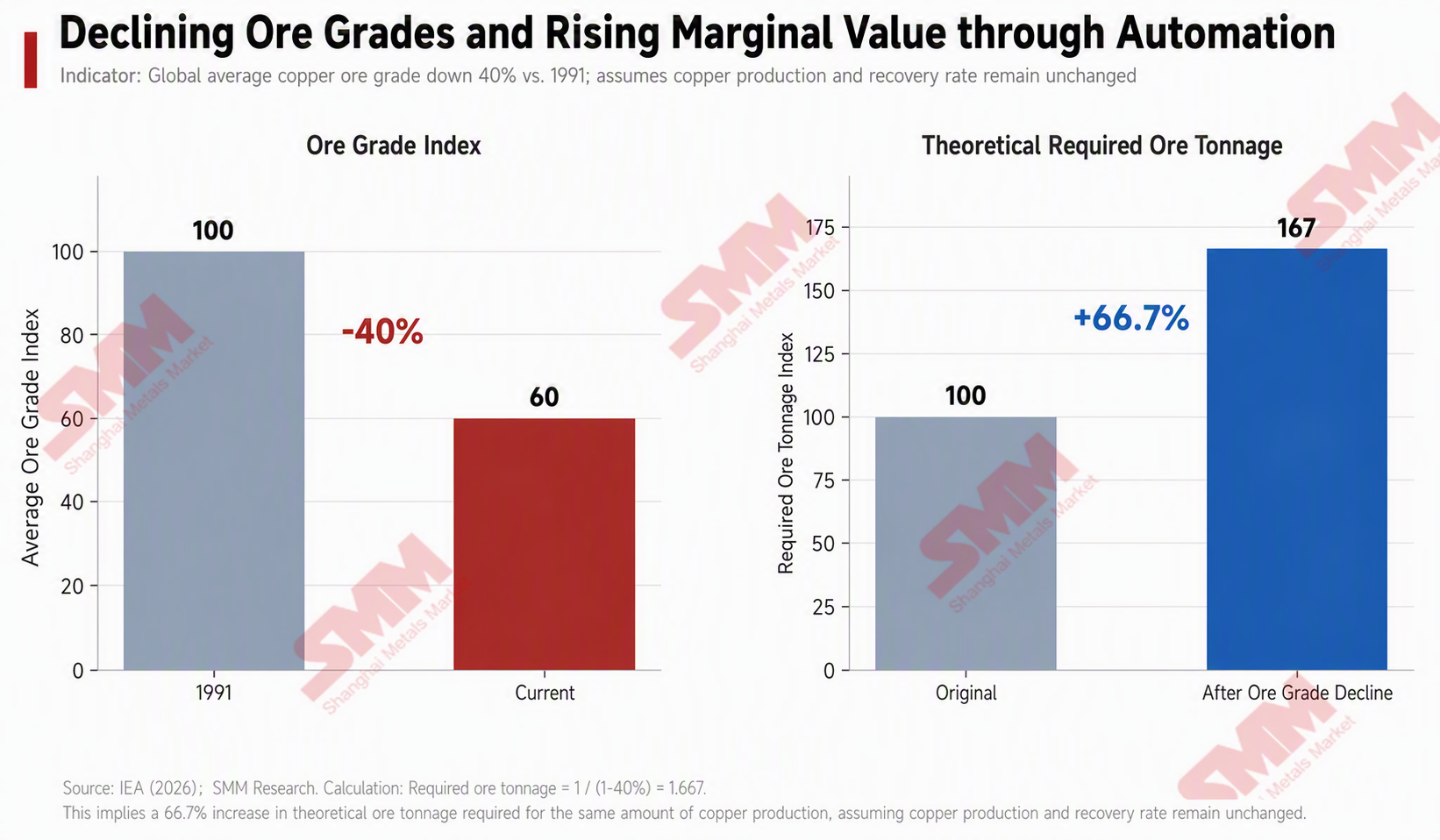
1. Declining grades mean that to maintain the same mt Cu, miners need to move more ore
IEA data shows that the average global copper ore grade has declined by 40% since 1991, and the capital intensity of brownfield expansions has risen by 65% since 2020. If grades halve, producing the same mt Cu as in previous years would require moving twice as much ore, doubling the workload in every step of mining, hauling, and processing. The lower the grade, the more valuable equipment efficiency becomes, making automation increasingly cost-effective.
2. Top miners have the conditions to spread high fixed costs
Why are top miners the first to invest? Because an AHS isn't just about buying trucks and operating them; it also requires building a dedicated communications network, a control center, and a dispatch system, along with road modifications, system integration, training, and long-term maintenance. These fixed costs must be spread across each truck. The larger the fleet and the longer the mine life, the thinner the spread per truck becomes, making it easier to achieve payback. BHP planned in 2022 to update its fleet of over 160 trucks at Escondida over about 10 years; Quellaveco has a mine life of 36 years. Both are well-suited to integrating automation into the normal truck replacement pace.
3. Automation strengthens continuous production in mining areas and reduces unexpected risks
Autonomous driving can reduce shift changes, commuting, driver fatigue, and fluctuations in human operation. Rio Tinto disclosed that since 2018, each autonomous truck has run an average of 700 more hours per year, with 15% lower loading and hauling costs; BHP disclosed that truck automation at Jimblebar and Newman has reduced heavy vehicle safety risks by 90%. It is worth noting that autonomous driving does not mean eliminating all drivers; instead, it shifts those roles toward remote dispatching, maintenance, networking, and data-related areas. Escondida, for instance, has already trained more than 5,000 people in this field.
4. Mine Sites Are Naturally Suited for Unmanned and Electric Operations
Mine sites are among the few places that are both hazardous and enclosed, making them an ideal testing ground for unmanned and electric technologies. Major accidents such as slope collapses and blind-spot collisions occur frequently in mines. Letting vehicles drive themselves, or having them remotely operated by humans, means drivers no longer need to sit inside the mining truck cab, eliminating casualty risks at their root. In addition, mine roads are enclosed, with fixed routes and loading/unloading points, and speed limits are under 30 km/h. There are no pedestrians, no public vehicles, and no license plate requirements. The issues that plague autonomous driving for passenger vehicles simply do not exist in mines in the first place. Meanwhile, with fixed loading and unloading points, charging piles can be built directly at the work sites, allowing vehicles to recharge nearby after completing a cycle without the “driving range anxiety” and “charging station anxiety” common with passenger cars. Furthermore, using electrified equipment in underground mines saves the ventilation, cooling, and heating costs associated with vehicle exhaust, while for open-pit mines, the focus turns to slopes, haul distances, charging queues, and local electricity prices.
5. ESG Is Another Invisible Driving Force
Major miners are investing heavily not just to cut costs, but also because of the invisible hand of ESG. (E) On the environmental front, diesel is the largest component of miners’ own operational emissions—accounting for roughly 40% at BHP and about 12% at Rio Tinto. Switching to electric is the most direct way to cut emissions and can also preemptively hedge against carbon tax and CBAM risks. (S) On the social front, safety is the top indicator for miners. Automation removes drivers from dangerous cabs, potentially reducing heavy-vehicle safety risks by 90%—a highly quantifiable achievement. (G) On the governance front, higher ESG scores help miners borrow at lower costs; conversely, downstream automakers and power grids are demanding “green copper.” If emissions are high, copper could be rejected by major clients. ESG, therefore, is not a nice-to-have but has transformed “should we invest?” into “must we invest.”
II. AHS and BEV Progress
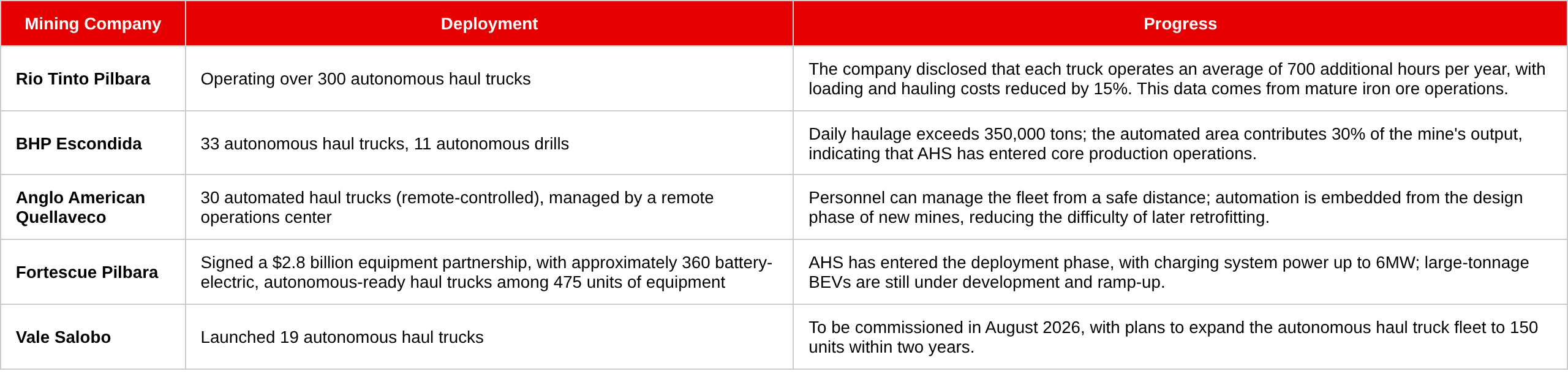
Source: Data as of August 24, 2026. Equipment count based on the latest available public disclosures from companies.
The clearest conclusion at this stage: AHS can already operate stably at large mines, creating value through higher available operating hours, steady cycles, and reduced safety risks. For large-tonnage BEVs, there is still no industry return rate that can be directly applied. Fortescue’s $2.8 billion contract covers 475 units of equipment, technology development, and supporting systems, and remains in the production ramp-up phase. Autonomy is also spreading to more copper mines: the world’s first AHS debuted in 2008 at Codelco’s Gabriela Mistral copper mine, and in August 2026, Vale’s Salobo copper mine has just commissioned 19 autonomous haul trucks and plans to expand its autonomous fleet to 150 units within two years.
3. Background
Commercial AHS was born in copper mines.
In 2008, the first commercial AHS was deployed at Codelco’s Gabriela Mistral copper mine (Komatsu FrontRunner)—the world’s first—making copper mines the “birthplace” of autonomous haulage.
Why has copper mining intelligence lagged behind?
Over the following 18 years, however, large-scale AHS deployment shifted mainly to iron ore mines—more than 300 trucks in Rio Tinto’s Pilbara, BHP, Fortescue, Vale; while copper mines have followed with Escondida (33 fully autonomous trucks), Quellaveco (30 remotely operated trucks), Salobo (19 new units in 2026) and others, the overall scale and pace have lagged behind iron ore. The root cause lies in the nature of the copper mining industry:
1. Copper ore properties are more complex: deep porphyry pits, irregular ore bodies, and more difficult road conditions than iron ore; numerous by-product minerals such as molybdenum, gold, and silver extend the beneficiation process, and automating haul trucks alone cannot efficiently solve the entire process;
2. Lower financial benefit from automation: automation mainly saves on haulage costs. Iron ore costs only tens of dollars per mt, requiring massive volumes to be profitable, and haulage costs account for a large share, so a 15% saving in loading and hauling costs is immediately noticeable; copper ore, by contrast, is worth tens of thousands of dollars per mt, and the same saving is marginal when spread across each mt of copper. Therefore, the cost advantages of automation in copper are far smaller than in iron ore;
3. Miners like Codelco carry heavy legacy burdens: its main mines are too old, truck fleets are mixed, and large mines such as Chuquicamata are transitioning from open-pit to underground, making retrofits expensive and difficult; moreover, as a state-owned enterprise, its spending is constrained by budget, and unions closely watch for layoffs, so it has moved the slowest;
4. Prospects and constraints for AHS and BEV
The way forward over the next 5–10 years
In all likelihood, full-site automation and electrification will not happen all at once, but will be phased in alongside equipment renewal. For example, BHP has planned since 2022 to replace the Escondida fleet over roughly 10 years, spreading retrofit risk into the normal replacement cycle. However, the variables for the two paths differ: for AHS, the question is not whether the technology is mature but whether the benefits can materialize in copper; for BEV, the question is whether batteries and charging can pass muster, whether on-site green electricity supply can keep up, and whether carbon pricing will extend to copper. There is also an easily overlooked coupling: AHS does not depend on electrification—it can run autonomously on diesel; but BEVs are almost inseparable from autonomy, because their limited battery driving range means decisions on when to charge, for how long, and how to run efficiently must be centrally coordinated by a dispatch system. Thus, autonomy is the foundation and electrification is the extension—this is the deeper reason why “AHS matures first, BEV climbs later.”
Chinese Producers: Accelerators and Costs
Finally, there is another accelerating force—Chinese producers. Caterpillar and Komatsu have long dominated high-priced AHS, but XCMG and SANY are now entering Latin American copper mines with cheaper in-house solutions (often starting with electric vehicles), lowering the barriers to autonomy and electrification and accelerating their popularization. Meanwhile, Codelco has already signed a contract with XCMG to introduce the XDE130 autonomous mining truck. For copper ore, this could be the fastest and most uncertain cost-reduction variable in the next decade.
Constraints
In addition to benefits, attention must also be paid to constraints:
1. High ongoing investment: software updates, sensor recalibration, and maintenance of dedicated communication networks are all continuous expenditures;
2. High altitude plus extreme temperature differences challenge battery and sensor lifespan (Chilean Andes, over 3,000 meters);
3. The payback period for technological transformation typically ranges from 2 to 5 years, and small to medium mines face much higher financing costs than major miners, which may make the wait unaffordable;
4. Supplier lock-in: once an AHS/BEV system is chosen, subsequent upgrades, spare parts, and maintenance are all tied to a single producer, weakening bargaining power;
5. Cybersecurity: mining trucks plus remote control centers expand the attack surface for cyber threats, increasing the risk of critical infrastructure being hacked.
V. Conclusion: What miners are buying is not a few new pieces of equipment, but options on long-term costs
In general, what top-tier miners are buying is not a few autonomous vehicles or charging piles, but “cost options” to address long-term trends—grade will only decline further, and new mines will only become harder to develop. Whoever first lowers unit costs, stabilizes production, and extends asset life will seize the initiative in the copper cycle over the next decade. That is why they dare to invest early: AHS has been proven to increase running time, save costs, and reduce accidents, delivering benefits immediately; BEVs are still ramping up, but they hedge exposure to diesel and carbon costs. The gap among miners in the future will not lie in whether they have autonomous mining trucks, but in who can truly transform technology into lower unit copper costs, fewer production disruptions, and longer asset life.
![Tight Supply Holds Prices Firm, Spot Price at a Premium of 170 yuan/mt [SMM Shandong Copper Cathode Spot Weekly Review]](https://imgqn.smm.cn/usercenter/AbRbz20251217171711.jpg)