SMM August 27 News:
On the metal market front:
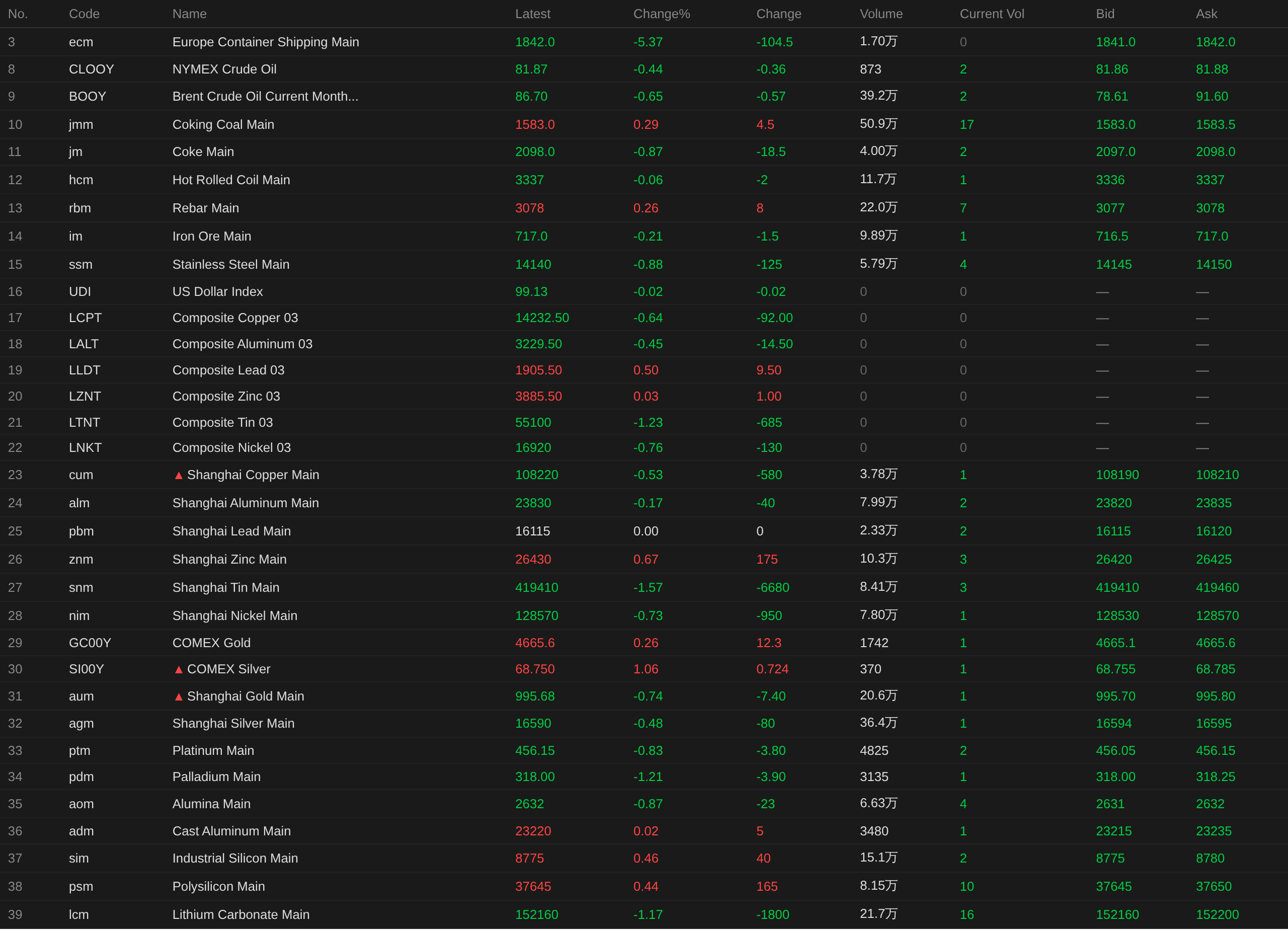
Overnight base metals in domestic and overseas markets mostly fell, while LME lead, LME zinc, and SHFE zinc rose together. LME lead gained 0.5%, LME zinc gained 0.03%, and SHFE zinc gained 0.67%. SHFE lead was flat at 16,115 yuan/mt. LME tin and SHFE tin both fell over 1%, with LME tin down 1.23% and SHFE tin down 1.57%. LME nickel fell 0.76%, and SHFE nickel declined 0.73%. Other metals showed relatively small % changes. The most-traded alumina contract fell 0.87%, while the most-traded cast aluminum contract rose 0.02%.
On the overnight ferrous metals front, most declined. Stainless steel fell 0.88%, iron ore declined 0.21%, rebar edged up 0.26%, and hot-rolled coil fell 0.06%. For coking coal and coke, coking coal rose 0.29% and coke fell 0.87%.
On the overnight precious metals front, COMEX gold fell 0.99%, and COMEX silver declined 0.87%. On the domestic front, SHFE gold fell 0.74%, breaking below the key 1,000 yuan/g mark, and SHFE silver declined 0.48%.
As of 6:47 AM on August 27, overnight closing prices:
Macro Front
China:
[China to Promote 6G Industry Maturity and Ecosystem Building During 15th Five-Year Plan Period] At a press conference of the State Council Information Office on the “Start of the 15th Five-Year Plan” series on August 26, Liu Yulin, Director of the Information and Communication Development Department of the Ministry of Industry and Information Technology (MIIT), stated that during the 15th Five-Year Plan period, China will accelerate breakthroughs in core 6G technologies, continue to conduct 6G technology trials and standard development, promote the maturity of the 6G industry and ecosystem building, and prepare for 6G commercial deployment. (Xinhua News Agency)
[MIIT: China to Cultivate 500 Zero-Carbon Factories During 15th Five-Year Plan Period] At the State Council Information Office’s press conference on the “Start of the 15th Five-Year Plan” series, si MIIT officials introduced efforts to fully implement the 15th Five-Year Plan and accelerate new-type industrialization. During the 15th Five-Year Plan period, 500 zero-carbon factories will be cultivated, creating a set of replicable and scalable development models. (CCTV News)
[Zhengzhou Housing Provident Fund Loan Policy Further Optimized; Down Payment Ratio for Second-Hand Homes Lowered to 20%] The Zhengzhou Housing Provident Fund Managment Center issued a notice on further optimizing housing provident fund loan policies. For employees purchasing existing housing within the administrative area of Zhengzhou and applying for housing provident fund loans, the minimum down payment ratio has been reduced from 30% to 20%. The policy also supports intergenerational family mutual assistance in using housing provident fund loans. When applying for a housing provident fund loan to purchase self-occupied housing in this city, if the borrower's loanable amount under the housing provident fund does not reach the maximum family loan limit, his or her parents or children who have been normally paying into the housing provident fund and meet the conditions for provident fund loans may act as co-borrowers in this loan application. (Zhengzhou Housing Provident Fund Management Center) (Jin10 Data APP)
[Shanghai: Promote the Construction of Comparative Testing Demonstration Bases for Multiple Technology Routes Including Solid-State Batteries, and Plan for 10 MW-Level Standalone ESS Demonstration Power Stations]The General Office of the Shanghai Municipal People's Government issued the "Shanghai Strategic Emerging Industries Development 15th Five-Year Plan." It mentions the implementation of new-type energy storage and green fuel innovative application demonstrations, promoting the construction of comparative testing demonstration bases for multiple technology routes including solid-state batteries, and planning for 10 MW-level standalone ESS demonstration power stations. It will accelerate the construction of Shanghai's international shipping green fuel certification and bunkering centers and promote the demonstration of hydrogen energy storage backup power supply and other industrial scenarios. Key areas of development: 1. Next-generation energy storage. Advance all-solid-state batteries, flow batteries, high performance sodium-ion batteries, large-scale advanced compressed air energy storage, and other long duration energy storage (LDES) technologies. 2. Wind power equipment. Advance the research and development of deep-sea floating wind turbines and accelerate the demonstration application of deep-sea wind power equipment. 3. PV equipment. Tackle key technologies in high-efficiency heterojunction and perovskite PV cells, and develop offsore floating PV equipment, space PV equipment, and megawatt-level solar thermal equipment. 4. Advanced nuclear energy. Continue to promote the independent and controllable development and batch construction of third-generation nuclear power equipment, and plan for fourth-generation nuclear power, small and micro reactors, marine nuclear power, and other technologies. 5. Gas turbines. Promote research on hydrogen co-firing technology for industrial gas turbines and accelerate the development and commercial application of heavy-duty gas turbines. 6. Power transmission and distribution equipment. Promote the development and industrialisation of ultra-high voltage transformers and ultra-high voltage gas-insulated switchgear (GIS).
[Shanghai: Orderly Cultivate and Promote Low-Altude Economy Application Demonstration Scenarios, and Expand Low-Altude Production Operations and Public Governance Applications]The General Office of the Shanghai Municipal People's Government issued the "Shanghai Strategic Emerging Industries Development 15th Five-Year Plan." It mentions the orderly cultivation and promotion of low-altitude economy application demonstration scenerios, expanding low-altitude production operations and public governance applications, enriching consumption formats such as cultural tourism and sports, gradually releasing the potential of low-altitude logistics, and steadily and prudenly developing low-altitude transportation. Key areas of development: 1. Advanced low-altitude aircraft. Develop new-type vertical take-off and landing (VTOL) aircraft with large payload and long endurance, support low-altitude aircraft with new configurations such as compound wings and tilt rotors, overcome difficulties in the overall design and aerodynamic layout of traditional general aviation aircraft, and innovatively develop large-scale industrial-grade unmaned aerial vehicles. 2. Key Components of Low-Altitude Equipment. Focusing on areas such as advanced energy and power systems, advanced flight control systems, and drone safety protection, we aim to make breakthroughs in core technologies including high-energy-density aviation power batteries, high-power-density motors, and highly reliable flight control. 3. Low-Altitude Infrastructure. Implement integrated planning for low-altitude infrastructure projects such as takeoff and landing, flight support, and safety protection, orderly promote the designation of low-altitude public air routes, and accelerate the construction of low-altitude intelligent connected systems. Promote the coordinated planning and seamless integration of low-altitude infrastructure with related infrastructure in energy, information, transportation, agriculture, water conservancy, and other sectors.
US Dollar:
As of the overnight close, the US dollar index rose 0.23% to 99.14. The US July annual inflation rate unexpectedly held steady, remaining significantly above the Fed's 2% target for the 65th consecutive month. Affected by the Iran war, the recent pullback in inflation after rising to high levels has stalled, which may intensify the tense debate within the Fed over whether to raise interest rates or keep them unchanged. Data released by the Bureau of Economic Analysis of the US Commerce Department on Wednesday showed that the Fed's preferred gauge, the US July PCE price index, rose 3.7% YoY, unchanged from June, while analysts had expected 3.6%. As trade negotiations between the US and its second-largest trading partner, Canada, broke down on Friday, a new round of tariff-induced inflation pressures may be about to arrive. On a MoM basis, the PCE price index rose 0.2% in July, also exceeding economists' expectations. In June, the index had declined 0.1% MoM, the lowest level since April 2020. The Bureau of Economic Analysis also updated its Q2 economic growth data, leaving the annualized growth rate of US real gross domestic product (GDP) in Q2 unchanged at 1.5%. (Jin10 Data APP)
Market pricing showed that expectations for a Fed rate hike next month edged up, after US government data showed that the Fed's key inflation gauge rose 3.7% YoY in July, slightly above economists' expectations. Interest rate futures data indicated that after the release, the market priced in about a 42% probability of a Fed rate hike in September, up from around 36% before the data. (Jin10 Data APP)
According to the CME "Fed Watch": The probability of the Fed leaving rates unchanged in September is 63.5%, and the probability of a cumulative 25 basis point hike is 36.5%. For October, the probability of rates remaining unchanged is 47.3%, the probability of a cumulative 25 basis point hike is 43.4%, and the probability of a cumulative 50 basis point hike is 9.3%. (Jin10 Data APP)
Macro Front:
Due today are US initial jobless claims for the week ended August 22, Germany's Gfk consumer confidence for September, Canada's Q2 current account, and other data.
Additionally, the Ministry of Commerce held its second regular press conference for August, the European Central Bank released the minutes of its monetary policy meeting, and the Jackson Hole Global Central Bank Annual Conference will be held from August 27 to 29. Nvidia reported its earnings after the US stock market close on August 26, and Nvidia held its earnings call.
Crude Oil:
Overnight, oil prices fell across both benchmarks, with US oil down 0.55% and Brent oil down 0.65%. According to Sepah News, the official news site of Iran's Revolutionary Guard, Revolutionary Guard spokesman Mohbi Hossein stated regarding the latest situation in the Strait of Hormuz: "The Strait of Hormuz is currently under our control, and there are no enemy warships in the Persian Gulf." He added: "From a military and territorial juridictional perspective, no vessel can pass through this waterway without Iran's permission and under Iran's administration." Mohbi Hossein stated: "The Strait of Hormuz belongs to Iran and Oman, which faces us across the sea. About a month ago, we commenced negotiations with Oman and achieved mutually acceptable outcomes." "In these negotiations, the two sides reached some agreements on the respective shares of the strait's waters owned by each country, as well as the revenue shares Iran and Oman would receive." "The US is interfering in this process, which has delayed the progress of related work." He stressed: "If the US does not accept our conditions, the Strait of Hormuz will never be opened." (Jin Shi Data APP)
Crude oil loadings by Saudi Arabia in the Persian Gulf appear to be increasing significantly, the latest sign that the country is recalibrating its crude transportation routes after Houthi threats to its Red Sea oil exports. Based on images captured by the EU's Sentinel-1 and Sentinel-2 satellites, ships with a combined capacity of about 7 million barrels were loading crude oil on Tuesday at different areas of the Ras Tanura terminal, Saudi Arabia's largest export hub. A total of four vessels were berthed at Ras Tanura and Ju'aymah ports that day, the highest level since a brief loading surge in late June during a short-lived temporary peace agreement between the US and Iran. Traders have been closely monitoring Saudi oil shipments since the Iran war erupted in late February. After the conflict broke out, Riyadh quickly divert oil supplies to the Red Sea port of Yanbu, but last month the Houthis announced a blockade on Saudi shipping, prompting Saudi Arabia to adjust its transport arrangements once again. (Jin Shi Data APP)
US Energy Information Administration (EIA): US crude oil inventories increased by 95,000 barrels last week, Bloomberg users expected an increase of 2 million barrels, analysts expected an increase of 1.3928 million barrels, and the prior week saw an increase of 4.405 million barrels. U.S. gasoline inventories hit a seasonal low not seen since 2012. East Coast distillate fuel oil inventories fell to their lowest level since May 2022, setting a new seasonal record low. Midwest refinery throughput reached an all-time high. U.S. refinery utilization rate rose to its highest since September 2018. (from Wall Street CN APP)
![PCE Slightly Exceeds Expectations, September Rate Hike Probability Rises to 42% SHFE Tin 2610 Contract Consolidates Around 420,000 [SMM Tin Morning Brief]](https://imgqn.smm.cn/usercenter/bYFQn20251217171752.jpg)
![Supply Tightens Provide Support & High Prices Suppress Demand, Lead Prices Move Sideways [SMM Lead Morning Meeting Summary]](https://imgqn.smm.cn/usercenter/guTSZ20251217171722.jpg)
![Major Players Actively Market-Making, Fierce Tug-of-War Between Sellers and Buyers [SMM South China Spot Aluminum Daily Review]](https://imgqn.smm.cn/usercenter/tYQzs20251217171653.jpg)