Tantalum Price Stops Falling and Stabilizes: Off-Season Ends, Can the Next Round of Market Rally Begin? [SMM Analysis]

Published: Aug 26, 2026 18:06 (GMT+8)
[SMM Tantalum Market Analysis: Tantalum Prices Stop Falling and Stabilize: Off-Season Ends, Can the Next Round of Market Movement Be Launched?] At the end of May, driven by news factors and supported by future demand expectations, tantalum prices shot up, with tantalum ore prices soaring to $240-245/mtu. However, the positive news failed to materialize, market panic sentiment intensified, and tantalum prices turned to grind lower, entering a prolonged period of consolidation at lows. As the traditional off-season of July and August comes to an end, the market is stirring at the bottom, and tantalum prices are expected to usher in a new operating cycle.

At the end of May, supported by news stimuli and future demand expectations, tantalum prices shot up, with tantalum ore prices surging to $240-245/mtu. However, the positive factors did not materialize later, market panic sentiment fermented, and tantalum prices shifted to a grind lower channel and entered a long period of consolidation at lows. As the traditional off-season in July and August comes to an end, underlying currents stir at the market bottom, and tantalum prices are expected to usher in a new operating cycle.
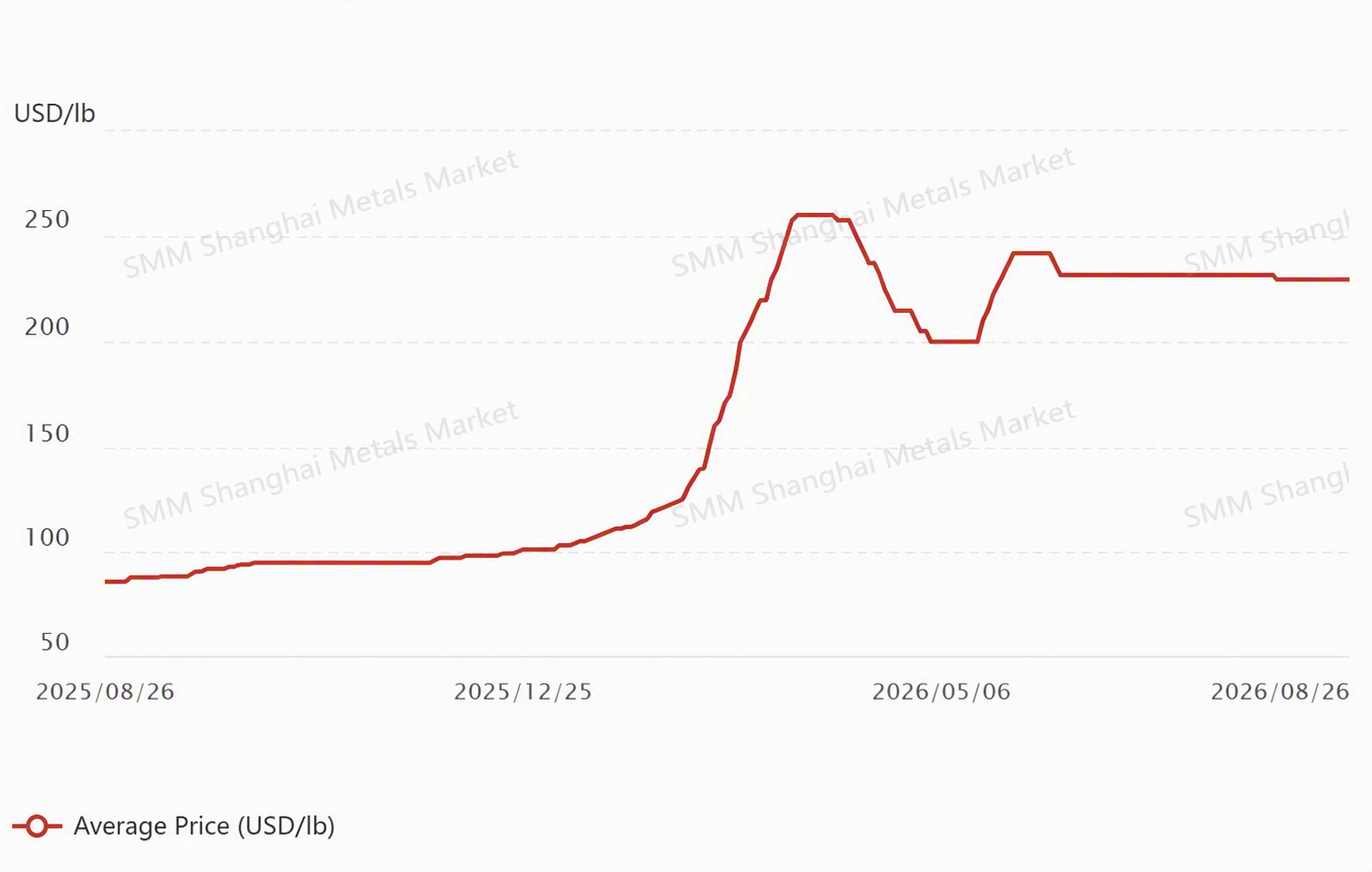
Recently, signals of price increases have emerged one after another. There are three main supporting factors: First, downstream tantalum smelters restocked in a timely manner, providing underlying support for the market, which is also the core reason for the limited overall pullback in tantalum prices earlier. Second, the annual supply gap exists naturally, and the recovery of traditional demand coupled with the release of demand in the emerging AI sector keeps demand for tantalum ore and tantalum smelting products strong. Third, speculative demand amplified the gains. As the off-season ends, some miners began to purchase and stockpile, low-priced goods in the market were quickly digested, and the bottom of tantalum prices gradually rose.

However, the sustainability of this round of increase remains uncertain. On the one hand, the sharp rise in tantalum prices creates substitution pressure on traditional demand. Long-term high prices will prompt downstream enterprises to actively seek substitutes, limiting the upside room for prices. On the other hand, the market still maintains a certain amount of raw material inventory. Combined with smelters' fear of high prices, downstream procurement shows the characteristics of "long intermittent periods and concentrated procurement," making it difficult for the demand side to form a sustained boost.
Data Source Statement: Except for publicly available information, all other data are processed by SMM based on publicly available information, market communication, and relying on SMM's internal database model. They are for reference only and do not constitute decision-making recommendations.

Images in this article contain AI-translated captions for reference only.

For any inquiries or for more information, please contact: lemonzhao@smm.cn
For more information on how to access our research reports, please contact:service.en@smm.cn
Related News
【Flash | Regulator Orders Partial El Teniente Shutdown; Molybdenum Impact Remains Unconfirmed】
17 hours ago
【Flash | Regulator Orders Partial El Teniente Shutdown; Molybdenum Impact Remains Unconfirmed】
Read More
【Flash | Regulator Orders Partial El Teniente Shutdown; Molybdenum Impact Remains Unconfirmed】
Chile’s National Geology and Mining Service ordered a temporary halt on October 13 at El Teniente’s North Crater waste dump and other areas exposed to avalanche or ground-movement risks, while stating that the order does not suspend the entire division. Amerigo Resources separately said its Minera Valle Central tailings operation was unaffected. El Teniente produced 1,483.1 metric tonnes of contained molybdenum in the first half of 2026, down 34.9% from a year earlier. No disruption to underground mining, concentrators or the molybdenum recovery circuit has been confirmed; SMM is not revising its forecast.
17 hours ago
[SMM Chromium Flash] Tharisa’s Average Chrome Price Slips to $285/t in Q4 as FY2027 Guidance Holds at 1.50-1.65 Mt
17 hours ago
[SMM Chromium Flash] Tharisa’s Average Chrome Price Slips to $285/t in Q4 as FY2027 Guidance Holds at 1.50-1.65 Mt
Read More
[SMM Chromium Flash] Tharisa’s Average Chrome Price Slips to $285/t in Q4 as FY2027 Guidance Holds at 1.50-1.65 Mt
[SMM Chromium Flash] Tharisa’s Average Chrome Price Slips to $285/t in Q4 as FY2027 Guidance Holds at 1.50-1.65 Mt
Tharisa reported an average metallurgical-grade chrome concentrate price of US$285/t on a 42% basis in the fourth quarter of its 2026 financial year, down 6.9% from US$306/t in the third quarter. The FY2026 average was US$290/t, up 9.0% from US$266/t in FY2025. CEO Phoevos Pouroulis said the pricing environment was materially stronger than in the prior year. The PGM basket moved in the same direction. The average PGM contained-metal basket price was US$2,535/oz in the fourth quarter, down 5.4% from US$2,681/oz in the third quarter. The FY2026 average was US$2,607/oz, against US$1,615/oz in FY2025. For FY2027, Tharisa guided chrome concentrate production of 1.50-1.65 Mt and PGM production of 150,000-170,000 oz on a 6E basis, reflecting production from the Tharisa Mine only. The chrome range is unchanged from FY2026 guidance, and FY2026 output of 1.56 Mt fell within it.
17 hours ago
[SMM Chromium Flash] Tharisa’s FY2026 Chrome Concentrate Output Reaches 1.56 Mt, in Line With Guidance
17 hours ago
[SMM Chromium Flash] Tharisa’s FY2026 Chrome Concentrate Output Reaches 1.56 Mt, in Line With Guidance
Read More
[SMM Chromium Flash] Tharisa’s FY2026 Chrome Concentrate Output Reaches 1.56 Mt, in Line With Guidance
[SMM Chromium Flash] Tharisa’s FY2026 Chrome Concentrate Output Reaches 1.56 Mt, in Line With Guidance
Tharisa produced 416,700 mt of chrome concentrate in the fourth quarter of its 2026 financial year (July-September), up 5.8% quarter-on-quarter from 393,800 mt in the third quarter. The quarter’s output comprised 371,300 mt of metallurgical grade and 45,400 mt of specialty grades. Full-year FY2026 production came to 1,563,800 mt, marginally above the 1,558,200 mt produced in FY2025 and in line with the company’s guidance. Higher throughput supported the quarterly gain. At the Tharisa Mine in South Africa, reef mined increased 8.5% quarter-on-quarter to 1.34 million mt, while reef milled rose 7.3% to 1.43 million mt. The company’s PGM output rose alongside chrome, with quarterly production of 41,000 oz on a 6E basis, bringing the FY2026 total to 153,700 oz. Tharisa CEO Phoevos Pouroulis said the group met its market guidance for both commodities in FY2026, describing it as the year the company’s growth moved from planning into construction.
17 hours ago
Register to Continue Reading
Gain access to the latest insights in metals and new energy
Already have an account?Sign in here