SMM August 23 News:
This week, SMM headed to various copper scrap raw material yards in Zhenhai, Ningbo for a field visit. Since the beginning of this year, due to the implementation of "reverse invoicing" in the secondary copper raw material industry, many scrap utilization enterprises have been unable to carry out "reverse invoicing" on a large scale, forcing them to increase procurement volumes of imported copper scrap. Based on the findings of this visit, inventory levels at major yards were not ample. With growing demand for copper scrap from outside China, yard managers also indicated expectations that future imports of copper scrap would decline.
Yard A: The yard primarily stored blister copper ingots and No.2 copper semis (mostly copper pipe & tube), with very limited quantities of bare bright copper wire;
Yard B: The yard mainly stored bare bright copper wire nodules. According to the yard manager, this batch of bare bright copper wire nodules had already been sold and awaited buyer cargo pick-up, so only small amounts of copper ingots and No.1 copper semis were available for sale;
Yard C: The yard mainly stored brass and shredded copper, with inventory less than one-quarter of past levels;
Yard D: The yard stored various types of copper scrap, but inventory was extremely low.
From this field visit, imported copper scrap inventory was at low levels. With the arrival of the traditional September-October peak season, yard managers indicated that although they had completed stockpiling for the peak season, given current domestic policy expectations, the "reverse invoicing" policy would remain in effect as is, and scrap utilization enterprises would still have huge demand for imported copper scrap.
To directly reflect the impact of current tax costs on scrap utilization enterprises, SMM conducted a tax calculation for a scenario where the selling price of copper semis made from scrap was 104,200 yuan/mt. The calculation showed: if using completely tax-free procurement, the total actual tax paid by the enterprise would be 9,618 yuan/mt, with a business negotiation invoice tax rate of 9.23%; if using reverse invoicing with a 1% tax rate, the actual tax paid would be 9,846 yuan/mt, with the invoice tax rate rising to 9.45%; if using simplified levy with a 3% tax rate, the actual tax paid would reach 10,309 yuan/mt, with an invoice tax rate of 9.89%; and if fully compliant procurement using 13% tax invoices, the total actual tax paid by the enterprise would soar to 12,563 yuan/mt, with a business negotiation invoice tax rate as high as 12.06% (and even 13.62% from a financial perspective).
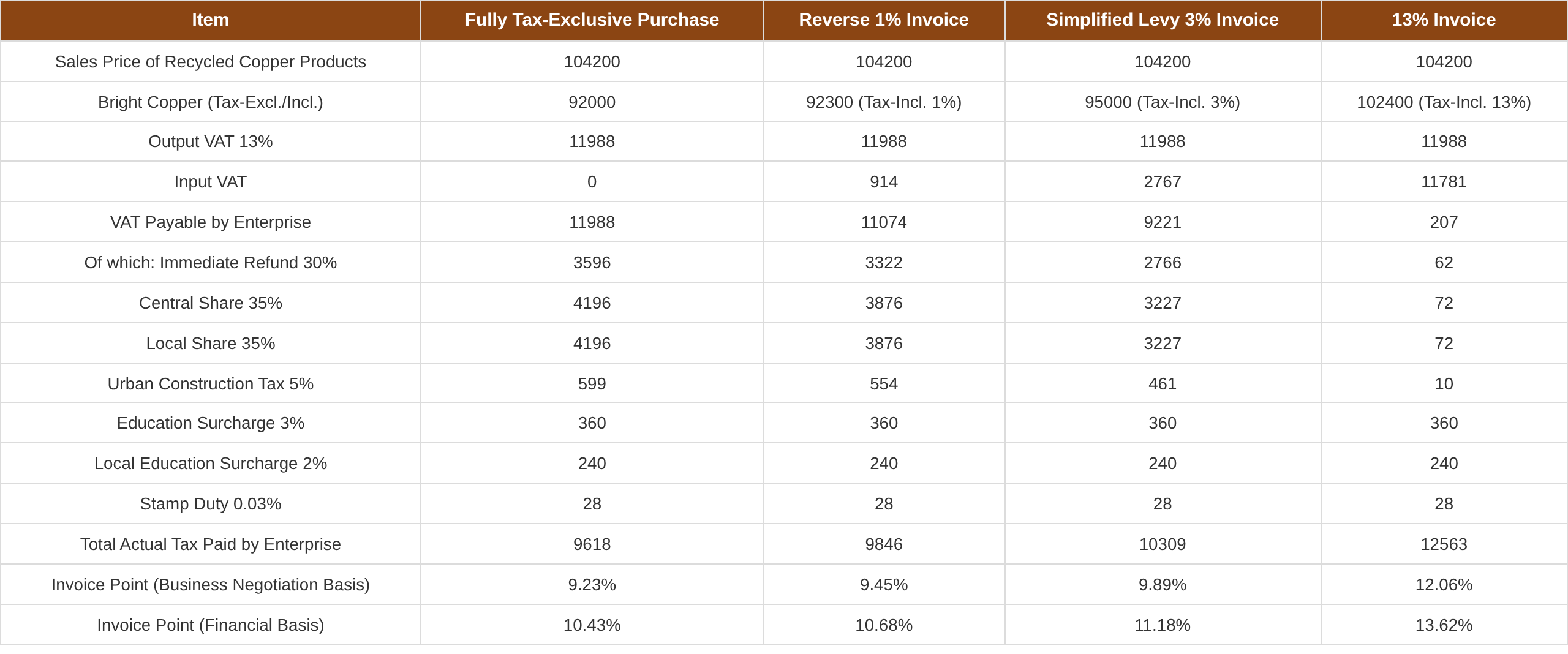
According to SMM's preliminary calculations, if scrap utilization enterprises fully purchase imported copper scrap, although it would ensure legal and compliant operations, due to the sharp increase in tax costs, the price spread between copper cathode rod and secondary copper rod would narrow, the economic benefits of secondary copper rod would be overshadowed, and market competitiveness would decline. Faced with high compliance costs, scrap utilization enterprises could only pass on the pressure by lowering upstream tax-free copper scrap prices.
Looking ahead, under the context of building a "unified" market, although reverse invoicing will standardize the issue of invoice shortages in the industry, the bonus period for scrap utilization enterprises is fading. Enterprises need to find a balance between stockpiling during peak season and cost pressure, continuously improving their procurement bargaining power and product competitiveness.