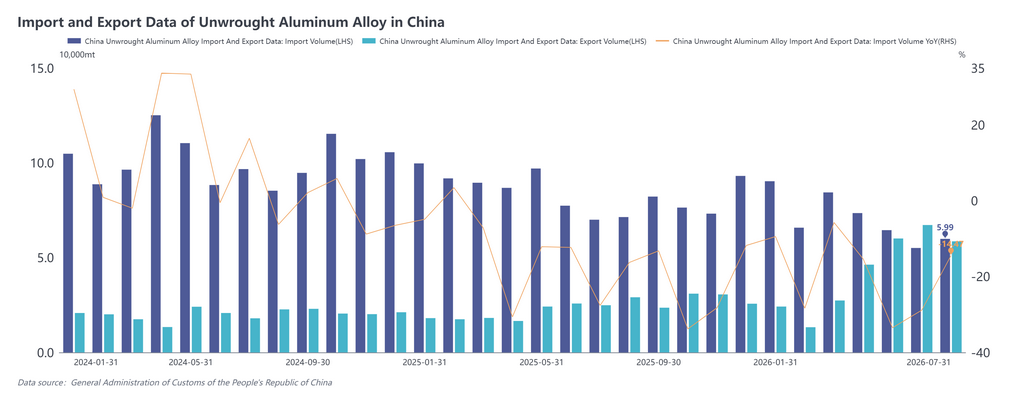
The General Administration of Customs released import and export data for July 2026 today, showing:
In July 2026, imports of unwrought aluminum alloys were 59,900 mt, down 14.5% YoY and up 8.7% MoM; cumulative imports from January to July totaled 493,400 mt, down 19.4% YoY.
On the export side, exports of unwrought aluminum alloys were 58,600 mt in July, up 135.1% YoY and down 12.8% MoM; cumulative exports from January to July totaled 297,100 mt, up 104.6% YoY.
From the perspective of import source structure, China's imports of unwrought aluminum alloy in July 2026 remained highly concentrated. That month, the top five source countries—Russia, Thailand, Malaysia, Vietnam, and Cambodia—totaled 47,500 mt, accounting for 79.3% of total imports. Among them, Russia ranked first with 16,100 mt (27% share); Thailand and Malaysia imported 10,200 mt and 10,000 mt respectively, each accounting for 17%; Vietnam imported 8,900 mt (15%); and Cambodia imported 2,300 mt (4%).
From the regional distribution perspective, Southeast Asia remained China's core source region for unwrought aluminum alloy imports. In July, total imports from major Southeast Asian countries including Malaysia, Thailand, Vietnam, Indonesia, and Cambodia reached approximately 32,100 mt, accounting for about 53.6% of total imports; when combined with Russia's imports, the two regions accounted for approximately 80.6% of total imports, further concentrating in the two major regions of Southeast Asia and Russia. Meanwhile, imports from other countries and regions were relatively scattered, with the share of individual sources generally low.
From a trade mode perspective, processing trade with supplied materials remained the primary export mode, but its share further declined, while the shares of processing trade with imported materials and Ordinary Trade continued to rise, making the trade mode structure of export growth more diversified. Based on July data, processing trade with supplied materials accounted for approximately 40.8%, processing trade with imported materials for 30.3%, together exceeding 70%; the share of Ordinary Trade rose to 9.0%, a notable increase from earlier levels, reflecting a reduced reliance on traditional processing trade for China's unwrought aluminum alloy exports, and a greater contribution from Ordinary Trade to export growth.
By export destination, market concentration continued its downtrend. In July, Japan remained the largest export destination, with exports of 25,900 mt, accounting for 44.3%; exports to South Korea, Morocco, Thailand, and India were all sizable, with South Korea at 12.3%, Morocco at 8.1%, Thailand at 7.2%, and India at 7.1%.
Overall, July saw a continuation of the pattern of "import contraction, export expansion" for China's unwrought aluminum alloy trade, but marginal performance diverged. On the import side, driven by falling overseas quotes and improved price spreads between Chinese and overseas markets, imports recovered somewhat from earlier levels, yet remained low on a YoY basis overall; on the export side, they stayed high, and despite a pullback MoM, still maintained a high growth rate YoY.
Imports: Marginal recovery occurred, but the overall contraction pattern remained unchanged. Overseas aluminum alloy quotes have pulled back recently, the price spread between Chinese and overseas markets has been narrowing, the degree of import losses has improved, and the import window showed signs of marginal recovery. However, imports are still constrained by relatively high domestic prices and costs, leaving limited room for a significant rebound in the near term.
Exports: High growth continued, but marginal momentum weakened. July exports pulled back MoM, but still recorded a high growth rate YoY, and the trend of diversification in export markets and trade modes continued. Overseas demand and prior orders still supported exports, but as overseas quotes fell, the price spread advantage between China and overseas narrowed, and combined with the high base effect from earlier periods, the growth rate of subsequent exports is expected to gradually slow down. H2 changes on the import side will depend more on whether the price spread between Chinese and overseas markets can further recover, while on the export side, attention should be paid to ex-China demand and changes in the price spread between Chinese and overseas markets. It is expected that export volume will remain at a relatively high level, but the sustainability of the YoY high growth rate is expected to weaken.
![Raw material strength supports rising costs while supply pressure accumulates [SMM Prebaked Anode Weekly Review]](https://imgqn.smm.cn/usercenter/fjmVq20251217171654.jpg)
![Aluminum Fluoride Prices Rise on Cost Support; Premium for High-Grade Supply Widens [SMM Fluoride Salt Weekly Review]](https://imgqn.smm.cn/usercenter/zlIyw20251217171654.jpg)
![ADC12 Consolidates on a Strong Note as Costs Rise and Orders See Marginal Improvement [Aluminum Scrap and Secondary Aluminum Weekly Review]](https://imgqn.smm.cn/usercenter/YhgvU20251217171725.jpg)