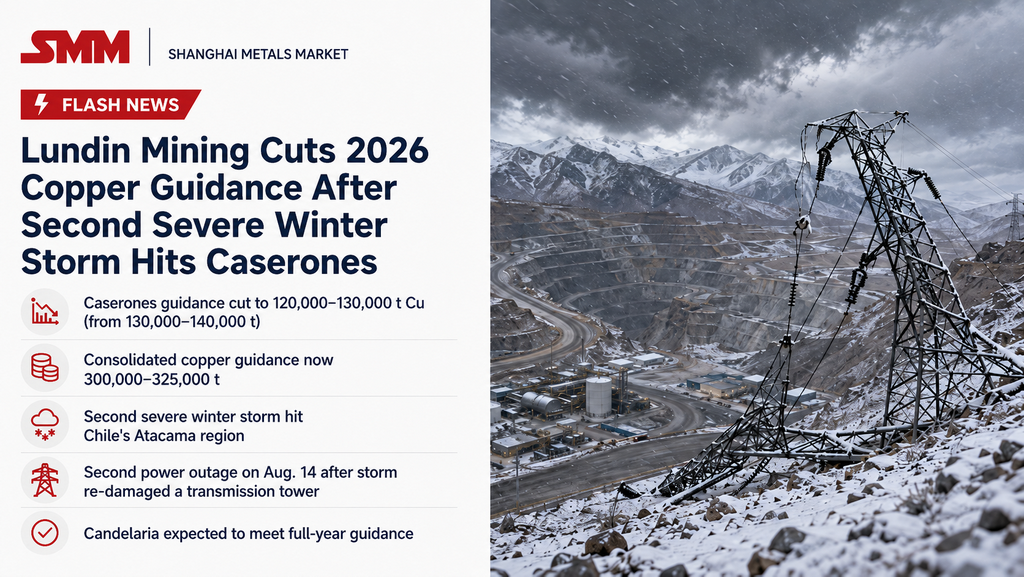
Lundin Mining has lowered its 2026 copper production guidance after a second severe winter storm disrupted operations at its Caserones mine in Chile’s Atacama region, extending downtime and delaying the site’s recovery.
The latest storm began on August 13 and brought heavy rainfall at lower elevations, together with unusually heavy snowfall and strong winds at higher altitudes. Caserones suffered a second power outage on August 14 after severe weather re-damaged a transmission tower that had already been affected by an earlier storm in July.
The mine had previously experienced a power outage from July 18 to July 30. Lundin had initially expected the impact of the first disruption to be contained within the lower end of its original guidance range, but the second storm delayed the return to full operations and prompted a further revision to the company’s outlook.
Caserones’ 2026 copper production guidance has been reduced to 120,000–130,000 tonnes, from 130,000–140,000 tonnes previously. Cash cost guidance has also been raised to $2.15–$2.35/lb, from $2.05–$2.25/lb.
At the group level, Lundin Mining now expects consolidated 2026 copper production of 300,000–325,000 tonnes. Candelaria is still expected to meet its full-year production guidance, limiting the impact of the weather disruption largely to Caserones.
Repair crews are working to restore the damaged transmission infrastructure, with full power expected by the end of the week before a gradual ramp-up of operations. Backup generators are continuing to support critical site infrastructure in the meantime.
From a copper-market perspective, the guidance cut adds to a series of weather-related supply disruptions in Chile this year. The reduction at Caserones is relatively modest in global terms, but repeated operational setbacks across major Chilean mines continue to reinforce concerns around the reliability of near-term supply from the world’s largest copper-producing country.
![[SMM Analysis] Copper Market Review and Outlook After China’s National Day Holiday](https://imgqn.smm.cn/production/admin/votes/imagesvbbEy20261007195832.png)