Zambia’s exposure to El Niño-related rainfall weakness is emerging as a renewed risk to the country’s copper-growth ambitions, with hydropower still accounting for the majority of installed electricity capacity while planned mine expansions are expected to require significantly more power.
The risk had already been flagged domestically in June, when Zambia’s Ministry of Green Economy and Environment highlighted forecasts for a new 2026–27 El Niño season and warned of the potential for drought, water shortages, reduced crop yields and other climate-related challenges. More recent international forecasts have since strengthened the outlook for a significant El Niño event during late 2026 and early 2027.
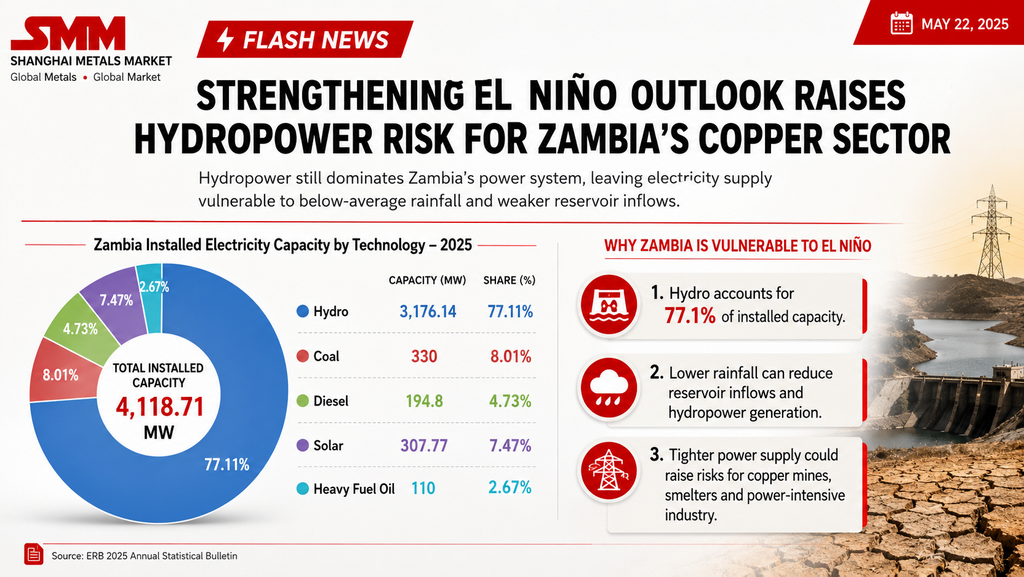
According to the Energy Regulation Board’s 2025 Annual Statistical Bulletin, Zambia had 4,118.71 MW of installed electricity generation capacity at the end of 2025. Hydropower accounted for 3,176.14 MW, or 77.11% of total capacity, followed by coal at 8.01%, solar at 7.47%, diesel at 4.73% and heavy fuel oil at 2.67%. This generation mix leaves electricity availability particularly sensitive to rainfall patterns and reservoir inflows.
The exposure is significant because Zambia’s copper-growth strategy will require substantially more electricity. The country is targeting annual copper production of 3 million tonnes by 2031, supported by mine expansions, new developments and additional processing capacity. Industry estimates indicate that approximately 2,000 MW of additional power capacity will be required to support the expansion of the mining sector and associated industrial demand.
El Niño therefore presents a potential constraint on both sides of Zambia’s copper-growth equation. While mining investment is increasing future electricity demand, prolonged rainfall weakness could simultaneously restrict output from the hydropower system that currently supplies more than three-quarters of installed generation capacity.
The experience of the 2023–24 drought illustrates this vulnerability. Weak rainfall and lower reservoir inflows sharply reduced hydroelectric generation, contributing to severe electricity shortages and increased reliance on imports and load-management measures. A repeat of similar conditions during the 2026–27 rainy season could again tighten the power balance as mining demand continues to rise.
The key issue for Zambia is therefore not simply expanding installed capacity, but increasing the resilience of the electricity system. Continued investment in solar, thermal generation, regional power imports, transmission infrastructure and other non-hydro sources will be increasingly important if the country is to insulate copper production growth from rainfall variability.
For the copper market, the strengthening El Niño outlook adds a potentially important supply-side risk to Zambia’s medium-term production ambitions. With hydropower still representing 77.1% of installed capacity and the mining sector requiring roughly 2,000 MW of additional power, the ability to diversify electricity supply could become a critical determinant of whether Zambia can translate its expanding project pipeline into the targeted 3 million tonnes of annual copper production.
![[Mingyi Electronics Launches High-Aspect-Ratio Gantry Line Electroplating Equipment for AI Servers and IC Substrates]](https://imgqn.smm.cn/usercenter/CaDcj20251217171711.jpg)
![US Inflation Exceeds Expectations, Combined with Inventory Buildup in China, Copper Prices Rebound Under Pressure [SMM Macro Weekly Review]](https://imgqn.smm.cn/usercenter/JnFuh20251217171711.jpg)