SMM News on August 18:
Metals market:
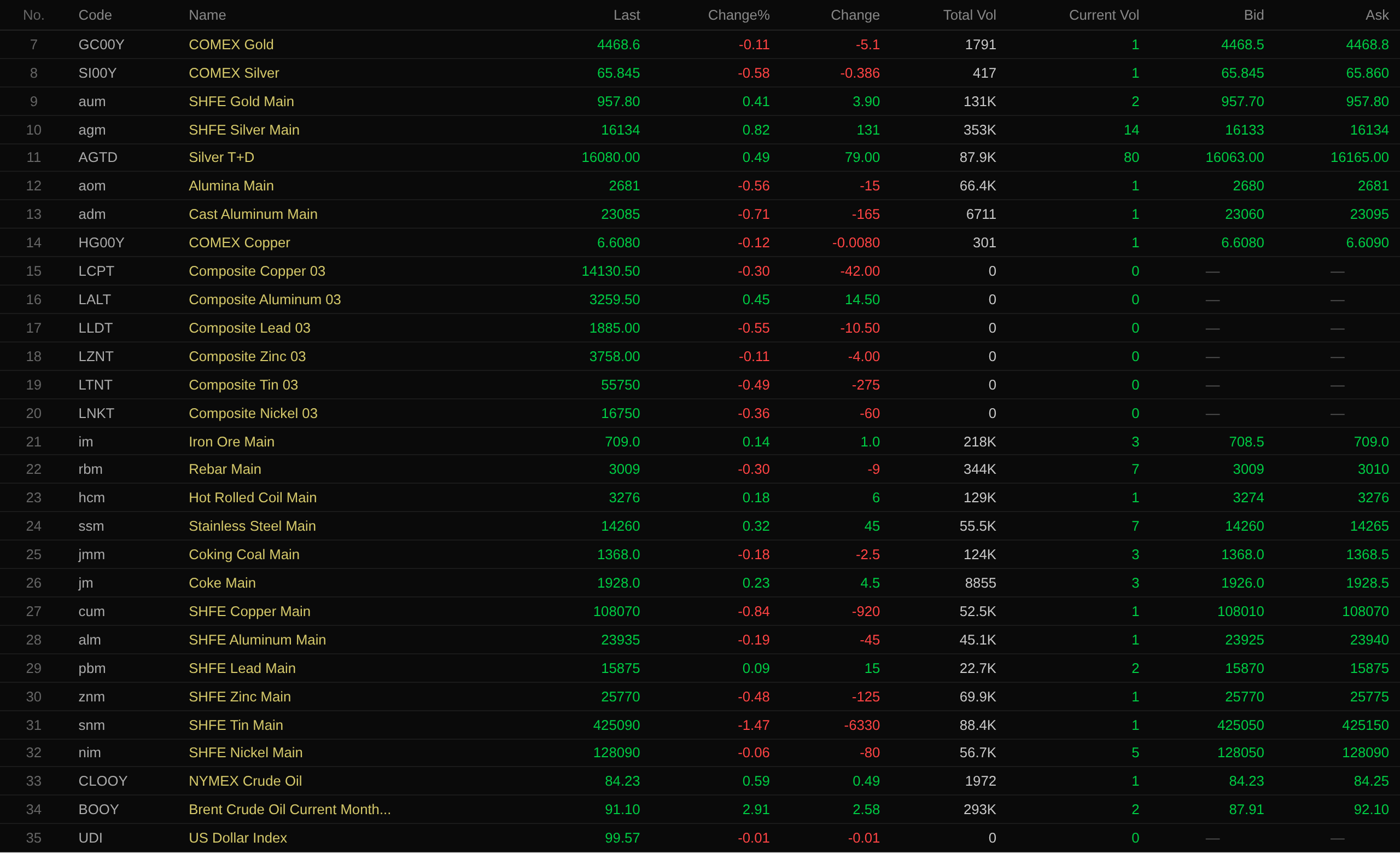
Overnight, base metals in the domestic market mostly fell. SHFE copper fell 0.84%. SHFE aluminum fell 0.19%. SHFE zinc fell 0.48%, and SHFE tin fell 1.47%. SHFE lead edged up, while SHFE nickel edged down. In addition, the most-traded alumina futures contract fell 0.56%, and the most-traded cast aluminum contract fell 0.71%.
Overnight, ferrous metals mostly rose. Stainless steel rose 0.32%, iron ore rose 0.14%, and rebar fell 0.3%. Hot-rolled coil rose 0.18%. Coking coal and coke: the most-traded coking coal contract fell 0.18%, while the most-traded coke contract rose 0.23%.
Overnight, in overseas metals, LME base metals mostly moved lower. LME copper fell 0.3%. LME aluminum rose 0.45%. LME lead fell 0.55%. LME zinc fell 0.11%. LME tin fell 0.49%. LME nickel fell 0.36%.
Overnight, precious metals:COMEX gold extended the previous trading day’s gains, rising 0.81%, while COMEX silver rose 1.22%. Overnight, the most-traded SHFE gold contract extended the previous trading day’s gains, rising 0.41%, and the most-traded SHFE silver contract rose 0.82%.
As of 7:16 on August 18, overnight closing quotes:
Macro front
China:
[The Ministry of Commerce and eight other departments issued a document to invigorate county-level consumption] The Ministry of Commerce and eight other departments released the “Opinions on Further Stimulating Vitality in Lower-Tier Markets and Invigorating County-Level Consumption,” which proposed accelerating the renewal of existing commercial facilities. It supports the upgrading and renovation of traditional department stores and aging shopping malls, and promotes optimized layout for branded chain stores, discount retail stores, and fresh e-commerce storefronts, among others. It will deepen the renovation and upgrading of the “1,000 markets and 10,000 stores,” support the construction and upgrading of township commercial and trade centers, (agricultural) trade markets, and distinctive township fairs, and carry out standardized and regulated construction and renovation of new-type convenience stores and village-level integrated postal and express logistics service stations.
[National Bureau of Statistics (NBS): January-July value-added industrial output above designated size nationwide grew 5.3%, and the national economy maintained a trend of newer drivers, better quality, and improving momentum] According to the National Bureau of Statistics (NBS): From January to July, under the strong leadership of the CPC Central Committee with Comrade Xi Jinping at its core, all regions and departments conscientiously implemented the decisions and arrangements of the CPC Central Committee and the State Council, adhered to the general principle of pursuing progress while ensuring stability, effectively responded to various external shocks and internal difficulties, focused on implementing more proactive and effective macro policies, and solidly advanced high-quality development. Production and supply grew steadily, employment and prices were generally stable, foreign trade resilience continued to stand out, new momentum grew and strengthened, and overall economic performance remained stable, continuing the development trend of newer momentum and a more optimized structure. From January to July, the value added of industrial enterprises above the designated size nationwide increased by 5.3% YoY. By three major sectors, value added increased by 2.5% YoY in mining, 5.6% in manufacturing, and 5.4% in the production and supply of electricity, heat, gas, and water. Value added in equipment manufacturing increased by 9.7% YoY, and value added in high-tech manufacturing increased by 13.8%, respectively 4.4 and 8.5 percentage points faster than overall industrial enterprises above the designated size.
[National Development and Reform Commission (NDRC) and National Energy Administration Issue the 15th Five-Year Plan for Oil and Natural Gas Development]The National Development and Reform Commission (NDRC) and the National Energy Administration issued the 15th Five-Year Plan for Oil and Natural Gas Development. It proposed that by 2030, China’s oil and gas supply will reach 440 million mt of oil equivalent; newly added long-distance oil and gas pipelines will total 20,000 km; the nationwide long-distance oil and gas pipeline network will reach 220,000 km; natural gas storage capacity will continue to increase, accounting for more than 13% of national consumption; LNG receiving terminals will have a receiving capacity of 200 million mt/year; the capacity for imported natural gas via onshore pipelines will reach 114 billion m³/year; and annual CO₂ injection under carbon capture and storage/carbon capture, utilization and storage (CCS/CCUS) will reach 10 million mt.
[NDRC Deploys Efforts to Accelerate the Deployment of New-Type Policy-Based Financial Instruments in 2026 and Increase Support for Private Investment Projects]On August 14, Yue Xiuhu, a member of the Party Leadership Group and Vice Chairman of the National Development and Reform Commission (NDRC), chaired a working meeting to deploy efforts to accelerate the deployment of new-type policy-based financial instruments in 2026 and increase support for private investment projects. Officials in charge from the development and reform commissions of some provinces, as well as officials from China Development Bank, the Export-Import Bank of China, the Agricultural Development Bank of China, and relevant departments and bureaus of the NDRC attended the meeting. Next, the NDRC will earnestly implement the decision-making and deployment of the CPC Central Committee and the State Council and, in active coordination with relevant parties, further accelerate all related work on the new-type policy-based financial instruments for 2026. (NDRC)
[Li Bin of the State Administration of Foreign Exchange: Since July, China’s Foreign Exchange Market Has Maintained Stable Operations]Li Bin, Deputy Administrator of the State Administration of Foreign Exchange, said in response to reporters’ questions on foreign exchange market conditions in July 2026 that since July, the external environment has been complex and volatile, geopolitical uncertainty has risen, and international financial markets have continued to fluctuate. China’s foreign exchange market has maintained stable operations, the scale of cross-border receipts and payments has expanded steadily, market expectations have remained generally stable, and foreign exchange trading has been rational and orderly. From the perspective of the scale of cross-border transactions, in July, total cross-border receipts and payments of non-bank sectors such as enterprises and individuals amounted to $1.7 trillion, up 20% YoY; foreign exchange market trading volume was $4.3 trillion, up 8% YoY, both remaining at relatively high levels. From the perspective of cross-border capital flows, in July, net cross-border capital inflows of $59.8 billion were recorded for non-bank sectors such as enterprises and individuals. Among these, net inflows under goods trade remained at a high level, while net outflows under services trade and items such as profit distributions and dividend payments by foreign-invested enterprises remained stable. From the perspective of foreign exchange market supply and demand, in July, banks recorded a surplus of $18.3 billion in foreign exchange settlement and sales. Enterprises conducted foreign exchange settlement and sales transactions rationally based on actual needs and changes in market conditions, and foreign exchange market supply and demand were basically balanced. (State Administration of Foreign Exchange)
US dollar:
Overnight, the US dollar index extended the declines of the previous two trading days, falling another 0.06% to 99.58. On Monday local time, US Treasury yields broadly moved higher. The 30-year Treasury yield, which is typically more sensitive to geopolitical events, rose by more than 4 basis points to 5.311%, the highest level since June 2007. The 10-year Treasury yield—the main benchmark rate for mortgages, auto loans, and credit card debt—rose by more than 2 basis points to 4.724%. The 2-year Treasury yield, which typically fluctuates in line with US Fed short-term rate decisions, rose by more than 1 basis point on Monday to 4.182%. Oil prices rose as the 60-day deadline for the peace agreement reached between the US and Iran was set to expire on Monday, and Iran had ruled out the possibility of extending the deadline. Investors were awaiting the release of the US Fed meeting minutes later this week to gain further insight into the US Fed’s latest monetary policy decision and the future path of interest rates. At its July 29 meeting, the US Fed voted 9–3 to keep rates unchanged in the 3.50% to 3.75% range. The three dissenting committee members—Hammack, Kashkari, and Logan—called for a 25-basis-point rate hike.
According to CME “FedWatch”: the probability that the US Fed will keep rates unchanged through September was 65%, and the probability of a cumulative 25-basis-point hike was 35%. The probability that the US Fed will keep rates unchanged through October was 51.4%, the probability of a cumulative 25-basis-point hike was 41.3%, and the probability of a cumulative 50-basis-point hike was 7.4%.
Citadel Securities said that after inflation remained above target for an extended period, the US Fed’s continued reluctance to tighten monetary policy had kept long-term bond yields at multi-year highs and posed broader risks to the overall market. Noshad Shah, Head of Fixed Income Sales for Europe, the Middle East and Africa at Citadel Securities, said that although the policy rate was already 175 basis points below its peak, long-term US Treasury yields remained at their highest level in nearly 20 years. Shah said: “In my view, this reflects the market’s belief that, whether it is the US Fed or the fiscal authorities, when policymakers face difficult choices, they often tend to choose the easier path. “As long as this situation persists, it will continue to pose risks to the broader market.” On Monday, the US 30-year Treasury yield climbed to a 19-year high, breaking above 5.28%. Data released last week showed that both inflation and consumer demand had slowed down, prompting the bond market to scale back expectations for a US Fed interest rate cut in September. Shah warned that the recent improvement in inflation and the weakening labor market should not be interpreted as meaning interest-rate risks had been removed. He noted that more than 55% of core goods prices were still rising. As a result, he believed the US Fed’s policy meeting next month would be a “dead heat.”
Goldman Sachs Group said that, with US inflation cooling, expectations for US Fed interest rate hikes remained overly aggressive. Goldman’s chief economist Jan Hatzius wrote in a report that given weak retail sales, disappointing employment data, and continued slowing in inflation, the likelihood of the US Fed raising rates at its September meeting was “very low”. Hatzius wrote: “Based on our baseline economic forecast, over time, the probability that inflation data will improve further is higher than the probability that it will deteriorate again. We still believe the market’s pricing of the federal funds rate is too hawkish.” Data showed that the market had pushed back expectations for the next 25-basis-point US Fed rate hike to January next year, whereas a week earlier the market had fully expected the US Fed to hike in December. Goldman believed that, although market pricing was no longer as hawkish, there was still room for expectations for rate hikes to fade further. (Jin10 Data)
On the macro front:
Today will see the release of the UK three-month ILO unemployment rate for June, the UK unemployment rate for July, the UK claimant count for July, Germany’s ZEW Economic Sentiment Index for August, the eurozone ZEW Economic Sentiment Index for August, the weekly change in US ADP employment for the week ending August 1, US housing starts (annualized) for July, total US building permits for July, the US import price index (month-on-month) for July, US industrial output (month-on-month) for July, and the US pending home sales index (month-on-month) for July, among other data. In addition, watch for: Xiaomi Group’s earnings conference call; Baidu’s earnings conference call.
On crude oil:
Overnight, both crude oil futures extended the previous session’s gains and continued to rise, with WTI up 3.09% and Brent up 2.91%. The US-Iran memorandum of understanding signed in June this year technically expired on Monday.
With the US-Iran ceasefire expiration escalating tensions, oil prices strengthened. According to CCTV News, on August 17 local time, US President Trump made it clear that he was not seeking to extend the memorandum of understanding with Iran, and said there was “no timetable” for resolving the Iran issue, adding that he was “not in a hurry.”Iran issued a tough response in tandem. US Energy Secretary Wright said the US would “fight a long war” against Iran, and Treasury Secretary Bessent hinted that new economic sanctions are expected to be introduced soon. Russia, meanwhile, has faced fuel shortages after sustained strikes on refineries in Ukraine, with gasoline rationing implemented in two regions. Arne Lohmann Rasmussen, chief analyst at Global Risk Management, said that more oil being shipped through the Strait of Hormuz, combined with the US shift toward economic sanctions, is depressing the geopolitical premium and capping upside room for oil prices; however, the strategy of economic pressure means the strait could be closed for months. (Wallstreetcn)
Saudi Arabia is providing oil supplies loaded near the coast of Oman, suggesting the country may be following the UAE’s lead by transshipping more crude oil through the Strait of Hormuz. According to people familiar with the matter, Saudi Aramco is offering crude cargoes loaded at locations such as Sohar in the Gulf of Oman via ship-to-ship transfers. The cargoes involved are Arab Medium and Arab Heavy crude, implying the crude is highly likely to originate from the Persian Gulf. Saudi Aramco CEO Nasser said in March that the Yanbu pipeline mainly carries Arab Light and Arab Extra Light crude. He said at the time that the country’s offshore oilfields are primarily located in the Persian Gulf and constitute the country’s supply of medium and heavy oil. Saudi Aramco declined to comment on the above information. (Jinshi Data APP)
![PPI Cooling Benefited Digestion, 428,000 Became the New Battleground Pivot [SMM Tin Morning News]](https://imgqn.smm.cn/usercenter/iLVGs20251217171753.jpg)
![Routine Procurement Demand Rebounded on the Consumption Side, While Supply Increased and Decreased in Parallel; Lead Prices Maintained a Fluctuating Trend [SMM Lead Morning Meeting Minutes]](https://imgqn.smm.cn/usercenter/XMxKT20251217171720.jpeg)
![[Geely Auto: Li Shufu Appointed Lifetime Honorary Chairman, An Conghui Appointed Chairman of the Board]](https://imgqn.smm.cn/usercenter/tSwaX20251217171735.jpg)