Aluminum Alloy Futures and Spot Prices Fell Together; ADC12 to Move Sideways in the Short Term [ADC12 Daily Price Review]

Published: Aug 13, 2026 13:18
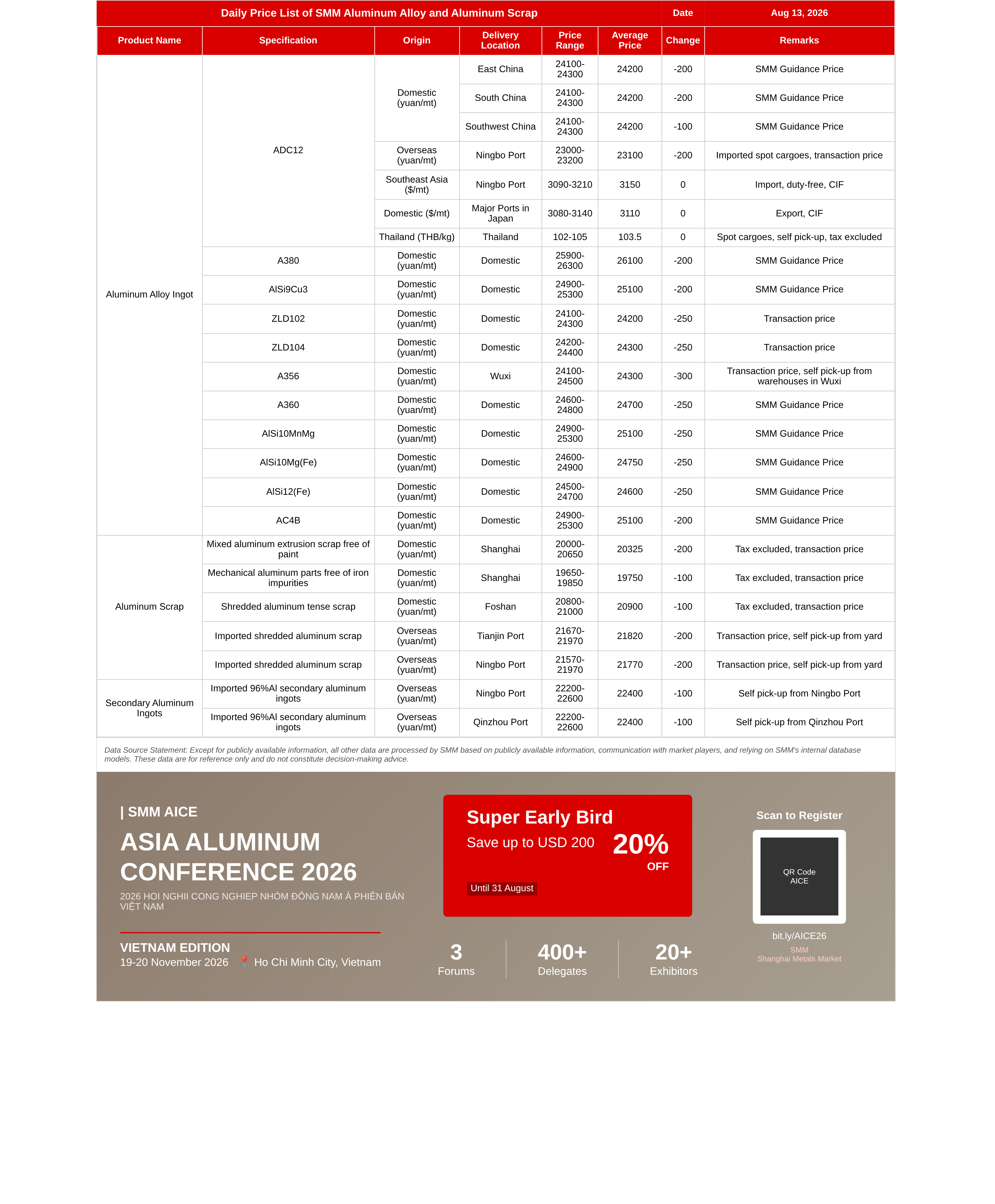
[ADC12 Daily Price Review: Aluminum Alloy Futures and Spot Prices Fall in Tandem; ADC12 to Move Sideways in the Short Term] Today, aluminum alloy market quotes were broadly lower, with the SMM ADC12 price revised down by 200 yuan/mt. The pullback in futures further dampened spot market sentiment, and enterprises generally followed suit by lowering their quotes.

Futures side: The aluminum alloy 2610 contract opened at 23,500 yuan/mt today; after edging slightly higher in early trading, it pulled back under pressure and drifted lower overall, with the decline widening somewhat intraday. It closed at 23,355 yuan/mt at midday, down 1.33%. On the 4-hour chart, it retreated after a rapid rise and formed a long upper shadow candlestick; the previous upward pace was interrupted, near-term overhead resistance became more evident, and the market shifted from a relatively strong tone to a consolidation and correction pattern.

Spot sideAluminum alloy market offers were broadly lower today, with the SMM ADC12 price lowered by 200 yuan/mt. The pullback in futures further dampened spot market sentiment, and enterprises generally followed by lowering their offers. Downstream demand is still in the off-season, with some enterprises still on high-temperature holidays or running at reduced loads; end-user orders and procurement demand are weak, and the spot market lacks sustained upward momentum. Cost side, however, there is still some support: aluminum scrap prices remain relatively high overall, leaving enterprises with relatively limited room to cut prices further. On the upside, the market lacks demand drivers, while on the downside it is constrained by costs. ADC12 prices are expected to move sideways in the near term.

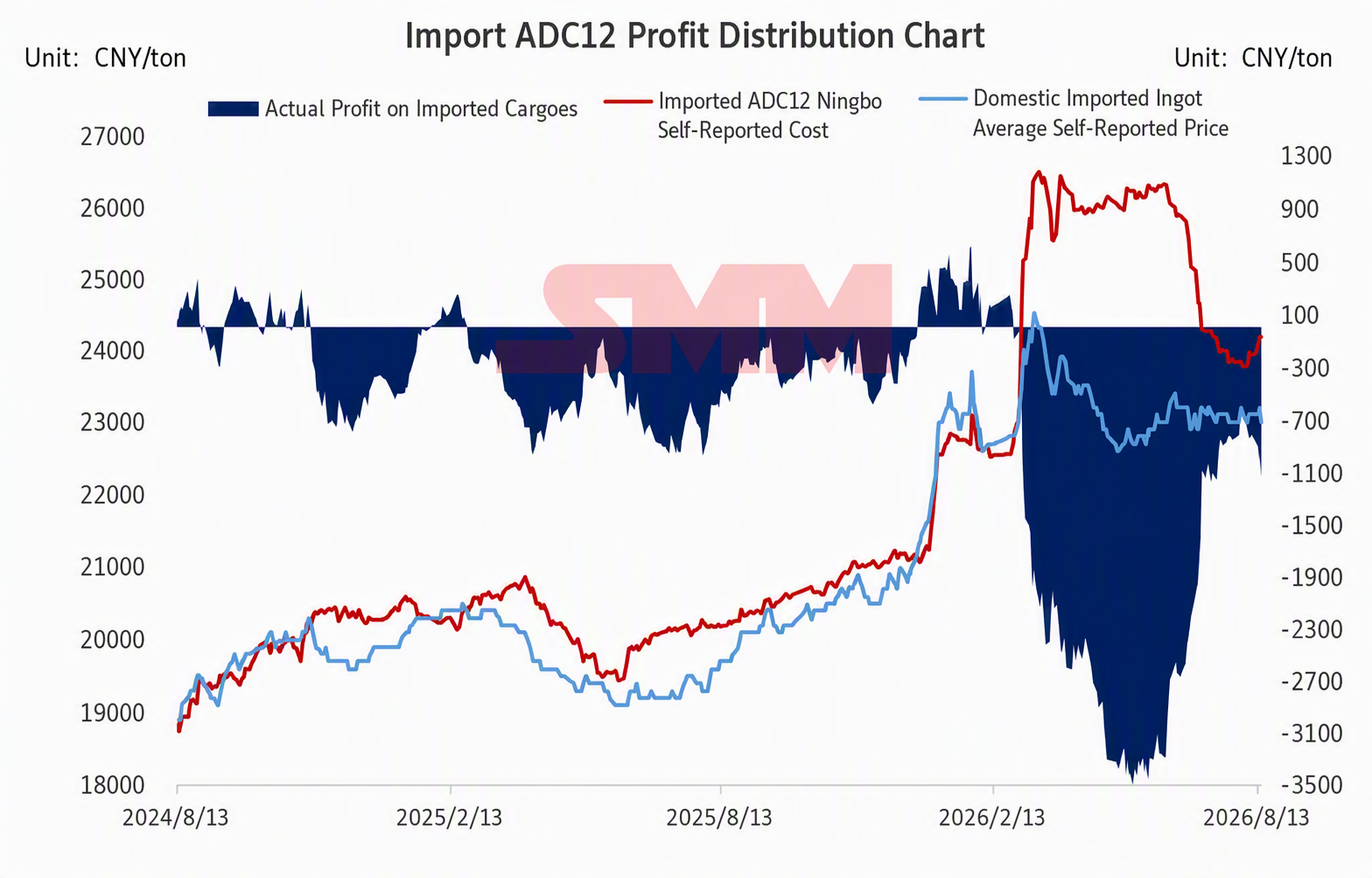
Import side, overseas ADC12 offers have pulled back slightly to $3,090–$3,120/mt, a smaller decline than in China, causing the immediate import loss to widen again to around 1,000 yuan.


Data Source Statement: Except for publicly available information, all other data are processed by SMM based on publicly available information, market communication, and relying on SMM's internal database model. They are for reference only and do not constitute decision-making recommendations.

Images in this article contain AI-translated captions for reference only.

For any inquiries or for more information, please contact: lemonzhao@smm.cn
For more information on how to access our research reports, please contact:service.en@smm.cn
Related News
[SMM Flash] Rising Chinese Ferrochrome Output Adds to South Africa's Smelting Recovery Challenge
15 hours ago
[SMM Flash] Rising Chinese Ferrochrome Output Adds to South Africa's Smelting Recovery Challenge
Read More
[SMM Flash] Rising Chinese Ferrochrome Output Adds to South Africa's Smelting Recovery Challenge
[SMM Flash] Rising Chinese Ferrochrome Output Adds to South Africa's Smelting Recovery Challenge
Merafe Resources' latest results highlight the growing competitive challenge posed by China's expanding ferrochrome industry as South African producers seek to restore smelting capacity. Merafe's market review shows that Chinese ferrochrome output increased by more than 6% in 2025 to approximately 9.5 million mt, accounting for around 60% of global supply, while South African production declined by about 50%. The company attributed China's growth to the commissioning and higher utilization of lower-cost smelting capacity, particularly in the second half of 2025. For South Africa, the recovery of ferrochrome smelting therefore remains dependent not only on improving energy costs but also on global demand and the competitive supply environment. Merafe states that the medium- to long-term viability of its smelting operations requires materially lower energy costs together with sustained improvement in global ferrochrome and steel demand and prices. SMM sees China's expanding, lower-cost ferrochrome capacity as an important factor that South African producers will need to consider as idled capacity gradually returns.
15 hours ago
[SMM Flash] South African Chrome Ore Traders Sound Alarm Over Widening Local Price Disconnect with International Buyers
17 hours ago
[SMM Flash] South African Chrome Ore Traders Sound Alarm Over Widening Local Price Disconnect with International Buyers
Read More
[SMM Flash] South African Chrome Ore Traders Sound Alarm Over Widening Local Price Disconnect with International Buyers
[SMM Flash] South African Chrome Ore Traders Sound Alarm Over Widening Local Price Disconnect with International Buyers
A growing gap between local prices and what international buyers are offering has become a mounting concern among South African chrome ore traders, with industry participants warning that the market is being skewed by pricing benchmarks that do not reflect the true cost structures of reliable, large-scale operations. Several traders have told SMM that international buyers are increasingly anchoring their offers to prices set by smaller traders operating low-cost wash plants. These smaller operations have significantly lower overheads and can afford to sell at levels that bear little resemblance to the actual production and logistics costs borne by larger, more established producers. Traders stress that international buyers are treating these low-end prices as market benchmarks without distinguishing between the vastly different value propositions offered by small-scale suppliers versus major operations backed by large, secure mines. Traders representing partnerships with big South African chrome ore mines point to key value-adds that justify a premium over low-cost wash-plant supply — value-adds they feel are being systematically overlooked. These include stronger quality assurances, greater resilience in supply continuity during adverse conditions, and the ability to sign firm contracts guaranteeing fixed volumes on consistent, agreed schedules such as weekly deliveries. Moisture content, a recurring buyer concern, was highlighted as an area where established operators can offer greater control and reliability — a point given added relevance by the severe winter weather that has recently hit South Africa, with a cold front and cut-off low pressure system bringing heavy snow, disruptive rain, strong winds and freezing temperatures across parts of the country. The broader concern among South African traders is that international buyers are not adequately factoring operations costs, operational stability, supply certainty, and quality assurance into their pricing decisions. With the gap between low-cost, smaller-scale supply and premium, large-scale production widening, traders are calling for greater market awareness of the cost realities and service levels that differentiate reliable, long-term partners from spot-market players offering bargain prices without the same commitments.
17 hours ago
[SMM Express] Higher Prices Drove Merafe's Doubled H1 2026 Profit as Ferrochrome Inventory Drawdown Offsets Lower Output
22 hours ago
[SMM Express] Higher Prices Drove Merafe's Doubled H1 2026 Profit as Ferrochrome Inventory Drawdown Offsets Lower Output
Read More
[SMM Express] Higher Prices Drove Merafe's Doubled H1 2026 Profit as Ferrochrome Inventory Drawdown Offsets Lower Output
[SMM Express] Higher Prices Drove Merafe's Doubled H1 2026 Profit as Ferrochrome Inventory Drawdown Offsets Lower Output
Merafe Resources' full H1 2026 results, released 11 August, show profit more than doubling to R512 million from R233 million a year earlier, with HEPS up 64% to 20.7 cents and revenue up 36% to R3.43 billion. The board quadrupled its interim dividend to 16 cents a share, from 4 cents, as net cash from operations swung to R976 million from R175 million utilized a year earlier. Merafe attributed the earnings increase to higher commodity prices and higher volumes sold over the period. The results disclose sales volumes for the first time, revealing how those volumes held up despite a 75% collapse in ferrochrome production, to 28,000 tonnes. Ferrochrome sales fell just 4% to 73,000 tonnes, a gap that can only be explained by Merafe drawing down existing finished ferrochrome stock built up in H1 2025, when production of 112,000 tonnes had far outpaced that period's sales of 76,000 tonnes. Chrome ore told a different story: production of 425,000 tonnes still exceeded sales of 380,000 tonnes, meaning ore inventory kept growing, even as the 75% jump in ore sales volumes from 217,000 tonnes a year earlier helped underpin revenue. The group also reported no fatalities, a 24% improvement in its injury frequency rate to 1.36, and net asset value up 7% to R5.03 billion. Together, the figures confirm that firmer pricing, not fresh production, was the primary driver of Merafe's H1 2026 earnings, with the ferrochrome inventory drawdown specifically helping bridge the gap between what the venture produced and what it sold.
22 hours ago
Register to Continue Reading
Gain access to the latest insights in metals and new energy
Already have an account?Sign in here
Aluminum Alloy Futures and Spot Prices Fell Together; ADC12 to Move Sideways in the Short Term [ADC12 Daily Price Review] - Shanghai Metals Market (SMM)