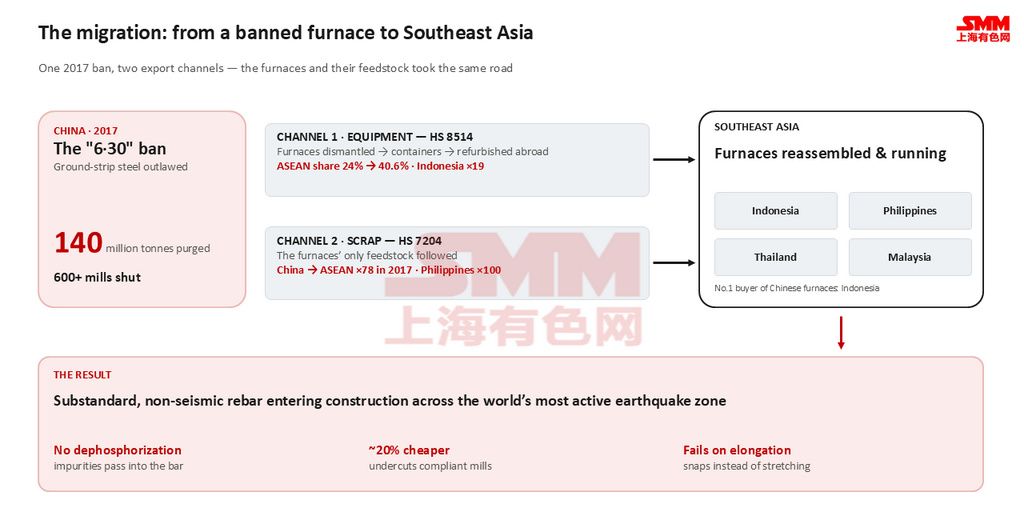
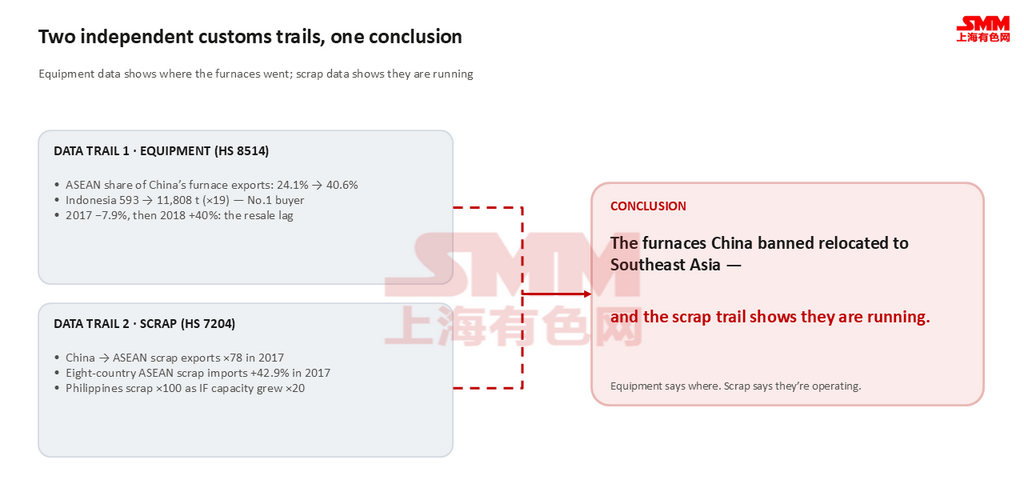
In 2017, China used a hard "June 30" deadline to purge roughly 140 million tonnes of "ground-strip steel" (ditiaogang) capacity — more than the combined annual crude steel output of the United States and Germany. But the furnaces did not disappear. Customs data tells the rest: after the ban, Southeast Asia's share of China's electric-furnace equipment exports climbed as high as 40.6%, and Indonesia's imports rose roughly 19-fold over eight years to become the world's No. 1 destination. In parallel, China's scrap exports to Southeast Asia surged 78-fold in 2017, and the Philippines' scrap imports expanded about a hundredfold over the same period. Two data trails — equipment and feedstock — point to the same fact: the induction furnace, which China classified as "backward capacity that must be eliminated", is rebuilding its supply chain on Southeast Asia's seismic belt.
1. Where the induction furnace came from: a technology with no original sin
The induction furnace (the medium-frequency induction furnace) is not, in itself, "bad technology". The principle of induction heating was proposed in the late 19th century, and in 1916 the American engineer Edwin Northrup built the first coreless induction melting furnace. It heats fast, takes little space and is cheap to install; its legitimate uses — foundry casting, specialty alloys and small-batch special steel — remain both legal and necessary worldwide.
The problem is where it was misused. From the 1980s and 1990s onward, large numbers of small township mills in China used induction furnaces to melt scrap directly and cast it straight into rebar, with no refining at all — this is "ground-strip steel". An induction furnace could be set up for a few million yuan, and many ran on the urban fringe, producing steel the moment the power was switched on. By the eve of the ban, this shadow output accounted for an estimated 4–7% of China's total steel production and consumed about 55 million tonnes of scrap a year, yet appeared in almost no official statistics. Using a small furnace meant for casting to mass-produce, in violation of the rules, construction rebar that carries the highest safety requirements inevitably led to an intrinsic loss of quality control.
2. Why China moved so hard: purging about 140 million tonnes in one campaign
From December 2016, Jiangsu, Hebei, Shandong and Sichuan launched successive dismantling drives; in January 2017 the central government set the "June 30" deadline and paired it with a starve-them-out package: barring scrap from flowing to induction-furnace mills, halting bank lending, requiring province-by-province reporting of offending companies, and holding officials personally accountable. The result was a one-off clearance rare in the history of steel: more than 600 companies shut and roughly 140 million tonnes of capacity eliminated.
The market reaction confirmed the scale of this hidden capacity. On the day the deadline was announced, rebar and iron-ore futures ran straight to their daily limits; and once the induction furnaces stopped en masse, scrap prices — having lost their biggest buyer — slid steadily, with the scrap price index falling to RMB 1,547.6/tonne by late May 2017 (about USD 225/tonne at that year's exchange rate), down more than 15% year on year. The reasons China acted so decisively — loss of quality control, bad steel driving out good, pollution and building safety — are precisely what Southeast Asia is living through today.
3. Trail one — the furnaces went overseas: equipment migration in the customs data
Capacity was cleared, but the furnaces were not all destroyed. China's customs data for HS 8514 (industrial electric furnaces) leaves a complete record of this equipment migration. Southeast Asia's share of China's exports in this category rose systematically — from 24.1% in 2017 to a peak of 40.6% in 2021, and still 31.5% in 2025 — while export value to the region climbed from USD 28.8 million in 2017 to USD 125.3 million in 2025.
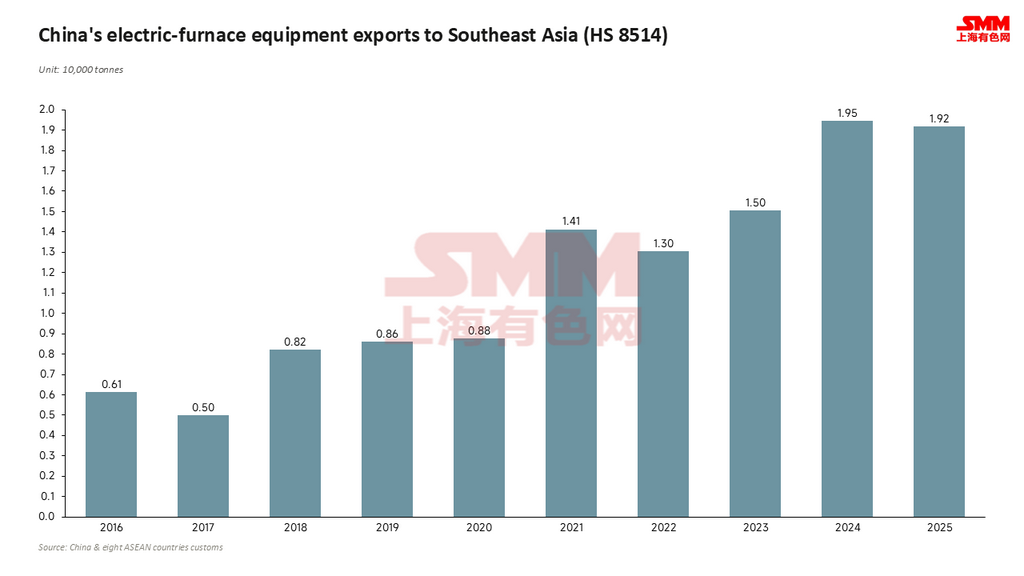
The timing is telling: in 2017, the year of the ban, export volume actually fell (−7.9%), then jumped 40% in 2018. By destination, Indonesia was the world's largest buyer of Chinese electric-furnace equipment over 2017–2025: a cumulative 56,000 tonnes, more than second-place Kazakhstan and third-place India combined. Its annual intake rose from 593 tonnes in 2017 to 11,808 tonnes in 2025, roughly 19-fold in eight years. Thailand's imports spiked to 4,125 tonnes in 2024 .
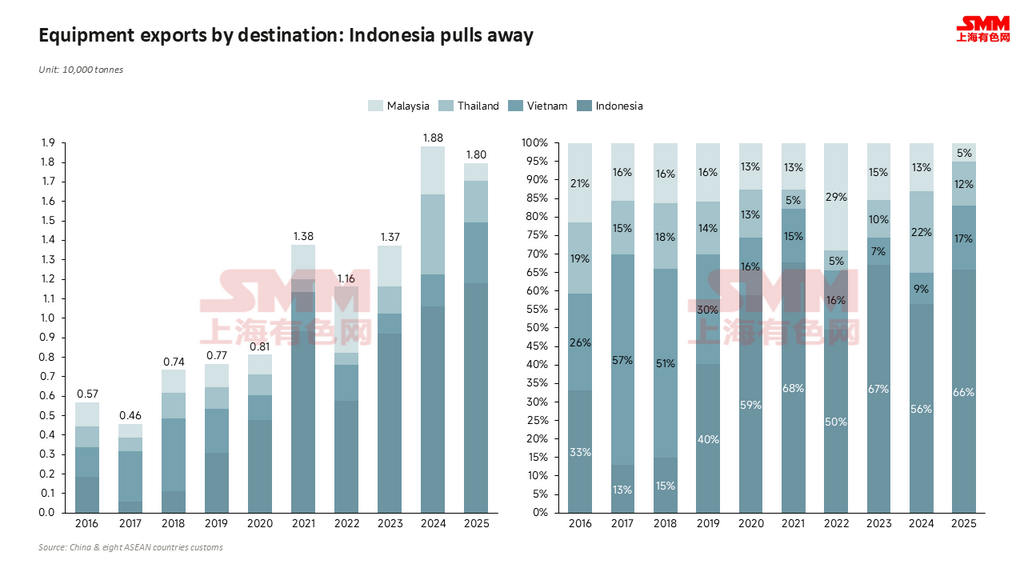
A note on scope: HS 8514 is a four-digit code covering all kinds of industrial electric furnaces (including legitimate foundry and specialty-steel induction furnaces), and second-hand equipment is often declared as parts. The data is therefore a proxy for equipment flows rather than a precise induction-furnace export volume — but its post-ban structural rise and destination mix corroborate the timeline of each country's induction-furnace build-out.
4. Trail two — scrap follows the furnace
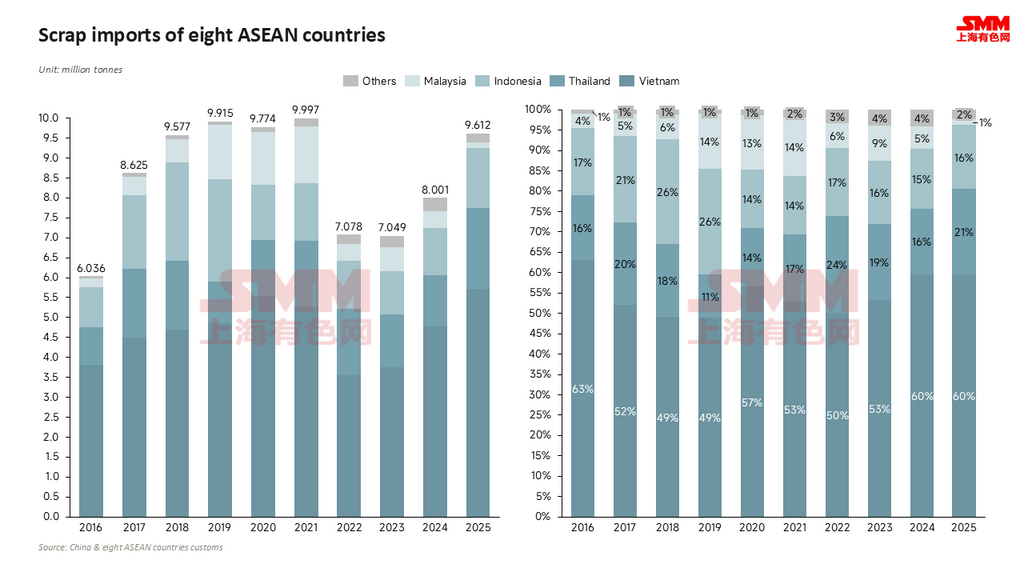
An induction furnace's only input is scrap. If equipment data shows where the furnaces are, the scrap trade is real-time evidence that the furnaces are running. Import data for HS 7204 from eight Southeast Asian countries gives two strong signals.
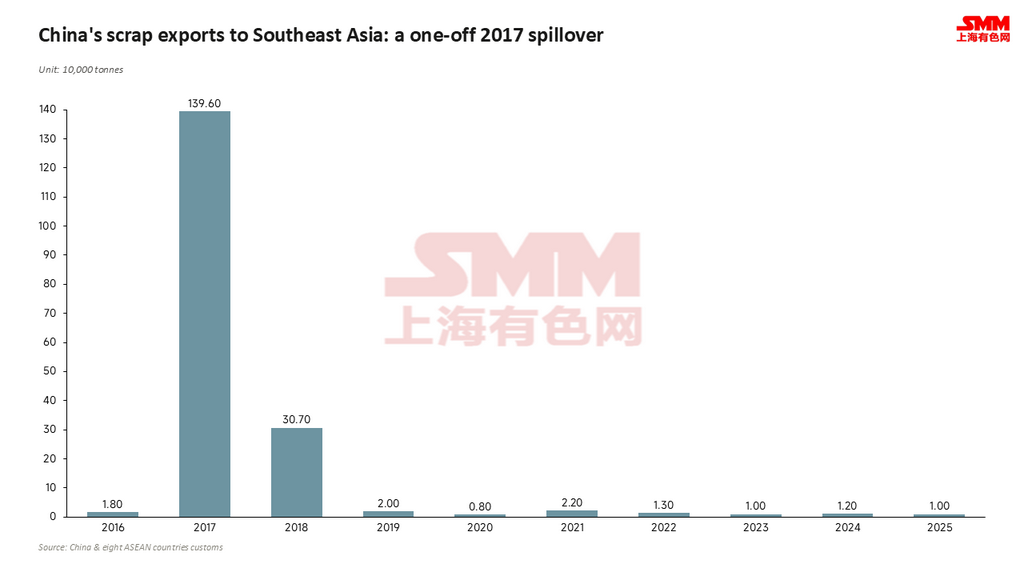
Signal one: China's one-off scrap spillover in 2017. China's scrap exports to Southeast Asia were just 18,000 tonnes in 2016, then surged to 1.396 million tonnes in 2017 — about 78-fold; they fell back to 307,000 tonnes in 2018 and to near zero from 2019. The scrap that lost its buyers when ground-strip steel was shut down flowed out in the same year, and in the same direction, as the second-hand equipment.
That same year, total scrap imports by the eight Southeast Asian countries jumped from 6.036 million tonnes to 8.625 million tonnes, up 42.9%, and have since held a 7–10 million tonne plateau.
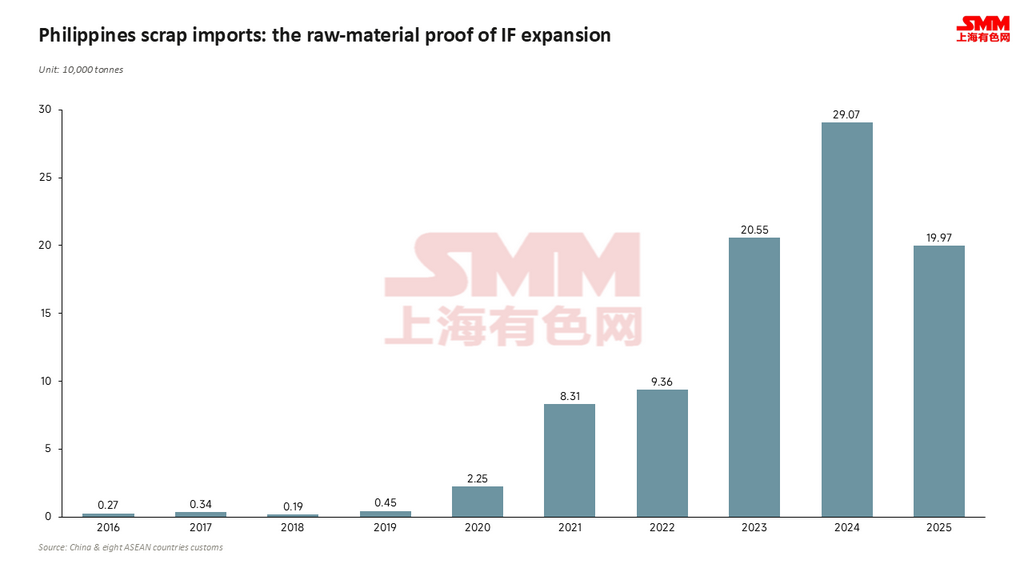
Signal two: the Philippines' raw-material corroboration. Philippine scrap imports ran below 5,000 tonnes a year in 2016–2019, reached 83,000 tonnes in 2021, and surged to 291,000 tonnes in 2024 — roughly a hundredfold in eight years. Over the same span, the Philippine Iron and Steel Institute (PISI) estimates induction-furnace capacity grew from under 150,000 tonnes in 2017 to about 3 million tonnes in 2025. The raw-material curve and the capacity curve fit precisely. More seriously, global and regional scrap supply is set to stay in tight balance for a long time to come; the induction furnaces' frenzied scrap-buying in Southeast Asia is badly overdrawing the region's limited scrap resources and directly raising the raw-material barrier for compliant steelmaking capacity.
5. What sets it apart from proper steelmaking: the missing “refining” step that decides life and death
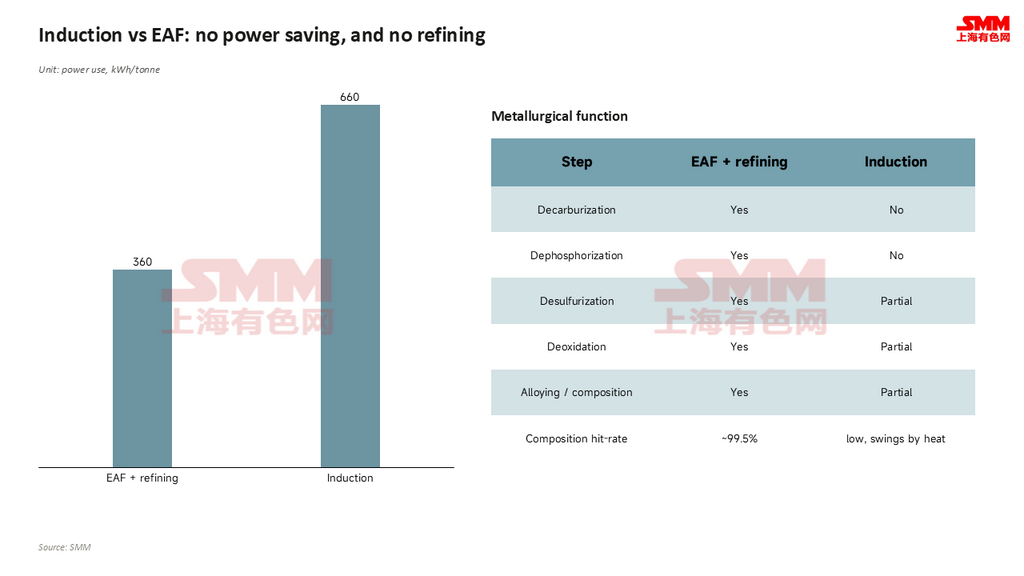
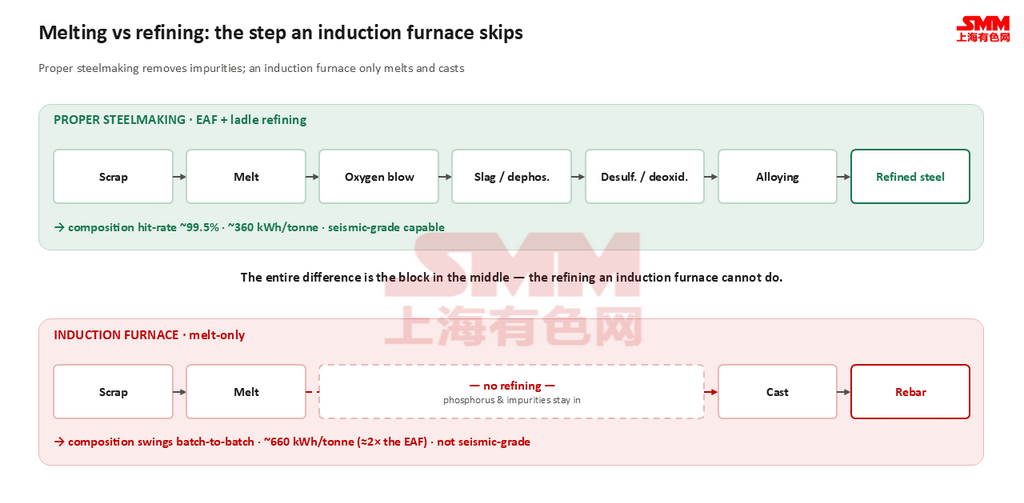
Proper steelmaking — the blast-furnace/converter or electric-arc-furnace (EAF) route — is about refining, not merely melting: oxygen blowing, slagging, dephosphorization, desulfurization, deoxidation, alloying and ladle refining, locking composition precisely into the standard band. A modern compliant EAF can also flexibly adjust the mix of scrap and hot metal in response to environmental limits and cost. An induction furnace, by contrast, has no such elasticity and can only melt the scrap and pour it out: the process cannot dephosphorize or decarburize, so impurities pass into the rebar untouched, and the final composition swings sharply with the quality of each heat of scrap. Industry benchmarking shows an EAF-plus-refining composition hit-rate above 99.5%, while the induction furnace's is low; within a single batch of rebar, some bars meet spec and others snap when bent — and the eye cannot tell them apart.
More ironically, it does not even save power: under comparable conditions an induction furnace uses about 660 kWh per tonne of steel, nearly double the EAF's roughly 360 kWh. Its low cost never came from technology, but from the refining it skips, the environmental equipment it lacks, and gray-market operation beyond the reach of regulators. That is why what an induction furnace sends to market can only be low-quality steel — off-spec in composition and lacking seismic performance.
6. Three kinds of damage to the Southeast Asian market
- Safety: Southeast Asia sits on the Pacific Ring of Fire. The industry consensus is unambiguous: seismic-grade rebar cannot be produced by the induction-furnace process.
- Market: Induction-furnace steel sells for about 20% less than compliant EAF rebar. The four major ASEAN economies are in a fast phase of heavy infrastructure and investment, with intense demand for construction steel. Thailand has 4.3 million tonnes of EAF capacity against domestic demand of only 2.8 million tonnes, yet induction furnaces are still taking share; in Indonesia, of some 150 rebar mills, induction-furnace steel accounts for at least half of 8–9 million tonnes of annual output, and only 10–20 mills deliver consistent quality. Regional rebar margins are already thin — SMM data put southern Vietnam's CB300V at about USD 533/tonne ex-works in August 2026, against Chinese export offers of just USD 476–478/tonne FOB Tianjin — and further undercutting by cheap, low-quality steel leaves compliant capacity almost no room to survive.
- Governance: Pollution shifts to weakly regulated areas; gray-market tactics — passing certification with good samples while selling substandard product, calibrating quality to a project's prominence, dumping rejects in outlying provinces — are exported along with the equipment, eroding the credibility of local standards regimes.
Even under external pressures such as the EU's Carbon Border Adjustment Mechanism (CBAM), Southeast Asia's existing blast-furnace/basic-oxygen (BF-BOF) long-process assets will not be shut down as a result. Since long-process and compliant short-process routes will long coexist as the absolute backbone of Southeast Asian steel capacity, the low cost the induction furnace derives from no abatement, no refining is not merely undercutting the EAF — it is indiscriminately damaging the entire region's industrial upgrading, decarbonization and compliant market order.
7. The real bottom line: seal off low-quality steel and defend the building “lifeline”
China wrote the answer with two decades of hard lessons and a single clearance of about 140 million tonnes of capacity: for substandard steel operating outside the standards, spot checks, fines and sales restrictions treat the symptom, not the disease. The cost advantage the induction furnace draws from no refining, no abatement lets it dump product on terms grossly unfair to compliant capacity. But more lethal than market disruption is its hidden damage to public safety — these steels' defects are buried in elongation and yield strength, invisible in normal times and revealed only under extreme forces such as an earthquake, in the form of fracture and collapse.
For Southeast Asia — one of the most seismically active regions on Earth — policy must return to the bottom line for building materials: zero tolerance for low-quality steel. From Thailand's revocation of certification for induction-furnace steel, to the Philippines' repeated calls to implement the updated PNS 49 standard, to Indonesian industry's vigilance against SNI certification fraud, a regional consensus is taking shape.
Sealing off low-quality steel completely has become a question the countries of Southeast Asia can no longer decline to answer.
![[SMM Analysis] Indian flat steel demand supports record JSW sales as coal costs squeeze margins](https://imgqn.smm.cn/usercenter/LMnqz20251217171717.jpg)
![Magnesium Prices Fall Nearly 14% in Over Half a Year, Hitting Yearly Low; Low-Priced Supply Hard to Find Support for Rebound [SMM Commentary]](https://imgqn.smm.cn/usercenter/UhBXJ20251217171724.jpeg)