1. Transmission Panorama: A Three-Tier Price Transmission Chain from High-End to Mid-End
The demand transmission path in the current computing power leasing market has clearly revealed itself as three steps:
First tier (B300 → H200): B300’s anchorless high price and opaque transaction information → high-end demand spills over to H200, driving H200 lease prices persistently higher;
Second tier (H200 → Pro 6000): H200 undersupply with lease terms locked at three years minimum → capital investors in computing power projects begin to eye Pro 6000 and Pro 6000D workstation-level GPUs;
Third tier (Pro 6000D → 4090/5090): The mid-end market below Pro 6000 faces dual supply pressure from existing 4090s and incremental new 5090s → limited price increase, transmission blocked.
SMM Analysis:The core driving force of this transmission chain is not an equivalent shift in demand, but rather that scarce high-end supply forces demand to "seek substitutes" at each level—every tier of transmission is accompanied by performance compromises and price concessions, and transmission efficiency depends on the supply elasticity of the next tier.
2. First-Tier Transmission: B300 Price Vacuum, H200 Becomes New Anchor for High-End Demand
Nvidia B300 server quotes have remained high, yet the market has consistently lacked a verifiable price anchor. B300 discussion remains hot across the industry chain, but publicly available sources on actual transaction information are extremely limited. A fierce tug-of-war between buyers and sellers has left the market in a degree of chaos. This state of being "priced but not traded" or "anchorless high price" is the direct driver of demand spilling over to H200.
As the performance pinnacle of the Hopper architecture, H200 has rapidly entered the sights of computing power lessors and demand parties:
Full-machine purchases: Spot market quotes for H200 HGX full-machine purchases reached approximately 5 million yuan/unit in early August 2026. Through data collection, SMM understands that actual transaction prices for spot purchases of H200 HGX servers are around 4.6 million yuan/unit. On July 30, quotes for spot PCIe versions of H200 were in the range of 3.45 million to 3.5 million yuan. In the Hong Kong market, the per-card quote for H200 PCIe is about $43,000.
Lease prices continue to climb: On August 3, H200 lease prices in the Guizhou region reached 120,000 yuan/unit/month; by August 10, quotes for similarly configured (non-networked) H200 leases in the Sichuan region further rose to 130,000 yuan/unit/month.
Undersupply: In late July, a large server leasing company in Hangzhou stated that all its H200 servers had been fully leased recently, with supply falling short of demand, and no resources would be available until next year at the earliest.
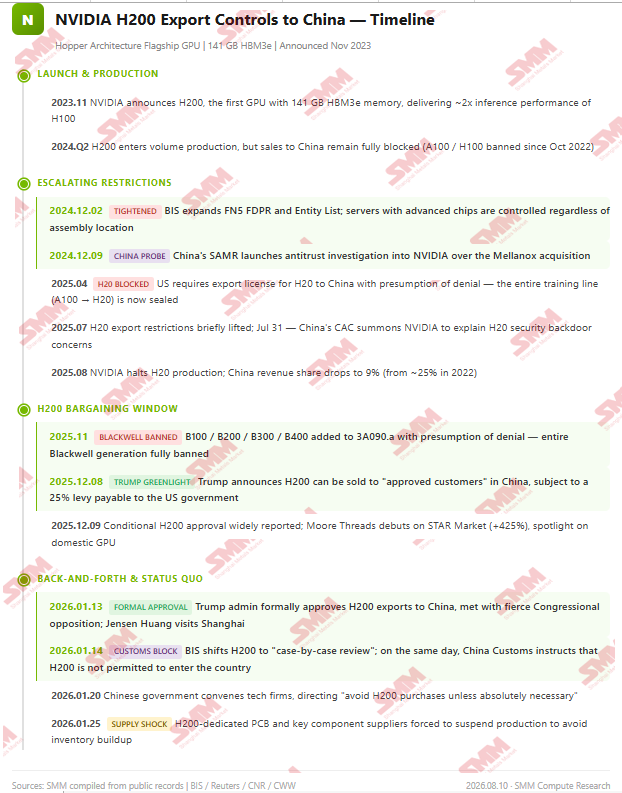
A rough back-calculation based on a three-year lease cycle payback: 130,000 yuan/unit/month × 36 months = 4.68 million yuan, which is broadly consistent with the previously mentioned actual purchase transaction price of 4.6 million yuan, indirectly confirming that the current lease price level is not artificially high but a reflection of the genuine supply-demand relationship.
In mid-July 2026, an unconfirmed rumor circulated among server leasing intermediaries: approximately 10,000 H200 servers were awaiting customs clearance in Hong Kong. The market had temporarily expected that the entry of these H200s would sharply depress domestic computing power lease prices and B300 purchase prices. However, H200 lease prices rose instead of falling, indirectly indicating that the entry progress of these H200s has not been smooth so far.
SMM View:The persistent rise in H200 lease prices reflects the structural reality of the high-end computing power market from two dimensions—on the demand side, computing power needs for AI training and inference are still accelerating; on the supply side, B300 struggles to form effective supply and H200 market entry is hindered, meaning effective supply of high-end computing power is far from enough to match demand growth. The B300 → H200 transmission is a "forced spillover," not an active choice.
3. Second-Tier Transmission: H200 Undersupply Brings Pro 6000 into the Sights of Capital
With H200 prices staying high and supply scarce, capital investors in computing power projects have begun to turn their attention to Pro 6000 and Pro 6000D workstation-level GPUs. Currently, the quoted price for the Pro 6000 server version GPU is about 130,000 yuan/unit, and the monthly rent for Pro 6000 in the Yangtze River Delta region is about 32,000 yuan.
Compared to the H200 lease price of 130,000 yuan/unit/month in Sichuan, Pro 6000’s entry barrier is significantly lower (about one-quarter of H200’s monthly rent), offering a certain appeal to projects with tight budgets or less stringent requirements for extreme computing power.
SMM View:The transmission logic of H200 → Pro 6000 differs from B300 → H200: the former is "turning to H200 because B300 is unaffordable," while the latter is "eyeing Pro 6000 because H200 is unavailable to lease"—one is price-driven, the other availability-driven. Pro 6000 is still at the stage of attracting capital attention, with no large-scale leasing market yet formed; the transmission is still in its early stages.
4. Third-Tier Transmission Blocked: Ample Supply of 4090/5090 Limits Upside Room for Mid-End Prices
The price transmission from mid-to-high-end computing power (Pro 6000) to mid-end computing power (4090/5090) faces significantly greater difficulty. Below the Pro 6000 level, the market faces dual supply pressure from existing 4090 eight-card servers and incremental new 5090 eight-card servers, markedly suppressing price increases.
Specifically,4090: Last week, two discrete 4090 resources in the Yangtze River Delta region were leased at 6,900 yuan/month, far below the market’s lowest quote of 7,300 yuan, indicating that existing resources exhibit considerable price elasticity when sold in piecemeal quantities, and lessors have weak bargaining power.
5090: The lease price for the 5090 512GB memory version server in the Pearl River Delta is about 13,000 yuan/month, up roughly 13% from about 11,500 yuan/month in the same region in early July 2026, far lower than H200’s price increase over the same period. The incremental supply of 5090s (new eight-card servers continuously entering the market) effectively offsets the demand pressure transmitted from upstream.
SMM View: The root cause of the blocked third-tier transmission lies in supply elasticity—the 4090 existing stock market is fragmented, with discrete resources frequently appearing and depressing the average price; incremental 5090 supply continues to expand and has not yet formed an undersupply situation. The mid-end computing power market leans more toward a "buyer’s market," in stark contrast to H200’s "seller’s market." When demand transmits from high-end to mid-end, what it encounters is not a price barrier but a "buffer" of ample supply—the transmission force is greatly weakened here.
5. Deeper Reason for Declining Transmission Efficiency: Supply Elasticity Amplified at Each Tier
The diminishing efficiency of the three-tier transmission chain is no accident; it is a systematic reflection of the differences in supply elasticity across layers:

SMM Analysis: The supply of high-end computing power (B300/H200) is locked in a rigid state by export controls, so increased demand can only be cleared through price rises; by contrast, the supply elasticity of mid-end computing power (4090/5090) is far greater than that of high-end, and new capacity can quickly respond to demand changes, thus smoothing out price signals. That is why, on the same demand transmission chain, upstream prices can rise while downstream cannot—it is not insufficient demand, but different "absorbing capacity" on the supply side.
6. Conclusion and Outlook: Where Is the Boundary of Demand Transmission
SMM believes:The current transmission of computing power leasing demand from B300 to H200 has been fully established, with the persistent rise in H200 lease prices as direct evidence; the transmission from H200 to Pro 6000 is underway but still in its early stages, depending on how long H200 supply tightness persists; further transmission from mid-to-high-end to mid-end (4090/5090) is constrained by ample supply, making it difficult to form an effective price linkage in the short term.
Future Outlook:
Short term (3–6 months): The tight supply situation for H200 will remain unchanged, with lease prices in regions such as Sichuan and Guizhou staying high; if the substitution progress of domestic high-end GPUs and development ecosystems is slow, H200’s position as the main high-end computing power model will further solidify. The Pro 6000 leasing market will gradually take shape, but its upside room will be capped by 4090/5090 supply.
Medium term (6–12 months): If H200 market entry progresses, high-end lease prices may see a pullback, but the extent will be limited—pent-up demand accumulated over three years will serve as price support. Should Pro 6000 form a sizable leasing market during this period, it will become a key pricing anchor linking high-end and mid-end.
Long term (over 1 year): The core variables lie in whether domestic high-end GPUs and development ecosystems can fill the supply gap in China’s high-end computing power market, and whether the Blackwell series can form an effective supply to China. If high-end domestic computing power continues to be absent, the entire computing power leasing price system will solidify into a "three-tier price ladder" with H200 at the top, Pro 6000 in the middle, and 4090/5090 at the bottom; transmission efficiency between tiers will be determined by their respective supply elasticities rather than being driven uniformly by demand. By then, the computing power leasing market will no longer be a "transmission chain" but a "layered pricing pool"—each layer with its own supply-demand logic, and price correlations between layers tending to weaken.
![[SMM Computing Power Express] Two IB-networked A100 80G nodes for rent in South China, at 35,000 yuan per month with a one-year minimum lease.](https://imgqn.smm.cn/usercenter/JYbQQ20251217171736.jpg)
![[SMM Computing Power Midday Review] H100 Low Prices in the West Rebound, Spot Cargo Reigns Supreme as Newly Released Resources Rise](https://imgqn.smm.cn/usercenter/tSwaX20251217171735.jpg)
![[SMM Computing Power Flash] A Leading Cloud Producer's GPU Quotes Saw Zero Fluctuations for 11 Days, A100/A10 Sold Out Across the Board](https://imgqn.smm.cn/usercenter/nQsOk20251217171736.jpg)