Zimbabwe Earmarks Chrome-Producing Regions for Dedicated Ferrochrome Hubs as H1 Mining Revenue Nears US$5.8 Billion

Published: Aug 5, 2026 23:50

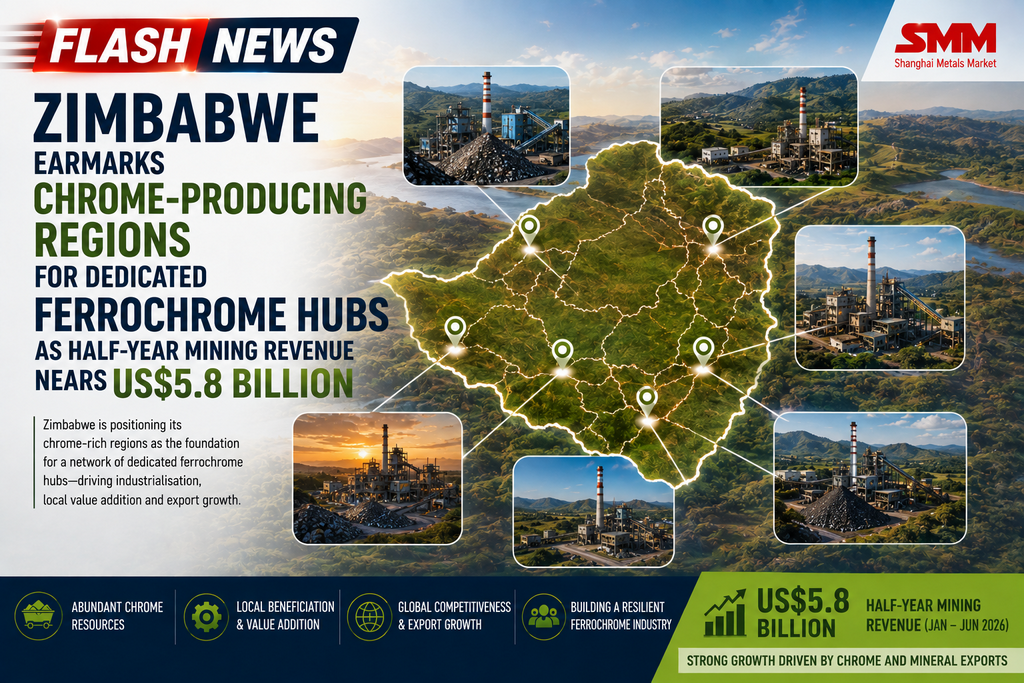
[SMM Express] Zimbabwe's Ministry of Mines and Mining Development used its three-day Mid-Term Strategic Planning Review Workshop in Kadoma this week to confirm that the country's mining sector generated approximately US$5.73 billion in export earnings during H1 2026 — gold contributing US$3.2 billion and other minerals a further US$2.53 billion through the Minerals Marketing Corporation of Zimbabwe — putting the sector on track to exceed 2025's record US$8.6 billion full-year total. Mines Minister Dr Polite Kambamura used the occasion to announce that government will establish regional beneficiation hubs aligned to each area's mineral endowment, with chrome-producing districts specifically earmarked to specialize in ferrochrome and chromium alloy production, while iron ore regions are directed toward steel.

The announcement reinforces the trajectory already visible in Zimbabwe's chrome sector this year: a February 2026 ban on exporting unbeneficiated minerals, combined with policy requiring chrome mining titles above 100 hectares to be tied to ferrochrome furnace development, has been steadily pushing production and investment toward smelting rather than raw ore shipment. Formalizing that push into designated regional hubs — rather than leaving beneficiation to individual operator discretion — signals Harare intends to treat chrome-specific value addition as a structural, geography-based policy rather than a company-by-company negotiation. With the Chamber of Mines projecting 10% sector growth for 2026 and full-year export earnings potentially reaching US$7.5–11 billion, the coming months should show whether the hub concept translates into concrete furnace investment in Zimbabwe's chrome belt or remains, for now, a stated policy direction.
Data Source Statement: Except for publicly available information, all other data are processed by SMM based on publicly available information, market communication, and relying on SMM's internal database model. They are for reference only and do not constitute decision-making recommendations.

For any inquiries or for more information, please contact: lemonzhao@smm.cn
For more information on how to access our research reports, please contact:service.en@smm.cn
Related News
[SMM Chromium Flash] Zimbabwe's Ferrochrome Smelters Race Against 2026 Captive Power Deadline Amid Beneficiation Push
17 hours ago
[SMM Chromium Flash] Zimbabwe's Ferrochrome Smelters Race Against 2026 Captive Power Deadline Amid Beneficiation Push
Read More
[SMM Chromium Flash] Zimbabwe's Ferrochrome Smelters Race Against 2026 Captive Power Deadline Amid Beneficiation Push
[SMM Chromium Flash] Zimbabwe's Ferrochrome Smelters Race Against 2026 Captive Power Deadline Amid Beneficiation Push
Zimbabwe's government has set 2026 as the deadline for the country's ferrochrome smelters to develop their own captive power generation, primarily from renewable sources, ending a period of subsidized grid electricity tariffs for the sector, the International Chromium Development Association said earlier this year. The requirement reflects a hard physical constraint rather than a purely commercial one: ferrochrome smelting consumes 3,500-4,000 kWh per tonne of output, a load Zimbabwe's debt-strained, generation-deficient grid cannot absorb at scale without compromising supply to other users. With 2026 now more than half over, the deadline is approaching at the same time Zimbabwe is pushing an aggressive beneficiation agenda — including a February 2026 raw mineral export ban and newly announced regional beneficiation hubs earmarking chrome-producing areas for dedicated ferrochrome and chromium alloy production. Whether the country's ferrochrome producers, many of them Chinese-invested operations still ramping up capacity, have made sufficient progress toward captive renewable generation to meet the year-end deadline remains an open question, and one with direct implications for how much of Zimbabwe's chrome-beneficiation ambition can actually be realized on schedule. SMM will continue to monitor for concrete updates on captive power project progress across Zimbabwe's ferrochrome sector as the year progresses.
17 hours ago
[SMM Chromium Flash] Southern Palladium Shares Sharply Higher, PGM-Chrome Project Clears Its Biggest Regulatory Hurdle
19 hours ago
[SMM Chromium Flash] Southern Palladium Shares Sharply Higher, PGM-Chrome Project Clears Its Biggest Regulatory Hurdle
Read More
[SMM Chromium Flash] Southern Palladium Shares Sharply Higher, PGM-Chrome Project Clears Its Biggest Regulatory Hurdle
[SMM Chromium Flash] Southern Palladium Shares Sharply Higher, PGM-Chrome Project Clears Its Biggest Regulatory Hurdle
Southern Palladium's JSE-listed share price surged 27.8% to R23.01 on 11 August 2026, up from a prior close of R18.00, after the company confirmed that South Africa's Department of Mineral and Petroleum Resources had granted the mining right for its flagship Bengwenyama project on the Eastern Limb of the Bushveld Complex in Limpopo. The approval, dated 7 August, marks the conclusion of a regulatory process that began when the mining right application was lodged and accepted in October 2023 — nearly three years of engagement compressed into a single-day market repricing once the outcome became public. The company had requested trading halts on both the JSE and the ASX on 6 August while it assessed the terms of the grant before making an orderly disclosure. The mining right has been granted for an initial 30-year period, with Southern Palladium entitled to apply for renewal thereafter. Company leadership described the approval as a pivotal step in moving Bengwenyama from studies toward execution. For SMM's chrome coverage specifically, the milestone matters beyond the platinum group metals headline: Bengwenyama is explicitly structured as a PGM-chrome co-product project, with chrome positioned to contribute close to a third of the project's total revenue at full production once developed. Having now cleared its largest regulatory hurdle, Bengwenyama's path toward a final investment decision — and toward becoming a genuine new source of South African chrome concentrate — is measurably shorter than it was a week ago, though completion of the DFS, project financing and further permitting still stand between the mining right and construction.
19 hours ago
[SMM Manganese Ore Weekly Review] Port Spot Cargoes Stay High, Manganese Ore Market Consolidates at Lows
21 hours ago
[SMM Manganese Ore Weekly Review] Port Spot Cargoes Stay High, Manganese Ore Market Consolidates at Lows
Read More
[SMM Manganese Ore Weekly Review] Port Spot Cargoes Stay High, Manganese Ore Market Consolidates at Lows
[SMM Manganese Ore Weekly Review] Port Spot Cargoes Stay High, Manganese Ore Market Consolidates at Lows
August 14: North China ports: 46% Australian lumps at 40-40.5 yuan/mtu, flat WoW; South African semi-carbonate ore at 32.2-32.7 yuan/mtu, down WoW; Gabonese ore at 37.8-38.2 yuan/mtu, flat WoW; South African high-iron ore at 28.5-29 yuan/mtu, flat WoW; South African medium-iron ore at 35-35.5 yuan/mtu, flat WoW. South China ports: 46% Australian lumps at 42.9-43.4 yuan/mtu, flat WoW; South African semi-carbonate ore at 36.3-36.8 yuan/mtu, flat WoW; Gabonese ore at 40.6-41.1 yuan/mtu, flat WoW; South African high-iron ore at 31.2-31.7 yuan/mtu, flat WoW; South African medium-iron ore at 38-38.5 yuan/mtu, flat WoW. Demand for manganese ore was subdued, port spot cargoes were elevated, and port manganese ore prices would consolidate at lows in the short term.
21 hours ago
[SMM Express] Zimbabwe's Ministry of Mines and Mining Development used - Shanghai Metals Market (SMM)