I. H1 Energy Storage Battery Cell Shipments Reach 486 GWh, Market Maintains High Prosperity
In H1 2026, the global energy storage battery cell market continued its rapid growth trend. SMM data showed that cumulative energy storage battery cell shipments from January to June reached 486 GWh; Q1 and Q2 shipments were 223 GWh and 263 GWh, respectively, with Q2 shipments up approximately 17.9% QoQ. On a monthly pace, China's shipments increased from 71 GWh in January to 86 GWh in June, with the monthly shipment center moving steadily upward.
In terms of application structure, power generation and grid side and C&I energy storage remained the main shipment direction for energy storage battery cells, accounting for 87.5% of total shipments in H1, while residential ESS battery cell shipments accounted for about 12.5%.
Overall, H1 2026 energy storage battery cell demand was still mainly driven by power generation and grid side and C&I energy storage, with residential ESS serving as an important supplement. The concentration of application structure towards utility-scale energy storage scenarios not only drove growth in battery cell shipment scale but also pushed the industry to accelerate product iteration towards large capacity, high energy density, and lower full life cycle cost.
As the market scale rapidly expanded, the competitive landscape of energy storage battery cell enterprises became further clarified. According to SMM's survey on the shipment status of these enterprises, top-tier players held a major market share by leveraging their client base, scale manufacturing, and stable delivery capabilities, while some enterprises achieved rank improvements through new production line releases, product volume ramp-up, and client expansion.
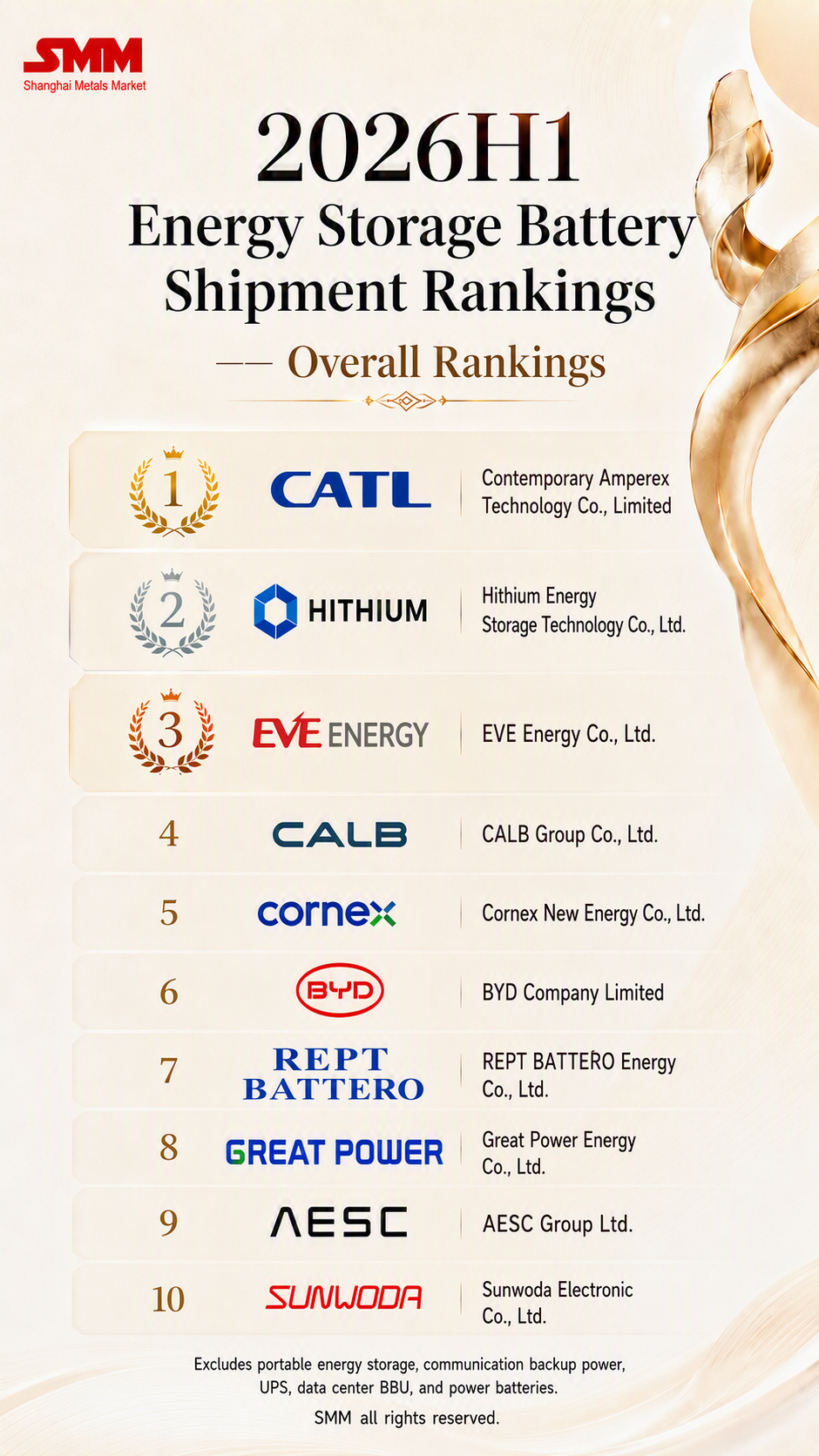
In the total ranking of H1 2026 energy storage battery cell shipments, CATL, Hithium, and EVE ranked top three, with CALB in fourth place. CORNEX New Energy saw its rank significantly improve to fifth place, and Great Power Energy rose to eighth place, making them relatively prominent enterprises in the total ranking. Overall, the top-tier group remained stable, while some mid-tier enterprises accelerated improvements in their shipment scale and market position.
As power generation and grid side and C&I energy storage contributed over 80% of energy storage battery cell shipments, the enterprise landscape in this sub-segment had a strong influence on the total ranking. Its large order volume, with high requirements for battery cell consistency, cycle performance, system compatibility, and bulk supply capabilities, makes it the market where energy storage battery cell enterprise competition is most concentrated.
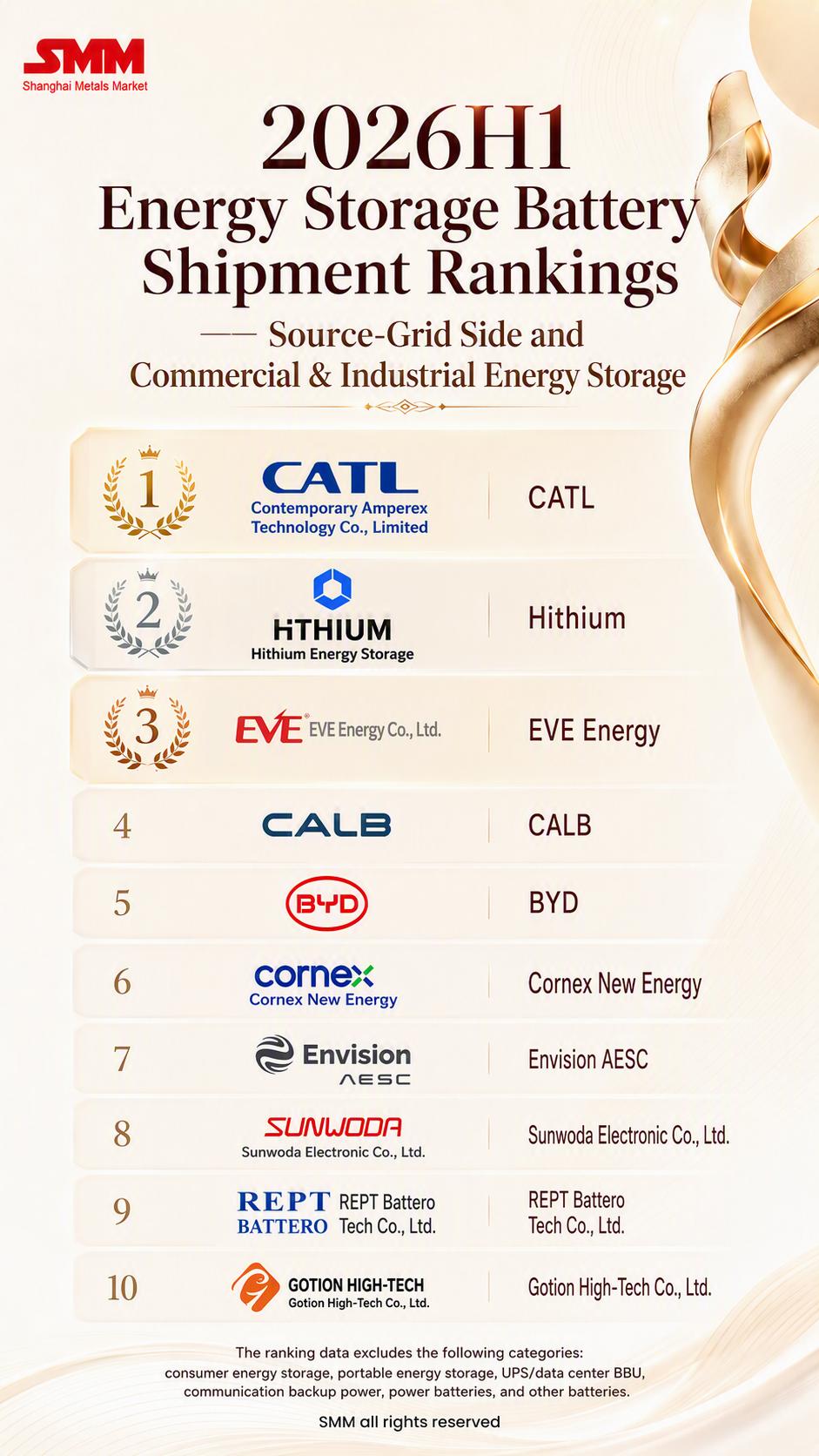
In the power generation and grid side and C&I energy storage market, CATL, Hithium, and EVE ranked top three, with CALB and BYD ranking fourth and fifth, respectively. CORNEX New Energy rose to sixth place, and Sunwoda rose to eighth place, reflecting the further expansion of these two enterprises in shipment scale and client coverage in utility-scale energy storage and C&I energy storage. Competitive advantage in this market was primarily built on large-scale order acquisition, product reliability, system compatibility, and continuous delivery capability.
Compared with power generation and grid side and C&I energy storage, the client structure of the residential ESS market is more dispersed, with different regions having varying requirements for product specifications, certification systems, and channel services. Enterprise competitiveness is more reflected in areas such as product compatibility, coverage of clients outside China, and rapid response capabilities.
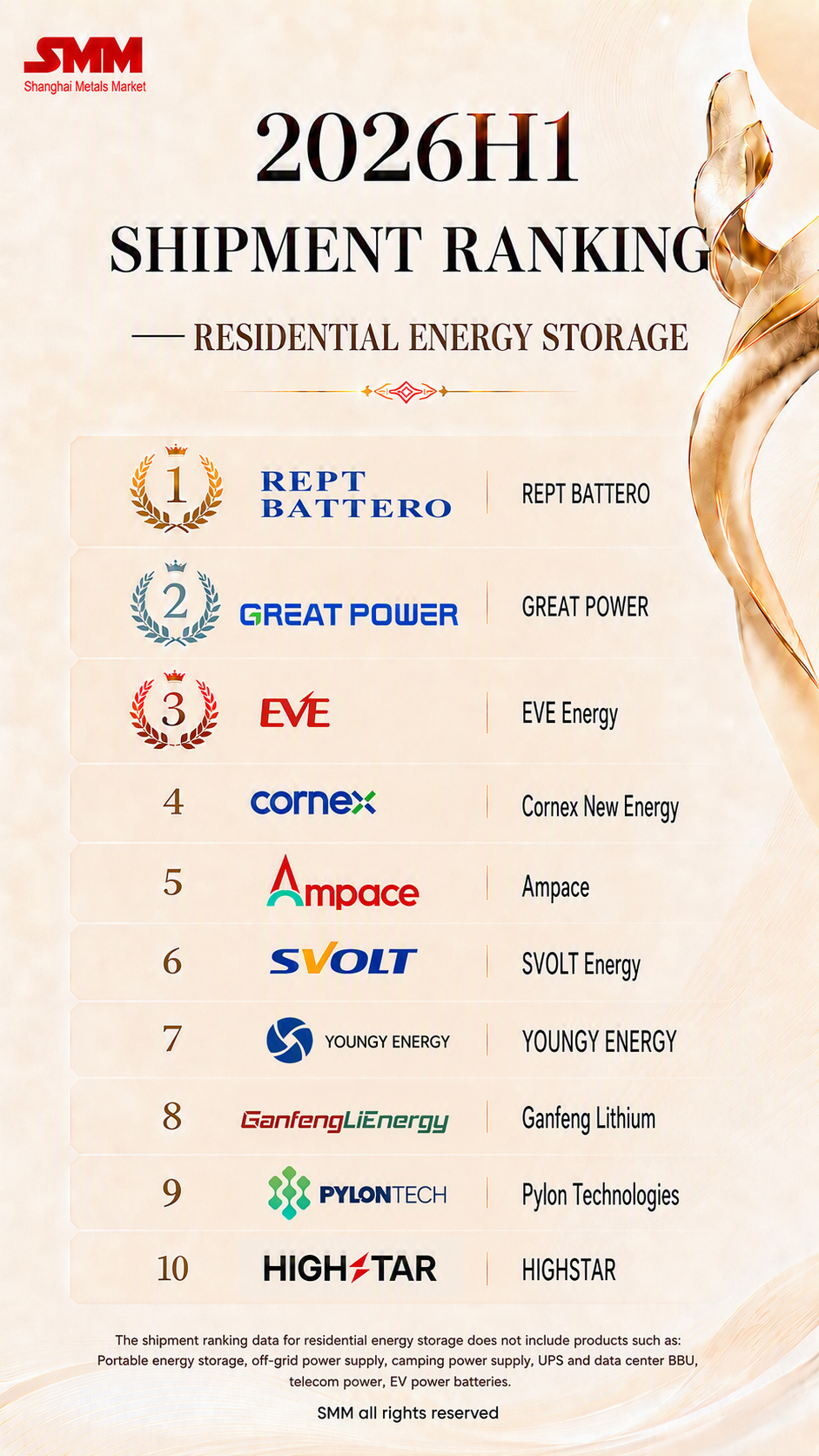
In the residential ESS market, REPT Battero, Great Power Energy, and EVE ranked top three. Among them, REPT Battero ranked first, and Great Power Energy rose to second place, with relatively outstanding residential ESS battery cell shipment performance. CORNEX New Energy, Ampace, SVOLT Energy Technology, Rongjie Energy, Ganfeng LiEnergy, Pylontech, and Highstar entered the top ten, with market participants showing diversified characteristics.
Looking across the three rankings, the current energy storage battery cell market shows characteristics of "top-tier players maintaining leadership, some enterprises improving their ranks, and advantages diverging across sub-scenarios." As the market shifts from scale expansion to competition in product and delivery capabilities, client acquisition, product structure, manufacturing stability, and cross-scenario layout will become important factors influencing enterprise market positions.
II. Large Battery Cells Above 500Ah Shipments Approx. 42 GWh, Product Upsizing Enters Scaled Delivery Stage
In addition to shipment scale growth, product capacity upgrades became one of the most prominent structural changes in the H1 2026 energy storage battery cell market. SMM data showed that shipments of large-capacity energy storage battery cells above 500Ah in H1 were approximately 42 GWh, accounting for 8.6% of total energy storage battery cell shipments. As related products gradually completed client acceptance, large-format battery cells above 500Ah have shifted from the earlier product release and verification stage to the scaled delivery phase.
The 42 GWh shipment scale indicates that large-capacity battery cells have already formed a preliminary foundation for industrialization, but the current market penetration rate is still less than 10%, and has not yet changed the mainstream status of 314Ah cells. In the short term, the market will maintain a parallel pattern of "314Ah product scaled delivery and 500Ah+ product accelerated penetration."
From a system perspective, the value of large-format battery cells above 500Ah is not just the increase in single-cell capacity. As single-cell capacity increases, the number of required battery cells, connectors, and management units decreases for the same system capacity, simplifying PACK and system structures and helping reduce integration costs for parts, assembly, and later operations and maintenance. Meanwhile, new-generation large-capacity battery cells typically optimize material systems, structural design, and thermal management solutions simultaneously to improve cycle times and usable electricity over the full life cycle; the reduction of inactive components within the system can also improve volume utilization and overall energy density. Based on joint improvements in integration cost, cycle life, and energy density, large-capacity battery cells can further reduce the full life cycle per-kWh cost and provide product support for future longer-duration energy storage systems.
However, expanding single-cell capacity does not directly equate to overall performance improvement. Whether large-format battery cells above 500Ah can continue to expand shipments still depends on product consistency, cycle performance, safety, thermal management adaptability, and mass manufacturing stability. The focus of future market competition will gradually shift from capacity parameters to product reliability and full life cycle economics.
III. Expansion of Battery Cells Above 500Ah Faces Multiple Constraints, Effective Supply Depends on Order and Manufacturing Synergy
In H1 2026, multiple battery cell enterprises accelerated the layout of large-capacity products above 500Ah, but some production lines encountered issues such as process stability, manufacturing yield, and quality control during construction, debugging, and ramp-up, resulting in actual expansion pace falling short of expectations. This indicates that a large cell production line cannot form stable delivery capability immediately after expansion is completed, as a longer process of equipment debugging and client validation cycle is still required from equipment installation to mass shipment.
Order support is also an important factor affecting the ramp-up of large cell production lines. Some enterprises have relatively limited orders on hand for products above 500Ah, with production lines lacking continuous and stable production tasks, which is unfavorable for process parameter optimization, yield improvement, and quality data accumulation. If order scale does not match the production line pace, even if enterprises have completed capacity deployment, it is difficult to quickly form stable effective supply.
At the same time, large-capacity products require deeper collaboration between battery cell enterprises and downstream system enterprises. Battery cell dimensions, thermal management methods, structural design, control strategies, and system capacity all need re-adaptation, with relatively long client validation and order introduction cycles. Therefore, whether large-format battery cells above 500Ah can achieve scaled delivery depends not only on the speed of production line construction, but also on manufacturing yield, quality control, order certainty, and joint development and delivery coordination capabilities with downstream clients.
From this perspective, the competitive focus of the energy storage battery cell industry is shifting from planned capacity scale to effective supply capability. Order acquisition, production line maturity, manufacturing yield, product performance, cost control, and client collaboration will jointly determine whether enterprises can steadily convert large cell capacity into actual shipments.
IV. H2 Energy Storage Battery Cell Market Is Expected to Continue High Growth, Tax Policy May Drive Upfront Demand and Delivery Pace
Looking to H2 2026, supported by the continuous release of energy storage demand in China and overseas, global energy storage battery cell shipments are expected to continue maintaining relatively fast growth, with power generation and grid side and C&I energy storage still comprising the main demand sources. As more large-format battery cells above 500Ah complete client validation and enter mass delivery, the shipment scale and market penetration rate of large-capacity products are expected to further increase, and product structure upgrades will remain an important main line in the H2 market.
Meanwhile, tax policy adjustments may have a significant impact on the phased shipment pace. Starting from September 1, 2026, a consumption tax will be levied on lithium-ion batteries at a rate of 2%; the VAT export refund rate for battery products was lowered to 6% in April, and will be revoked starting from January 1, 2027. Under expectations of rising tax burdens and export costs, some battery cell enterprises and clients may bring forward order confirmation, cargo pick-up, customs declaration, and export delivery arrangements, thus providing some support for shipments in Q3 and the early part of Q4.
Overall, the H2 2026 energy storage battery cell market is expected to continue high growth, but the market operation pace may be jointly affected by tax policy adjustments and product structure upgrades. Industry competition will further shift from mere scale expansion to a comprehensive contest of product reliability, manufacturing stability, client collaboration, and continuous delivery capability. Whether enterprises can seize the policy window, stably deliver existing orders, and drive large-format battery cells above 500Ah to form continuous shipments will become important variables affecting enterprise performance and market landscape in H2.
Appendix: SMM Methodology for H1 2026 Energy Storage Battery Cell Shipment Rankings: https://imgqn.smm.cn/production/expert/attachment/xGBNp20260806144327.pdf
SMM New Energy Industry Research Department
Wang Cong 021-51666838
Ma Rui 021-51595780
Feng Disheng 021-51666714
Lü Yanlin 021-20707875
Zhang Haohan 021-51666752
Wang Zihan 021-51666914
Wang Jie 021-51595902
Xu Yang 021-51666760
Chen Bolin 021-51666836
Yang Le 021-51595898
Li Yisha 021-51666730
Huang Chencong 021-51595860
![Solid-State Battery Next Decade Series, Part 6 of 9: Ternary Route May Become Great Again [SMM Analysis]](https://imgqn.smm.cn/usercenter/JSjkr20251217171728.jpg)