SMM August 1 News:
In the metals market:
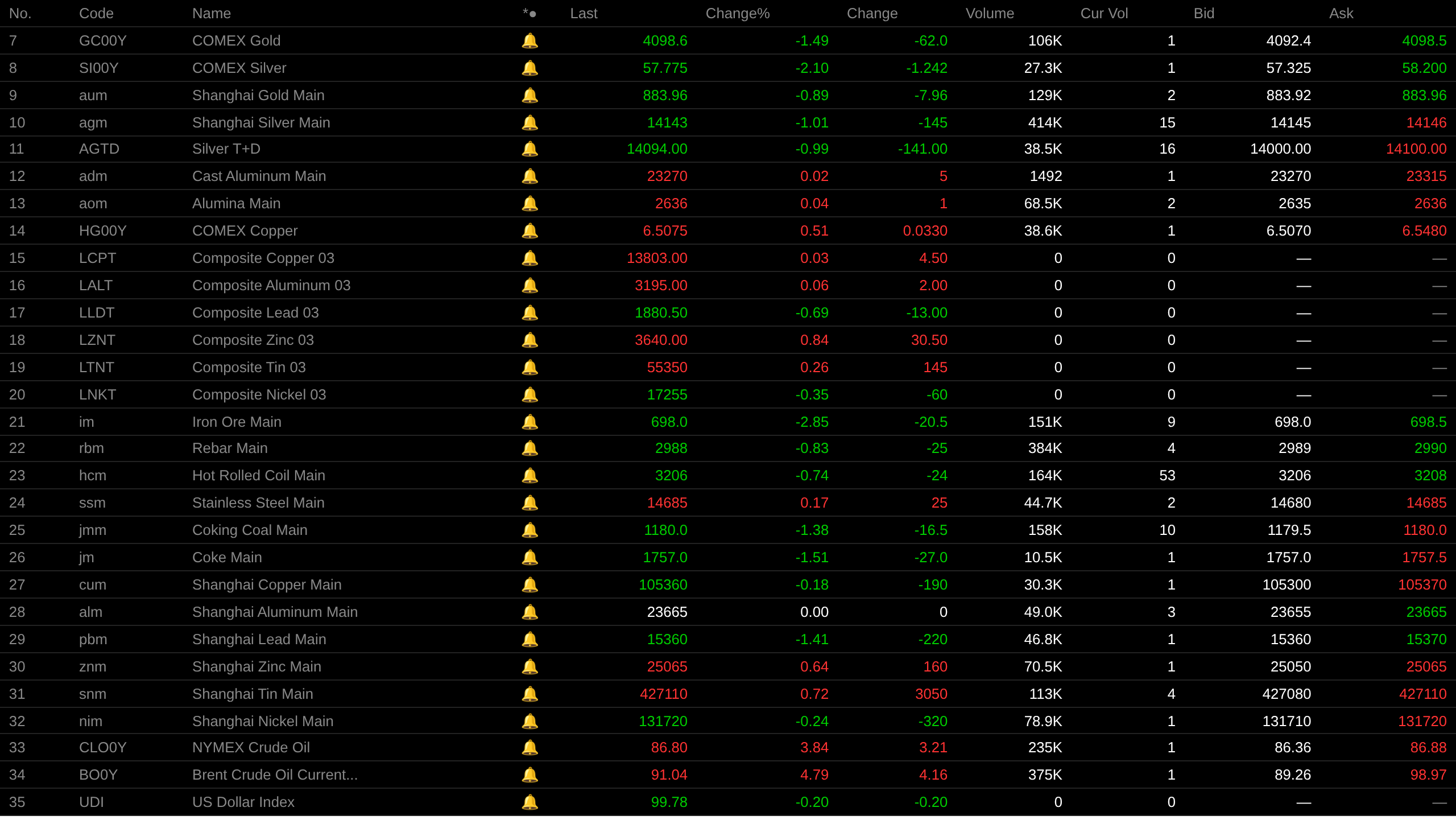
On the overnight session last Friday, base metals on the domestic market showed mixed performance. SHFE copper fell 0.18%, with a monthly gain of 2.9% in July. SHFE aluminum was flat at 23,665 yuan/mt, with a monthly gain of 4.63% in July. SHFE lead fell 1.41%, SHFE zinc edged up 0.64%, and SHFE tin rose 0.72%. SHFE nickel fell 0.24%. In addition, the most-traded alumina futures edged up 0.04%, while the most-traded foundry aluminum contract edged up 0.02%.
On the overnight session last Friday, ferrous metals mostly fell. Stainless steel rose 0.17%, iron ore fell 2.85%, rebar fell 0.83%, and HRC fell 0.74%. In the coking coal and coke sector, the most-traded coking coal contract fell 1.38%, and the most-traded coke contract fell 1.51%.
On the overseas market during the overnight session last Friday, LME base metals generally rose. LME copper edged up 0.03%, with a monthly gain of 3.16% in July. LME aluminum rose 0.06%, with a monthly gain of 2.9% in July. LME lead fell 0.69%. LME zinc rose 0.84%. LME tin rose 0.26%. LME nickel fell 0.35%.
In the precious metals market during the overnight session last Friday: COMEX gold fell 1.49%, with its weekly chart posting a second consecutive gain, up 0.68% for the week, and its July monthly chart rising 1.49%. COMEX silver fell 2.1%, with its weekly chart declining 1.92% for the week, and its monthly chart posting a second consecutive loss, down 3.58% in July. In the overnight session last Friday, the most-traded SHFE gold contract rose 0.89%, with its weekly chart posting a second consecutive gain, up 0.55% for the week, and its July monthly chart rising 1.52%. The most-traded SHFE silver contract fell 1.01%, ending a two-week winning streak but still up 0.98% for the week, and its July monthly chart rising 1.21%.
As of 8:16 AM on August 1, closing prices from the overnight session last Friday:
Macro Front
China:
[State Council Executive Meeting: Studying and Implementing General Secretary Xi Jinping’s Key Speech on the H1 Economic Situation and Efforts for H2 Economic Work] The meeting stressed the need to align thinking and understanding with the CPC Central Committee’s scientific assessment of the economic situation, take more concrete measures to consistently steer the economy toward new, superior, and sounder development, and strive for a good start to the 15th Five-Year Plan period. It called for effectively enhancing the implementation efficiency of macro policies, making full and good use of all existing policies, and promptly devising and rolling out pragmatic and effective incremental policies. It also emphasized the need to effectively expand domestic demand, launch a set of robust measures in sectors with great potential and strong driving force, accelerate the execution of major projects designated in the 15th Five-Year Plan, and solidly advance the planning and construction of the “Six-Network” infrastructure. Efforts must be continuously made to strengthen internal drivers of development, and more concrete and effective measures should be introduced in building a unified national market and improving the business environment. We must persistently guard against and defuse risks in key areas, do a solid job in disaster prevention, mitigation, and relief, as well as work safety, strengthen support for people in difficulty, and secure the bottom line of people’s livelihood. (CCTV)
[Ministry of Industry and Information Technology Visits Selected Automobile Producers for Supervision and Inspection] To further regulate competition order in the automotive industry and enhance production conformity and quality and safety levels of automotive products, the Equipment Industry Department I of the Ministry of Industry and Information Technology conducted supervision and inspection on vehicle product safety assurance capabilities and production conformity at Chery Automobile Co., Ltd., NIO Technology (Anhui) Co., Ltd., and Anhui Jianghuai Automobile Group Corp., Ltd. from the 30th to the 31st. It is learned that going forward, the Ministry of Industry and Information Technology will, together with relevant departments, further carry out actions to improve production conformity and quality of road motor vehicle products, strengthen entry review and testing verification management for “aggressive” innovative designs of automotive products, urge automobile and motorcycle producers to thoroughly identify product safety risks and hazards, strengthen product testing, verification, and safety assessment, standardize marketing and promotional practices, uphold product safety bottom lines, and effectively protect consumers’ lawful rights and interests. (Xinhua News Agency)
[CSRC Approves Registration of Coke Options] Recently, the CSRC approved the registration of coke options on the Dalian Commodity Exchange. The CSRC will urge the Dalian Commodity Exchange to make all preparations to ensure the smooth launch and stable operation of coke options.
On the US dollar:
Last Friday, the overnight US dollar index fell 0.2% to 99.78. On the weekly chart, the dollar index declined by 1.65% for the week. On the monthly chart, the dollar index declined by 1.37% for the month.
According to a New York Times report, Fed Chairman Warsh is reportedly considering reducing the number of regularly scheduled interest-rate-setting meetings of the Federal Reserve, a move that could cause huge shockwaves and would mark the most significant change in how the Fed operates in recent years. Currently, the Fed’s 12-member Federal Open Market Committee (FOMC) meets eight times a year to vote on whether to raise, lower, or maintain borrowing costs. According to four people familiar with the matter, Warsh proposed adjustments to the meeting frequency at this week’s Fed meeting. According to the people, at this week’s meeting, Warsh discussed the legal basis the Fed must follow regarding the minimum number of meetings it is required to hold each year and a timetable for such adjustments. According to sources, Walsh asked officials to provide him with their individual views, rather than holding a full discussion on the meeting agenda during this week’s session. (Jin10 Data APP)
Fed Chairman Walsh kept interest rates unchanged this week, but three officials dissented, arguing for an immediate rate hike to address persistent inflation risks. Katharine Neiss, Deputy Head of Global Economics at PGIM Credit, said Walsh’s press conference performance was "weaker than expectations," and she expects the US Fed’s "hawkish pivot" to materialize in September, when three consecutive rate hikes could be delivered. Elias Haddad of Brown Brothers Harriman noted: The support for the US dollar from the resilience in US economic activity was offset by Walsh’s failure to translate his hawkish inflation rhetoric into credible policy action, raising the risk of the Fed falling behind the curve. According to the CME FedWatch Tool, markets are currently pricing in a 65% probability of a September rate hike, a pullback from 82% a week ago. (Wall Street Insight)
Three Fed policymakers said their dissenting votes in favor of a rate hike this week stemmed from stubborn inflationary pressures, signaling rising internal pressure on Fed Chairman Walsh to act. In statements released Friday morning, Hammack and Kashkari said they are concerned that, while the current round of price increases may have originated from short-term factors such as President Trump’s tariff policies and the Iran war, the inflation picture now warrants action by the US Fed. Logan joined them, stating that even if inflation has cooled somewhat, it is unlikely to fully pull back to the Fed’s 2% target without a rate increase; without any policy restraint, inflation could continue to exceed the target until an unexpected shock hits. Kashkari said that if inflation remains stubborn, he could support a series of rate hikes—not just a single move—to prevent it from becoming further entrenched. "A series of smaller policy adjustments may be preferable to waiting for developments and ultimately having to take more forceful action," he said. Hammack said the pace of price increases could continue to accelerate if the Fed does not tighten policy. "Inflation has been stubbornly above 2% for more than five years, and I am not confident it will fall back to our target on its own," she said. (Jin10 Data APP)
Fed’s Barkin said it is an "open question" whether the US Fed has set interest rates at a level sufficiently restrictive to curb inflation, adding that he is unsure whether he would have voted in favor, like the three other regional Fed presidents who dissented in favor of a hike this week. In an interview on Friday, Barkin said: 'I think there is a strong case for tightening policy and taking back some of last year's rate cuts.' He noted that given the slowdown in June inflation data, 'I think one could also argue... there is time before the next meeting to judge whether the current policy stance is appropriate.' Barkin will not vote on interest rate decisions until next year. Additionally, Barkin was sceptical that the labour market has significantly strengthened. He said, 'It doesn't feel like the labour market is very tight.' He also pointed out that price increases are not transmitting evenly through the economy, making it difficult to gauge how much inflation remains. (Jin10 Data APP)
On the macro front:
This week will see the release of data including China July RatingDog Manufacturing PMI, Switzerland July CPI MoM, France July Manufacturing PMI Final, Germany July Manufacturing PMI Final, Eurozone July Manufacturing PMI Final, UK July Manufacturing PMI Final, US July S&P Global Manufacturing PMI Final, US July ISM Manufacturing PMI, US June Construction Spending MoM, US June Trade Balance, US June JOLTS Job Openings, US June Factory Orders MoM, China July RatingDog Services PMI, France June Industrial Production MoM, France July Services PMI Final, Germany July Services PMI Final, Eurozone July Services PMI Final, UK July Services PMI Final, Eurozone June PPI MoM, US July ADP Employment Change, US July S&P Global Services PMI Final, US July ISM Non-Manufacturing PMI, Switzerland July Seasonally Adjusted Unemployment Rate, Eurozone June Retail Sales MoM, US July Challenger Job Cuts, US Initial Jobless Claims for the week ending August 1, US July Global Supply Chain Pressure Index, US June Wholesale Sales MoM, France Q2 ILO Unemployment Rate, Germany June Seasonally Adjusted Industrial Production MoM, Germany June Seasonally Adjusted Trade Balance, UK July Halifax Seasonally Adjusted House Price Index MoM, France June Trade Balance, Switzerland July Consumer Confidence Index, Canada July Employment Change, US July Unemployment Rate, US July Seasonally Adjusted Nonfarm Payrolls, US July Average Hourly Earnings YoY, US July Average Hourly Earnings MoM, US July NY Fed 1-Year Inflation Expectations, China July Trade Balance in USD terms, China July Foreign Exchange Reserves, China July Trade Balance, China July CPI YoY, and China July PPI YoY.
In addition, attention this week should also be paid to: SpaceX will report its Q2 2026 results; 2028 FOMC voter, St. Louis Fed President Musalem will speak on the US economy and monetary policy; 2027 FOMC voter, Richmond Fed President Barkin will deliver a speech.
Crude Oil:
Both oil futures surged in the overnight session last Friday, with WTI up 3.84% and Brent up 4.79%. For the week, WTI futures fell 2.81%, while Brent futures slipped 0.7%. For the month, WTI futures soared 24.89% and Brent futures jumped 24.8%. A decline in ship transits through the Strait of Hormuz heightened market concerns over global crude oil shipments.
Uncertainty persists over when Middle Eastern crude oil supply will return to normal. The US-Iran ceasefire agreement reached in June had completely broken down by early July. From mid to late July, the Strait of Hormuz, the world’s most critical energy trade choke point, remained severely disrupted, with intermittent blockades at times. Meanwhile, Ukraine’s long-range drone strikes on Russian refineries destroyed around 30% to 45% of Russia’s operational refining capacity, pushing European diesel refining margins above $60/bbl and driving global refined product prices near wartime highs. (Wall Street CN)
Data released by the international shipping information platform “MarineTraffic” on July 31 showed that the number of ships transiting the Strait of Hormuz on the 30th fell to 5 from 22 the previous day, a decline of 77%. The platform’s data indicated that all 5 ships passed through the Strait of Hormuz via the lane on the Iranian side. (Jin10 Data App)
According to CBS News, citing multiple sources, the US and Israel are planning to carry out “one of the most intense bombing campaigns to date” against Iran’s energy infrastructure, potentially targeting power plants and refineries, with the operation possibly lasting through the weekend. Iranian media reported on August 1, citing an Iranian official, that Iran considers a US-Israeli attack on its infrastructure to be a “reckless act” and has developed a comprehensive plan to respond to “any possible reckless actions by the US.” (Jin10 Data App)
According to Iran’s Tasnim News Agency, the Yemeni Houthi group said that in implementing a “blockade for blockade” strategy, after imposing maritime restrictions on Saudi oil tankers, it had forced 8 Saudi tankers to change course and reroute around the Cape of Good Hope. (Jin10 Data App)
Additionally, data from the Intercontinental Exchange (ICE) showed that for the week ended July 28, speculative net long positions in Brent crude fell by 6,948 contracts to 185,083 contracts. Speculative net long positions in diesel rose by 2,654 contracts to 87,194 contracts. (Jin10 Data App)
Recommended Reads:
![The cost-driven upward momentum continues, next week the price center of finished steel may edge up slightly [SMM Steel Industry Chain Weekly Report]](https://imgqn.smm.cn/usercenter/aJuuq20251217171745.jpg)

![July brass billet imports sharply contracted MoM, while cumulative imports still kept up YoY [SMM analysis]](https://imgqn.smm.cn/usercenter/uoTGi20251217171713.jpg)