SMM July 30 News:
In the metals market:
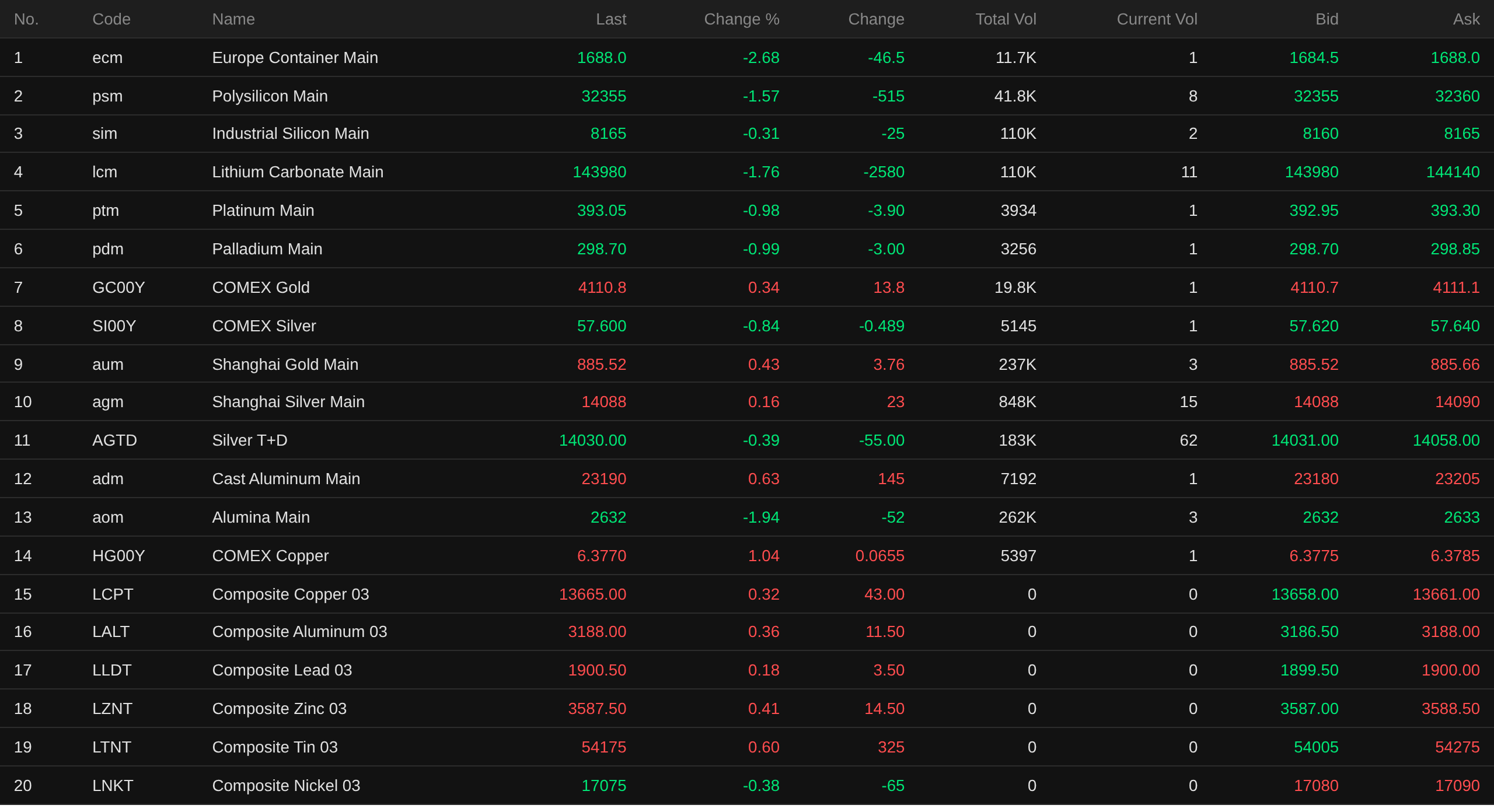
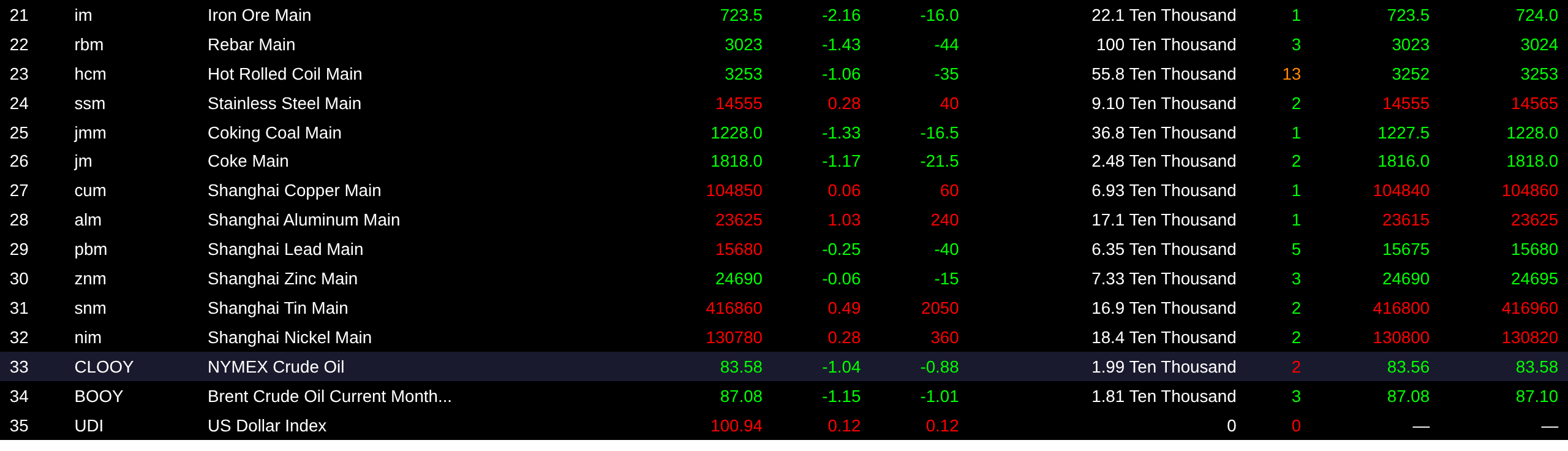
As of the midday close, domestic base metals generally rose. SHFE copper edged up, SHFE aluminum rose 1.03%. SHFE lead fell 0.25%. SHFE zinc edged down. SHFE tin gained 0.49%. SHFE nickel rose 0.28%.
Besides, the most-traded cast aluminum futures rose 0.63%, the most-traded alumina futures fell 1.94%. The most-traded lithium carbonate futures fell 1.76%. The most-traded silicon metal futures fell 0.31%. The most-traded polysilicon futures continued the decline from the previous two trading days, falling another 1.57%.
Ferrous metals mostly fell. Iron ore fell 2.16%, rebar fell 1.43%, hot-rolled coil fell 1.06%. Stainless steel rose 0.28%. In terms of coking coal and coke: the most-traded coking coal contract fell 1.33%, the most-traded coke contract fell 1.17%.
In the overseas base metals market, as of 11:38, LME metals almost all rose. LME copper, LME aluminum, LME lead, and LME zinc all gained within 0.5%. LME tin rose 0.6%. LME nickel fell 0.38%.
In the precious metals market, as of 11:38, COMEX gold rose 0.34%, COMEX silver fell 0.84%. In the domestic precious metals market: SHFE gold rose 0.43%, the most-traded SHFE silver contract rose 0.16%.
Besides, as of the midday close, the most-traded platinum futures fell 0.98%, the most-traded palladium futures fell 0.99%.
As of the midday close, the most-traded European container freight index futures fell 2.68% to 1,688 points.
As of 11:38 on July 30, some midday futures market conditions:
Spot and Fundamentals
Aluminum: During the morning session, the center of the SHFE aluminum 2608 contract was higher than the same period of the previous trading day. The rise in aluminum prices significantly dampened market purchasing sentiment. On the day, some suppliers quoted at parity with the SHFE aluminum 2608 contract, with market acceptance remaining weak. The mainstream transaction price was mainly from SHFE aluminum 2608 contract at a discount of 10 yuan/mt to parity...
Macro Front
Domestically:
[National Energy Administration: H1 China's renewable energy power generation share exceeded 40% for the first time] According to the press conference of the National Energy Administration, in H1, China's renewable energy developed rapidly, with power generation accounting for over 40% of total power generation for the first time. In H1, national renewable energy power generation was nearly 2 trillion kWh, up about 9% YoY, accounting for 41.2% of total power generation, exceeding 40% for the first time. Among them, wind and solar power generation totaled 1.25 trillion kWh, up 9.3% YoY. In terms of installations, China's renewable energy new installations reached 117 million kW in H1, accounting for 73.9% of total new installations, continuing to hold the dominant position. As of the end of June, China's renewable energy installations reached 2.455 billion kW, accounting for over 60% of China's total installed capacity. (CCTV News)
[China's coal-fired power generation share of total power generation fell below 50% for the first time in H1] It was learned from a press conference held by the National Energy Administration today that the pace of China's green and low-carbon energy transition accelerated in H1. As of the end of June, the combined installed capacity of wind and solar power reached 1.95 billion kW, up 16.8% YoY. In terms of power generation, total wind and solar power generation exceeded 1.2 trillion kWh in H1, accounting for roughly one-quarter of total electricity consumption. Meanwhile, China's coal-fired power generation was 2.5 trillion kWh, with its share of total power generation dropping to 49.7%, marking the first time the share fell below 50% in H1. (CCTV News)
The PBOC conducted a 270.5 billion yuan 7-day reverse repo operation in the open market at an operation rate of 1.40%, unchanged from the previous operation. Meanwhile, it conducted a 600 billion yuan overnight reverse repo operation. Today, 804 billion yuan of reverse repos matured.
The US dollar:
As of 11:38, the US dollar index rose 0.12% to 100.94. On Wednesday, July 29 (ET), the US Fed announced after the FOMC meeting that the target range for the federal funds rate would remain unchanged at 3.50% to 3.75%. To date, after cutting rates at three consecutive meetings through the end of last year, the FOMC has stood pat at all five monetary policy meetings since the start of 2026. The decision was in line with market expectations. (From Wallstreetcn APP)
Fed Chairman Warsh reiterated at the start of the press conference that the Fed is firmly committed to achieving its 2% YoY inflation target. Warsh stated that the committee would unwaveringly pursue price stability. Given the current environment of heightened uncertainty, refraining from providing forward guidance is a "prudent" approach. He stressed to reporters that the Fed has no so-called "soft inflation target" or any other implicit target; the sole inflation goal is 2%. Regarding the overall economy, Warsh said the US economy has shown "impressive resilience," and while it has faced a series of shocks recently, the overall trend remains positive. (Jin10 Data APP)
According to CME "FedWatch": The probability of the Fed keeping rates unchanged by September is 36.8%, the probability of a cumulative 25-basis-point rate hike is 63.2%, and the probability of a cumulative 50-basis-point hike is 0% (These probabilities were 17.8%, 60.2%, and 22% before the Fed decision, respectively.)The probability of the US Fed keeping rates unchanged through October is 26.2%, while the probabilities of cumulative rate hikes of 25 bps, 50 bps, and 75 bps are 55.6%, 18.2%, and 0%, respectively (versus 11.9%, 46.1%, 34.7%, and 7.3% before the Fed decision). (Jin10 Data APP)
A CICC research report noted that the US Fed kept rates unchanged at its July meeting, but hawkish sentiment within strengthened further as three voting members supported a 25 bps rate hike. We believe the greatest change from this meeting was not the rate decision, but rather Fed Chairman Warsh’s attempt to reduce policy intervention and rely more on a spontaneous rise in market rates to tighten financial conditions, outsourcing part of the tightening function to the market. However, against the backdrop of inflation persistently exceeding the target, this approach could easily undermine market confidence in the Fed’s policy credibility. After the meeting, long-end US Treasury yields surged and the curve steepened notably, likely reflecting investors beginning to price in higher long-term inflation and policy risks. Looking ahead, we believe that if employment or inflation data exceed expectations, the market will not only further raise expectations for a September rate hike, but may also price in the risk of the Fed acting “too late.” Long-end rates could rise further, and risk assets would face greater adjustment pressure.
T. Rowe Price Chief US Economist Blerina Uruci said that, assuming oil prices do not spike and inflation trends lower, the Fed could keep rates unchanged at its September meeting. She said in a report that, given the number of dissent votes at Wednesday’s FOMC meeting and oil price uncertainty, market expectations for the September rate decision reflect a roughly 50-50 chance. The market will continue to pressure the Fed and may not back down until inflation data forces it to act, maintaining the view that the Fed will keep rates unchanged. The US core CPI data for June did not influence the Fed’s decision, she added, noting that Warsh is watching this trend and that “with a bit of luck, this trend could play in his favor in a few months.”
DBS Group Research Senior FX Strategist Philip Wee said in a commentary that the US dollar could be weighed down by the divergence in forward guidance between the Fed and other central banks. By removing forward guidance and keeping rates unchanged, Fed Chairman Warsh has brought the Fed into a monetary “mirror maze,” resulting in volatile consequences. Warsh has left the US market “groping in the dark.” In contrast, the European Central Bank has been more unified in signaling a rate hike in September, which gives the euro a clear comparative advantage. If the Bank of England defies the broad consensus of holding rates steady and unexpectedly hikes later today, the pound is likely to appreciate. (Jin10 Data APP)
Other currencies:
[Data Dove, Market Hawk: Bank of England Faces Policy Signal Test on Thursday]Rate futures markets are firmly betting on a Bank of England rate hike in November. The BoE will announce its rate decision, meeting minutes, and latest economic forecasts on Thursday, followed by a press conference from Governor Bailey. Most economists surveyed by Reuters expect the MPC to keep rates unchanged 7-2, holding steady throughout the year. Previously, UK CPI fell to a 15-month low in June, while private sector wage growth was the weakest since 2020. The government led by new Prime Minister Andy Burnham has prioritized tackling the cost-of-living crisis, announcing the removal of VAT on household electricity bills. Almost no fundamentals side logic supports a Bank of England rate hike. However, rate futures data on Wednesday pointed to a 25bp hike in November and another in March 2027.
Data:
Today will see the release of US initial jobless claims for the week ending July 25, US core PCE price index YoY for June, US personal spending MoM for June, US Q2 real GDP annualized QoQ advance, US Q2 real personal consumption expenditures QoQ advance, US Q2 core PCE price index annualized QoQ advance, US core PCE price index MoM for June, Eurozone Q2 GDP YoY advance, Eurozone June unemployment rate, Eurozone July industrial confidence index, Eurozone July economic sentiment index, France Q2 GDP YoY advance, Swiss July KOF leading indicator, UK Bank Rate decision, Germany Q2 non-seasonally adjusted GDP YoY advance, and Germany July CPI MoM advance.
Crude oil:
As of 11:38, both crude oil benchmarks were down, with WTI down 1.04% and Brent down 1.15%. Although the Middle East conflict has continued to escalate, data shows tankers are still leaving the region.
Kpler shipping data showed 37 cargo ships passed through the Bab el-Mandeb Strait on Tuesday, the highest since July 19, while only a few passed through the Strait of Hormuz. Among the vessels passing through the strait, 20 entered and 17 departed. There were no VLCCs or LNG carriers. Among the departing vessels, three Aframax tankers were laden with crude oil: the Aisopos and Gustav, carrying over 750,000 barrels of crude, were heading to the Gulf of Aden, while the Karachi, with about 430,000 barrels, was bound for Pakistan. Among the inbound ships, two carried petrochemical products: the Velos Aquarius delivered 345,000 barrels of MTBE to areas west of the Suez, and the Sea Ambition shipped nearly 93,000 barrels of chemicals to Turkey. (Jin10 Data APP)
The UAE's Abu Dhabi National Oil Company (Adnoc) is continuing to export LNG from its Persian Gulf facilities, despite renewed conflict in the region forcing producers to limit shipments through the Strait of Hormuz. According to shipping data, an empty LNG carrier owned by Adnoc appeared in the Persian Gulf on Wednesday. The voyage is a rare occurrence, as visible traffic in the strait has largely halted since the attack on a Qatari LNG vessel earlier this month. Meanwhile, satellite images show ongoing cargo loadings, and on Friday an oil tanker was docked at the UAE's Das Island export terminal. These developments underscore that, despite the breakdown of US-Iran peace talks leading to tanker attacks near the strait, fuel exporters are still striving to maintain normal shipping operations. (Jin10 Data APP)
Government data released by the US Energy Information Administration on Wednesday showed that commercial crude oil inventories plunged by 7.2 million barrels last week, while the Strategic Petroleum Reserve (SPR) decreased by 3.8 million barrels to 307.7 million barrels, the lowest level in over 40 years. Meanwhile, US refinery capacity utilization rate has climbed to 97%, with some areas in the Midwest running at full 100% capacity. The direct trigger for this sharp inventory drawdown was the renewed military conflict between the US and Iran over the past week. The ongoing US-Iran hostilities have severely restricted tanker traffic through the Strait of Hormuz, and supplies of oil and petrochemical products from the Middle East face ongoing disruptions. (from Wall Street CN APP)
On July 29 local time, Farhan Haq, Deputy Spokesman for the UN Secretary-General, said at a regular press briefing at UN Headquarters in New York that the recent fighting in the Middle East is showing a trend of further escalation. UN Secretary-General António Guterres is deeply concerned about the escalation of the conflict and the involvement of more countries, and called on all parties concerned to cease hostilities and return to diplomatic negotiations and mediation. Responding to a question about a drone attack on a natural gas storage facility at Egypt's Damietta port, Haq said the UN does not have first-hand information on the incident, but expressed concern that as the conflict continues, more countries could be affected. (CCTV News)
Spot Market Overview:
►
►
►
►
►
►
►
►
►
►
►
►

![SHFE aluminum's tug-of-war between longs and shorts moves sideways, alumina falls under pressure [SMM Aluminum Futures Brief Comment]](https://imgqn.smm.cn/usercenter/wStpx20251217171650.jpg)