On July 27, Chifeng Gold shares rose. As of the close on July 27, the stock was up 4.52% at 38.14 yuan per share.
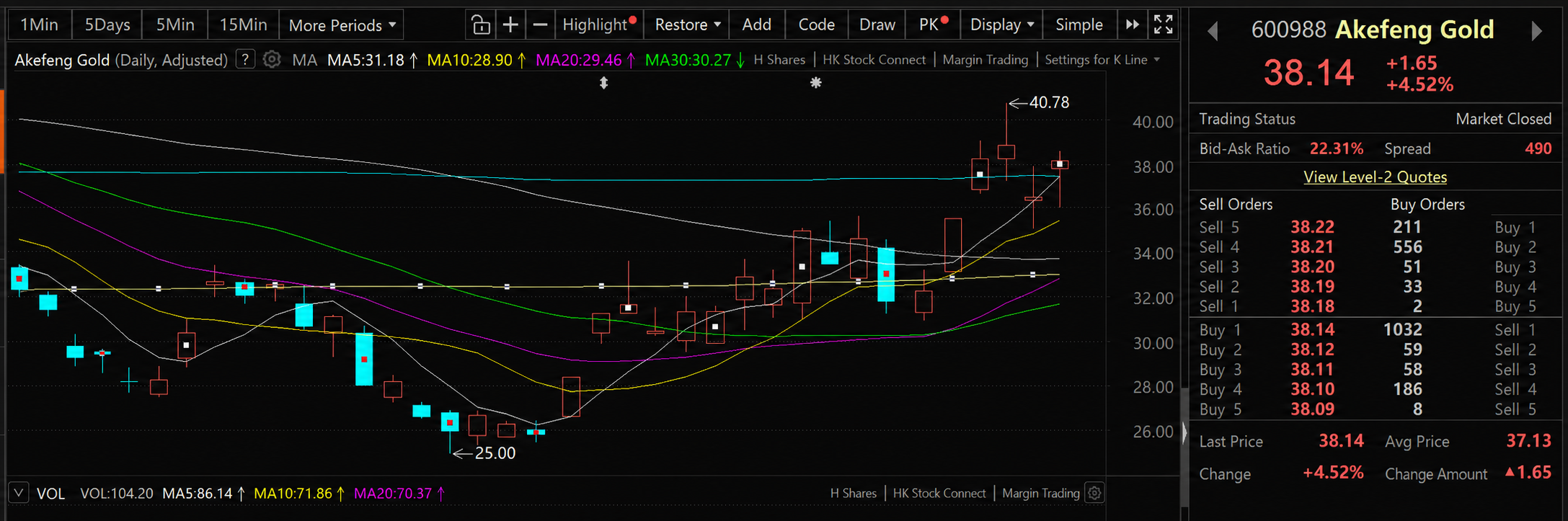
In terms of news: Chifeng Gold disclosed its H1 2026 preliminary earnings after market close on July 14, showing that the company estimates net profit attributable to shareholders of the publicly listed firm for H1 2026 to be between RMB 1,700 million and RMB 1,780 million. Compared with RMB 1,106.9 million in the same period last year, this represents an increase of RMB 593.1 million to RMB 673.1 million, up 54% to 61% YoY. It estimates net profit attributable to shareholders of the publicly listed firm after deducting non-recurring gains and losses for H1 2026 to be between RMB 1,710 million and RMB 1,790 million, compared with RMB 1,111.91 million in the year-ago period, an increase of RMB 598.09 million to RMB 678.09 million, up 54% to 61% YoY.
Regarding the main reasons for the performance change in the period, Chifeng Gold said the sharp YoY growth in both net profit metrics was primarily driven by a significant rise in gold prices relative to the same period last year, with the average gold selling price up about 43% YoY, alongside the company's continuous strengthening of production organization and operational management, which boosted results.
Regarding its main business, Chifeng Gold described in its 2025 annual report: The company belongs to the nonferrous metal mining and beneficiation industry, with principal products including precious metals such as gold and nonferrous metals like copper cathode. Its core business is gold mining, mineral processing and sales, while also engaging in polymetallic mining and comprehensive resource recovery. The company operates six gold mines and one polymetallic mine globally, with a footprint covering China, Southeast Asia and West Africa. Among them, domestic subsidiaries Jilong Mining, Wulong Mining, Huatai Mining and Jintai Mining focus on gold mining and beneficiation; Hanfeng Mining focuses on zinc, lead, copper and molybdenum polymetallic mining; the controlled subsidiary Laos Vientiane Mining is engaged in gold mining and copper mining and smelting; and the controlled subsidiary Ghana Wassa focuses on gold mining. In addition, the controlled subsidiary Guangyuan Technology specializes in comprehensive resource recovery, focusing on the dismantling of waste electrical and electronic products and other environmental protection business.
A review of Gold 99's price trend in H1 2026 shows: The average price of Gold 99 on June 30 this year was 866.2 yuan/g, down 110.79 yuan/g from 976.99 yuan/g on December 31, 2025, a decline of 11.34% in H1 2026. The daily average price of Gold 99 in H1 2026 was 1,037.71 yuan/g, up 315.43 yuan/g from 722.28 yuan/g in H1 2025, an increase of 43.67%.
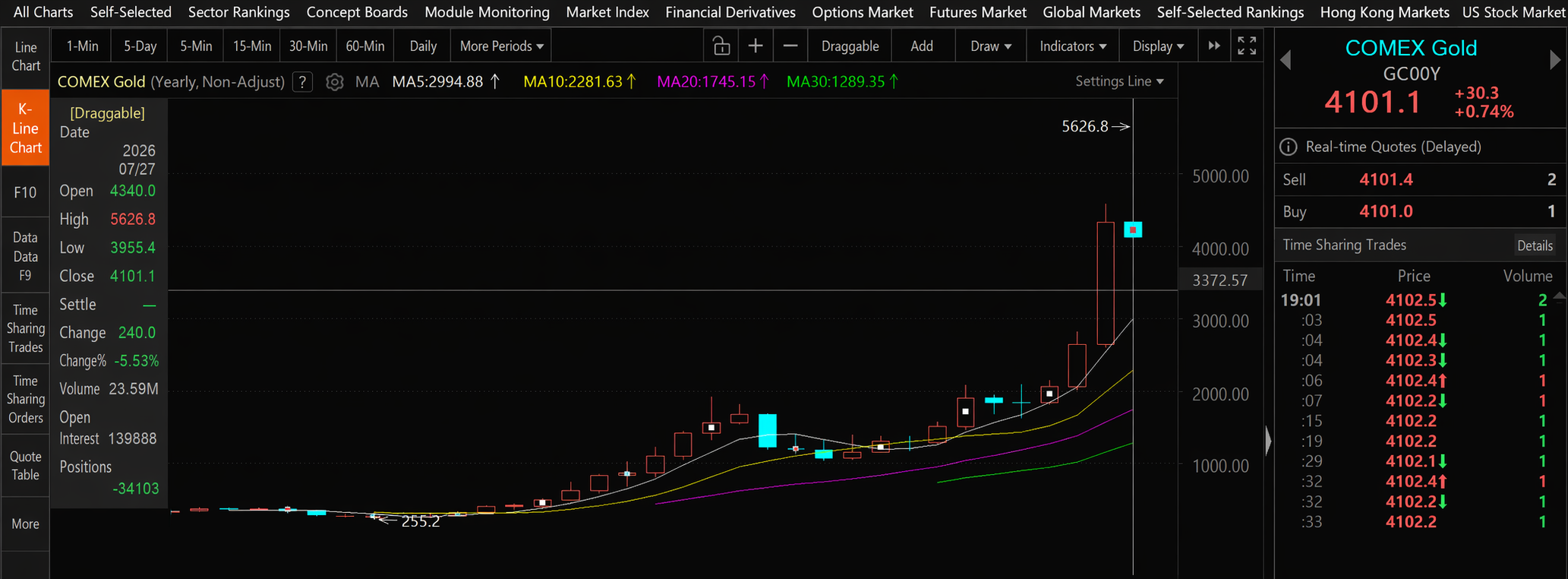
Gold price movements have been extremely sharp since the start of 2026. On January 29, COMEX gold hit an all-time high of $5,626.8 per ounce, but subsequently, pressured by factors such as heightened expectations for US Fed interest rate hikes, it fell to an intra-year low of $3,955.4 per ounce on June 30. Recently, easing US-Iran tensions have alleviated market concerns about inflation and interest rates staying high for longer, leading to a gold rebound. As of 19:12 on July 27, COMEX gold had risen 0.74% to $4,101.4 per ounce, with a year-to-date loss of 5.53%.
Regarding the outlook for precious metals, views from some institutions are as follows:
Teves Joni, gold strategist at UBS, remains positive on gold’s medium and long-term outlook. In her commentary, she noted that gold prices have risen since the start of this week, with gold stocks in Mainland China and Hong Kong gaining around 20% cumulatively over three days, a positive signal. "We think sentiment in gold is starting to improve and continue to expect gold prices to rebound from current levels before year-end," she said. The UBS global team stays upbeat about gold's medium-term picture and forecasts that gold will reach $4,675 per ounce by end-2026 and $4,800 per ounce by end-2027. Key events to watch ahead, she added, are the policy tone from the US Fed at the late-July FOMC meeting and further developments in the Middle East situation. (Jinshi Data App)
Analysts at ANZ Research said in a report that physical gold demand and central bank buying are supporting the gold market. They added that while gold faces near-term headwinds from expectations of further US Fed tightening and a firm US dollar, investment positioning in gold looks thin after months of ETF outflows, suggesting limited room for further declines. The high interest-rate environment typically weighs on non-yielding assets like gold. (Zhitoong Finance)
Goldman Sachs said that despite pressure from the US Fed’s tightening expectations, central bank buying is expected to provide a floor for gold. Demand remains strong, with the bank estimating that central banks purchased 81 mt in May, and the three-month average stood at 67 mt, well above the average of 17 mt before 2022. Goldman analysts noted, "We believe the trend of central banks adding gold will persist for years as they diversify reserves to hedge geopolitical and financial risks." The bank forecasts monthly average purchases of 50 mt this year and 40 mt next year. (Jinshi Data APP)
Kim Soojin, analyst at MUFG, said, "Recent price action suggests the market is placing more weight on the likelihood of U.S. rates staying higher for longer, rather than gold’s traditional safe-haven demand. This leaves gold vulnerable to stress unless geopolitical risks translate into a broader deterioration in financial market sentiment." (Jinshi Data APP)
Fidelity International said it plans to rebuild its gold position, which was trimmed earlier this year, at the right opportunity, believing that gold’s long-term drivers remain robust. Samson Ian, multi-asset portfolio manager at Fidelity International, recently said, "We plan to add back to gold, it’s just a matter of timing." He reduced gold allocation to neutral between January and February this year, when the multi-year bull run in gold ended. Samson expects gold to re-enter a bull market sometime in 2027, and only a scenario in which "governments return to fiscal discipline and central banks genuinely commit to bringing inflation back down" would undermine the case for a renewed bull market. "I don’t think we’re in that world right now," he added. Samson also said that sustained central bank gold buying, a key driver of the previous gold bull market, will continue to support prices.
Last Thursday, Bank of America technical strategists warned that gold’s pullback this year may have room to go much further, potentially resembling the devastating bear markets that followed the massive gold rallies in 1980 and 2011. They proposed a phased buying strategy, suggesting full allocation only when gold falls to the $3,450-$3,250 range. In a technical research note, BofA analysts pointed out that gold has gathered a series of bearish signals, with rising risks of a sustained drop: a death cross pattern, elevated net long open interest, a warning top candlestick, a TD Sequential exhaustion signal, and an RSI reading of 90 at the recent peak―a level consistent with the gold tops in 1980 and 2011.
UBP lowered its year-end gold target to $4,800 per ounce, and while it remains bullish on gold in the long term, it is not adding to positions for now. Its gold allocation stands at a neutral roughly 5%, down from an overweight position earlier this year, according to Gupta Paras, head of discretionary portfolio management for Asia at UBP, in an interview. Gupta said the previous overweight position "posed the biggest risk to our portfolio." UBP wants to see Middle East ceasefire agreements maintained, along with greater clarity on inflation and interest rate trends, before increasing its position. Gupta said that for investors with no gold exposure, a dip below $4,000 per ounce would be a highly attractive entry point. (Zhitoong Finance)

![Market awaits US CPI data for guidance; platinum spot market trading relatively active [SMM Daily Review]](https://imgqn.smm.cn/usercenter/yhuhG20251217171735.jpg)