Off-season weakness, high power and scrap costs, and defensive output cuts drag global crude steel production down 1.4% month-on-month to 155.7 million mt in June 2026.
Global crude steel production fell to 155.7 million mt in June 2026, down 1.4% from May, as the Northern Hemisphere summer lull collided with a persistent cost squeeze. Heat, monsoon rains, and negative mill margins combined to pull output lower, with the contraction led by European and North American summer maintenance and defensive production cuts in China. The Middle East and CIS bucked the trend, staging a modest rebound after sharp declines the month before.
A Breakdown of Regional and Core-Country Micro-Drivers in June 2026
Asia and Oceania: China trims, South Asia holds firm
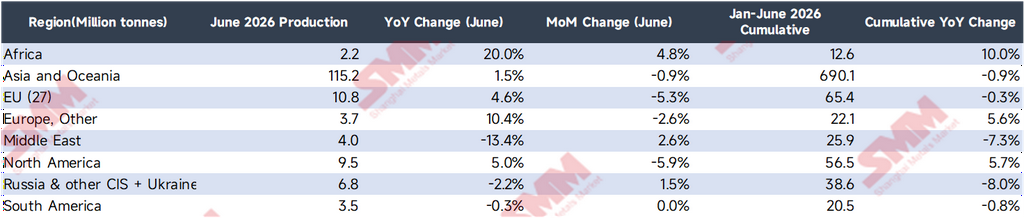
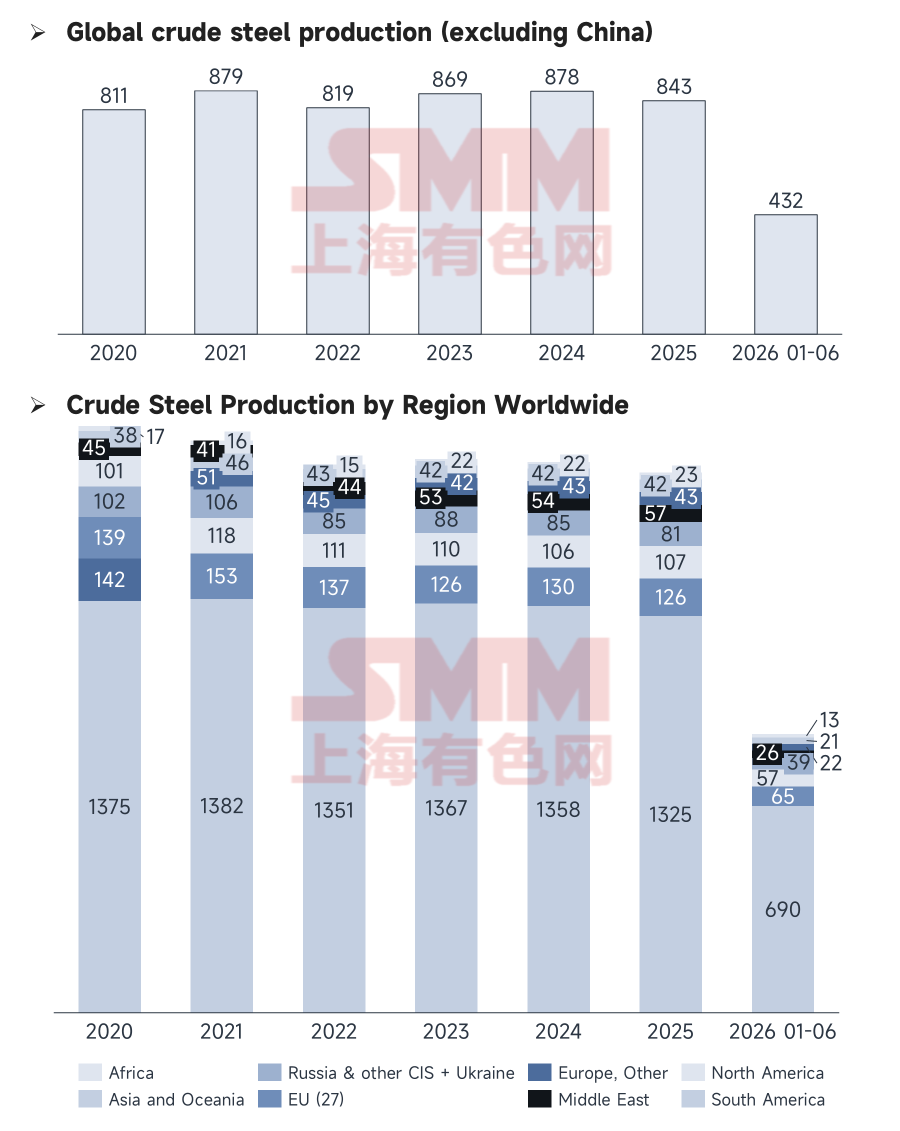
Asia and Oceania — the anchor of global steelmaking at 74% of world output in the first half of 2026 — saw production ease 0.9% month-on-month to 115.2 million mt.
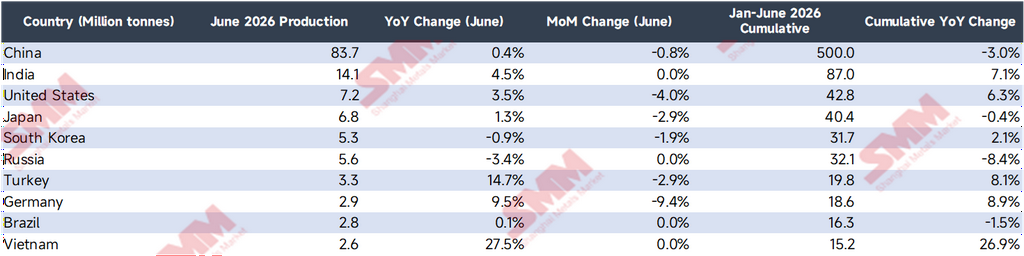
China, the world's largest producer, made 83.7 million mt, down 0.8%. Southern China's plum-rain season and a broad heatwave slowed outdoor construction, while poor finished-steel destocking and inverted margins — mills selling below cost — pushed producers to extend maintenance and cut output defensively.
South and Southeast Asia proved more resilient. India and Vietnam were both flat month-on-month at elevated levels of 14.1 million mt and 2.6 million mt respectively. India was supported by a domestic push to accelerate infrastructure work; Vietnam benefited from steady operations after Hoa Phat's Dung Quat Phase 2 capacity ramped up, alongside downstream restocking.
Northeast Asia was softer. Japan fell 2.9% to 6.8 million mt and South Korea 1.9% to 5.3 million mt, dragged by seasonal slowdowns in automotive and general machinery manufacturing.
Europe: summer maintenance and cost pressure
European producers entered a seasonal downturn as a group. EU-27 output dropped a sharp 5.3% to 10.8 million mt, while other European countries fell 2.6% to 3.7 million mt.
Germany was the main drag, plunging 9.4% to 2.9 million mt — a reflection of weak manufacturing order books and the early start of summer blast-furnace and rolling-line maintenance at major mills from mid-to-late June.
Turkey fell 2.9% to 3.3 million mt. Its heavily electric-arc-furnace-based (EAF) production was squeezed from both sides: high international scrap purchasing costs and competition from cheap Asian finished-steel exports, forcing mills to cut peak-hour operating rates. Across the region, concentrated summer maintenance, high power prices, and scrap costs eroding EAF margins sharply reduced the willingness to run.
Americas: weak north, steady south
The Americas showed a north-weak, south-stable pattern. North American output fell 5.9% to 9.5 million mt, while South America was flat at 3.5 million mt.
The US led the northern decline, down 4.0% to 7.2 million mt. Summer peak electricity demand widened peak-to-trough power price spreads, prompting major EAF operators to cut peak-hour shifts. At the same time, North American automakers began plant retooling for second-half model changeovers late in June, causing a temporary drop in finished-steel demand.
In South America, Brazil held flat at 2.8 million mt, with domestic construction and industrial demand steady and mills running at their normal pace.
Middle East and CIS: a rebound off the lows
In contrast to the weakness elsewhere, the Middle East and CIS staged a marginal recovery after sharp May declines.
The Middle East, which fell steeply in May on geopolitical conflict and sudden wartime energy rationing, recovered 2.6% to 4.0 million mt in June as tensions eased and energy allocations were adjusted, restoring some quotas to Iranian and Gulf mills.
The CIS and Ukraine region rose 1.5% to 6.8 million mt. Russia was flat at 5.6 million mt — still constrained by high interest rates and export bottlenecks — while restarts in Kazakhstan and other neighbors after May maintenance lifted the regional total. Africa also grew 4.8% to 2.2 million mt, driven by continued ramp-up of new North African direct-reduced iron (DRI) and EAF projects.
July Outlook and Key Risk Warnings
Global crude steel output is expected to hold at low levels through July 2026, caught between off-season demand and margin-crushing costs.
Three forces dominate. First, seasonal weakness intensifies: July is peak summer-holiday season across Europe and North America, idling downstream processors and auto plants and pushing end-demand to a third-quarter low, while China and South Asia enter their heat-and-monsoon peak. Second, the EAF cost ceiling comes into focus: high industrial power prices during peak summer demand, combined with a tight global scrap market, will compress EAF margins further and keep operating rates under pressure, even as overseas mills lift hot-metal or DRI charge ratios to cut costs. Third, margins remain under attack: entrenched high costs for premium iron ore and scrap will keep eroding mill profitability, and absent a strong demand pull, July output is likely to see another modest month-on-month contraction.

![[SMM Sheets & Plates Daily Comment] HRC futures surged alongside costs, with production still expected to edge down](https://imgqn.smm.cn/usercenter/ntiFA20251217171719.jpg)
![Tangshan Qian'an Raises Steel Billet Price by 10 to 3,000 Yuan/mt on August 24 [SMM Steel]](https://imgqn.smm.cn/usercenter/zLhJl20251217171720.jpg)