[SMM Chromium News]

Published: Jul 22, 2026 19:27

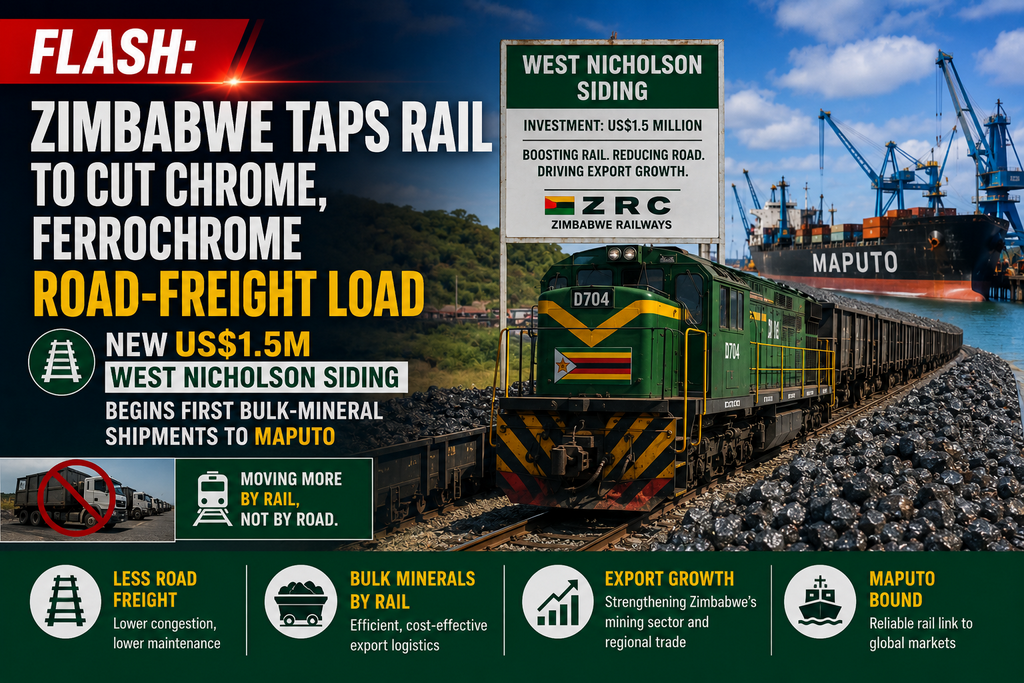
[Zimbabwe Taps Rail to Cut Chrome, Ferrochrome Road-Freight Load — New US$1.5M West Nicholson Siding Begins First Bulk-Mineral Shipments to Maputo]

1. Zimbabwe's Beitbridge Bulawayo Railway (BBR) commissioned a US$1.5 million transshipment rail siding at West Nicholson, Matabeleland South, on Monday — built in partnership with private operator Silvergill Logistics and state-owned National Railways of Zimbabwe (NRZ).

2. The siding is engineered to handle chrome, ferrochrome and other bulk minerals, moving output by rail to the Port of Maputo — the same corridor Zimasco already uses to ship ferrochrome from its Kwekwe smelters.

3. BBR General Manager Kumbulani Tendai Mabvura said the project is a declaration that "rail is back at the center of national logistics" for Zimbabwe's bulk minerals trade.

4. Cost relief: BBR and the Ministry of State for Matabeleland South frame the siding as easing pressure on the road network, cutting road-maintenance bills and truck congestion — costs that have been inflating landed prices of Zimbabwean chrome and ferrochrome.

5. Bulk-friendly shift: Rail is positioned as the safer, more efficient mode for bulk mineral freight, supporting Zimbabwe's push to scale ferrochrome output toward 1 million tonnes/year under the proposed Palm River project.

6. Timing: The siding opens as Zimbabwe's 2025 ferro-alloy sales rose 19% y/y to 433,293 tonnes (US$372 million, per MMCZ), even as chrome ore concentrate exports stagnated and revenue fell 12% — reinforcing rail as a national priority for chrome/ferrochrome tonnage.
Data Source Statement: Except for publicly available information, all other data are processed by SMM based on publicly available information, market communication, and relying on SMM's internal database model. They are for reference only and do not constitute decision-making recommendations.

For any inquiries or for more information, please contact: lemonzhao@smm.cn
For more information on how to access our research reports, please contact:service.en@smm.cn
Related News
[SMM Chromium Flash] CBAM Drives Ferrochrome Producers to Adopt EPDs, Enhancing Global Trade Competitiveness
6 hours ago
[SMM Chromium Flash] CBAM Drives Ferrochrome Producers to Adopt EPDs, Enhancing Global Trade Competitiveness
Read More
[SMM Chromium Flash] CBAM Drives Ferrochrome Producers to Adopt EPDs, Enhancing Global Trade Competitiveness
[SMM Chromium Flash] CBAM Drives Ferrochrome Producers to Adopt EPDs, Enhancing Global Trade Competitiveness
Kazakhstan's Kazchrome, the ferrochrome producer owned by Eurasian Resources Group, holds an internationally registered Environmental Product Declaration for its high-carbon ferrochrome, confirmed directly on the official EPD International registry as valid since 13 March 2026. The declaration, based on an independent lifecycle assessment by SGS, verifies the environmental footprint of ferrochrome produced at Kazchrome's Aktobe facilities across the full production cycle — from raw material mining and transportation through to water and energy consumption. SGS's ecology business manager for Kazakhstan and the Caspian subregion, Ilya Korlyakov, has said holding an EPD is becoming a meaningful competitive advantage as carbon requirements tighten in international markets. Kazchrome joins a small but growing list of ferrochrome producers with registered EPDs. Finland's Outokumpu was the first in the industry, publishing its declaration in July 2023, explicitly citing the EU's Carbon Border Adjustment Mechanism as the driver behind growing demand for verified low-carbon material. The EPD International registry also lists a Turkish ferrochrome declaration, registered through EPD Türkiye and valid since March 2026, alongside at least one other registered ferrochrome entry. With CBAM's transitional phase now well underway, EPDs are increasingly functioning as a practical requirement for import documentation into European markets rather than a purely voluntary sustainability signal.
6 hours ago
[SMM Chromium Flash] 6 Months After Lion Smelter's First Tap, South Africa's Ferrochrome Recovery Is Still Taking Shape
8 hours ago
[SMM Chromium Flash] 6 Months After Lion Smelter's First Tap, South Africa's Ferrochrome Recovery Is Still Taking Shape
Read More
[SMM Chromium Flash] 6 Months After Lion Smelter's First Tap, South Africa's Ferrochrome Recovery Is Still Taking Shape
[SMM Chromium Flash] 6 Months After Lion Smelter's First Tap, South Africa's Ferrochrome Recovery Is Still Taking Shape
South Africa's ferrochrome industry is still working through the recovery that began on 16 February 2026, when the Glencore-Merafe Chrome Venture's Lion Smelter in Steelpoort, Limpopo, achieved its first ferrochrome production tap after recommissioning 50% of its operating capacity. Six months on, that restart stands as the clear origin point of a recovery trajectory now visible across both Venture partners' own subsequent disclosures — even as the industry's underlying tariff economics remain only partially resolved. Lion's restart followed the National Energy Regulator of South Africa's approval of a 12-month interim electricity tariff of 87.74c/kWh, a steep cut from the roughly R2/kWh smelters had been paying, though the Venture said at the time that even this rate would not support Lion, Boshoek or Wonderkop sustainably over the long term — all three, it said, needed a tariff of 62c/kWh to be commercially viable. That gap defined the following months: NERSA approved the 62c/kWh tariff at the end of May, and the Section 189 retrenchment process affecting the smelters was formally withdrawn in June. At the time of Lion's restart, South Africa's ferrochrome sector had just 11 of its 66 furnaces operating nationally, against roughly 4.8 million tonnes of installed annual capacity — a level of distress industry voices warned could push output down toward 1 million tonnes in 2026 without tariff relief. The Venture's own subsequent reporting confirms Lion's tap as the start of a real, if gradual, recovery rather than a one-off event. Glencore's H1 2026 production report showed attributable ferrochrome output climbing from effectively nil in Q4 2025 and 13,000 tonnes in Q1 2026 to 97,000 tonnes in Q2 — a trajectory beginning exactly at Lion's February restart, with Glencore explicitly citing Lion's phased restart as the driver. Merafe's own H1 2026 results, released in full on 11 August, corroborate the same pattern from its 20.5% share of the Venture: chrome ore sales rose 75% to 380,000 tonnes and ferrochrome sales held nearly flat despite a 75% production collapse, with the company crediting higher prices and higher volumes sold, alongside continuing restart progress at Boshoek and Wonderkop, for the resulting profit more than doubling to R512 million. Taken together, the two companies' own numbers show that Lion's February tap was the first concrete evidence South Africa's ferrochrome collapse had found a floor, and that the subsequent tariff resolution and smelter restarts through H1 2026 have begun translating into real financial recovery for the Venture — even as the sector's longer-term competitiveness against lower-cost producers elsewhere remains an open question SMM continues to track.
8 hours ago
[SMM Chromium Flash] Global Chrome Ore Departures Fall 37.45% WoW to 448,500 mt, Dragged by Maputo
14 hours ago
[SMM Chromium Flash] Global Chrome Ore Departures Fall 37.45% WoW to 448,500 mt, Dragged by Maputo
Read More
[SMM Chromium Flash] Global Chrome Ore Departures Fall 37.45% WoW to 448,500 mt, Dragged by Maputo
[SMM Chromium Flash] Global Chrome Ore Departures Fall 37.45% WoW to 448,500 mt, Dragged by Maputo
Global chrome ore departures from major export ports totaled 448,500 mt in the week ended August 14, down 37.45% week-on-week, according to SMM's latest data. The pullback follows an unusually strong prior week in which total departures reached 717,000 mt, suggesting the latest figure reflects a partial normalization after elevated shipments rather than a sudden shift in underlying demand. Maputo remained the dominant corridor even as its volume eased to 333,200 mt from 496,200 mt, still accounting for roughly 74% of total departures. The decline coincided with unfavorable weather at the port, with freezing temperatures, heavy rains, and strong winds reported during the week, likely disrupting loading operations and contributing to the lower volume. Even so, Maputo's continued outsized share in a down week underscores Mozambique's growing structural weight in the seaborne chrome ore trade alongside, and increasingly rivaling, traditional South African export routes. Richards Bay saw a sharper proportional decline, falling to 82,200 mt from 171,500 mt, a drop-off that outpaced the market-wide contraction. The decline was likely affected by unfavorable coastal conditions, including strong winds and rain, which can slow vessel loading and berth operations at the port. Mersin departures also eased, to 33,100 mt from 49,300 mt, in line with its role as a smaller secondary loading point rather than a primary export corridor. Beira again recorded no chrome ore departures, indicating the port remains inactive in the current shipping cycle. Taken together, the week's data points to a weather-affected cooling in seaborne chrome ore flows from Southern Africa after a strong prior week, with Maputo's resilience relative to Richards Bay reinforcing the port's increasing centrality to regional export logistics.
14 hours ago