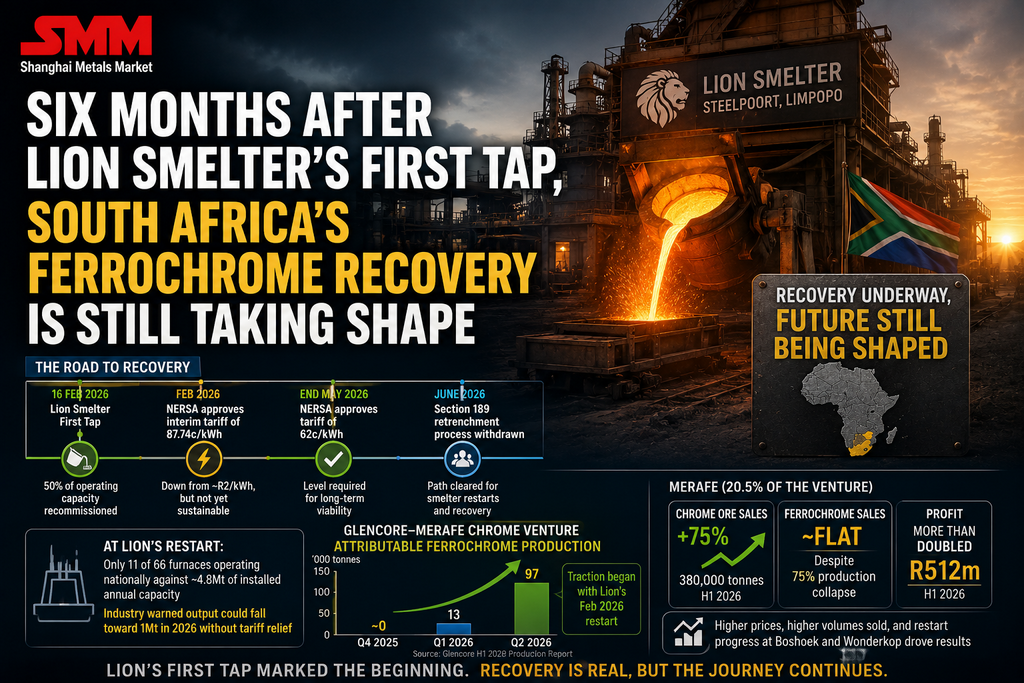
South Africa's ferrochrome industry is still working through the recovery that began on 16 February 2026, when the Glencore-Merafe Chrome Venture's Lion Smelter in Steelpoort, Limpopo, achieved its first ferrochrome production tap after recommissioning 50% of its operating capacity. Six months on, that restart stands as the clear origin point of a recovery trajectory now visible across both Venture partners' own subsequent disclosures — even as the industry's underlying tariff economics remain only partially resolved.
Lion's restart followed the National Energy Regulator of South Africa's approval of a 12-month interim electricity tariff of 87.74c/kWh, a steep cut from the roughly R2/kWh smelters had been paying, though the Venture said at the time that even this rate would not support Lion, Boshoek or Wonderkop sustainably over the long term — all three, it said, needed a tariff of 62c/kWh to be commercially viable. That gap defined the following months: NERSA approved the 62c/kWh tariff at the end of May, and the Section 189 retrenchment process affecting the smelters was formally withdrawn in June. At the time of Lion's restart, South Africa's ferrochrome sector had just 11 of its 66 furnaces operating nationally, against roughly 4.8 million tonnes of installed annual capacity — a level of distress industry voices warned could push output down toward 1 million tonnes in 2026 without tariff relief.
The Venture's own subsequent reporting confirms Lion's tap as the start of a real, if gradual, recovery rather than a one-off event. Glencore's H1 2026 production report showed attributable ferrochrome output climbing from effectively nil in Q4 2025 and 13,000 tonnes in Q1 2026 to 97,000 tonnes in Q2 — a trajectory beginning exactly at Lion's February restart, with Glencore explicitly citing Lion's phased restart as the driver. Merafe's own H1 2026 results, released in full on 11 August, corroborate the same pattern from its 20.5% share of the Venture: chrome ore sales rose 75% to 380,000 tonnes and ferrochrome sales held nearly flat despite a 75% production collapse, with the company crediting higher prices and higher volumes sold, alongside continuing restart progress at Boshoek and Wonderkop, for the resulting profit more than doubling to R512 million.
Taken together, the two companies' own numbers show that Lion's February tap was the first concrete evidence South Africa's ferrochrome collapse had found a floor, and that the subsequent tariff resolution and smelter restarts through H1 2026 have begun translating into real financial recovery for the Venture — even as the sector's longer-term competitiveness against lower-cost producers elsewhere remains an open question SMM continues to track.
![[SMM Chromium Flash] CBAM Drives Ferrochrome Producers to Adopt EPDs, Enhancing Global Trade Competitiveness](https://imgqn.smm.cn/usercenter/XUnxM20251217171723.jpeg)
![[SMM Chromium Flash] Global Chrome Ore Departures Fall 37.45% WoW to 448,500 mt, Dragged by Maputo](https://imgqn.smm.cn/usercenter/ZsMtd20251217171723.jpeg)