[SMM Analysis] DRC Announces Forfeiture and Reallocation of Unused Quotas in H1 2026 to Strategic Quotas

Published: Jun 30, 2026 18:35 (GMT+8)
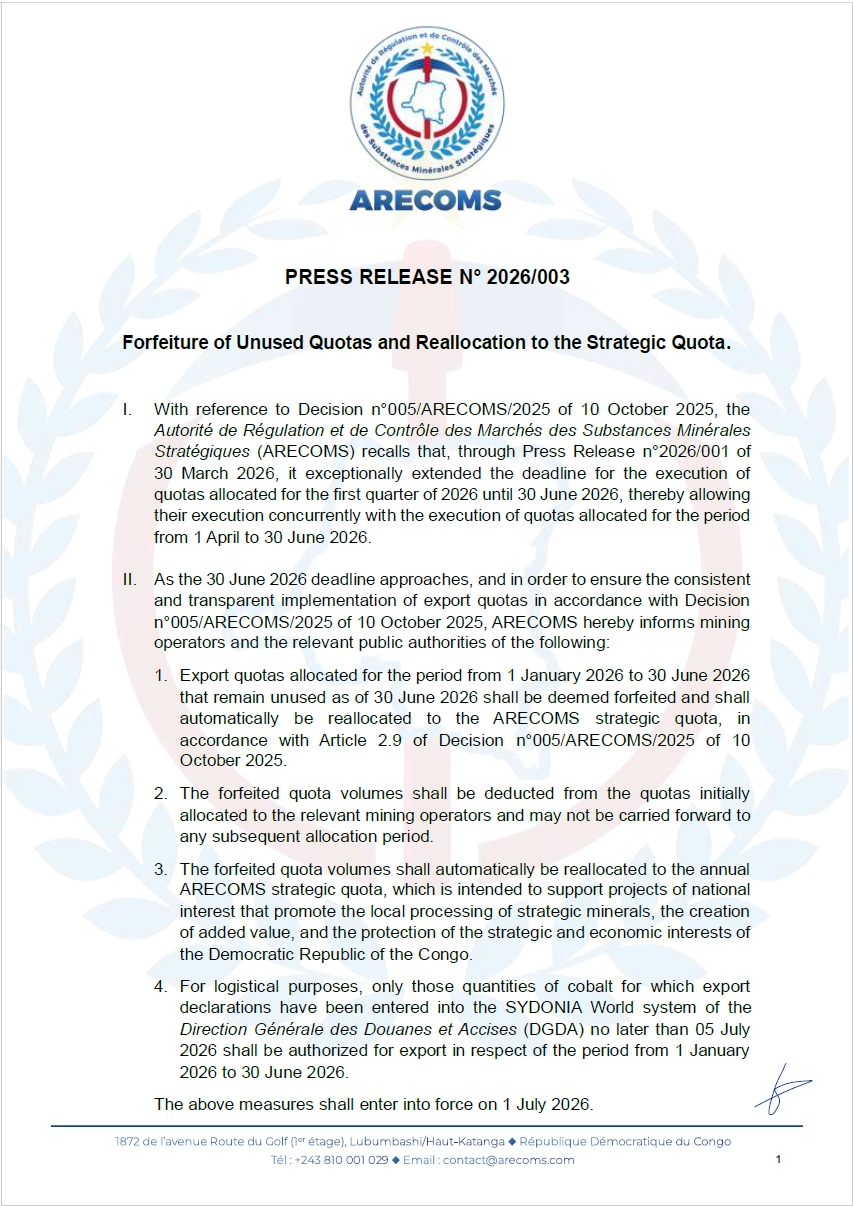
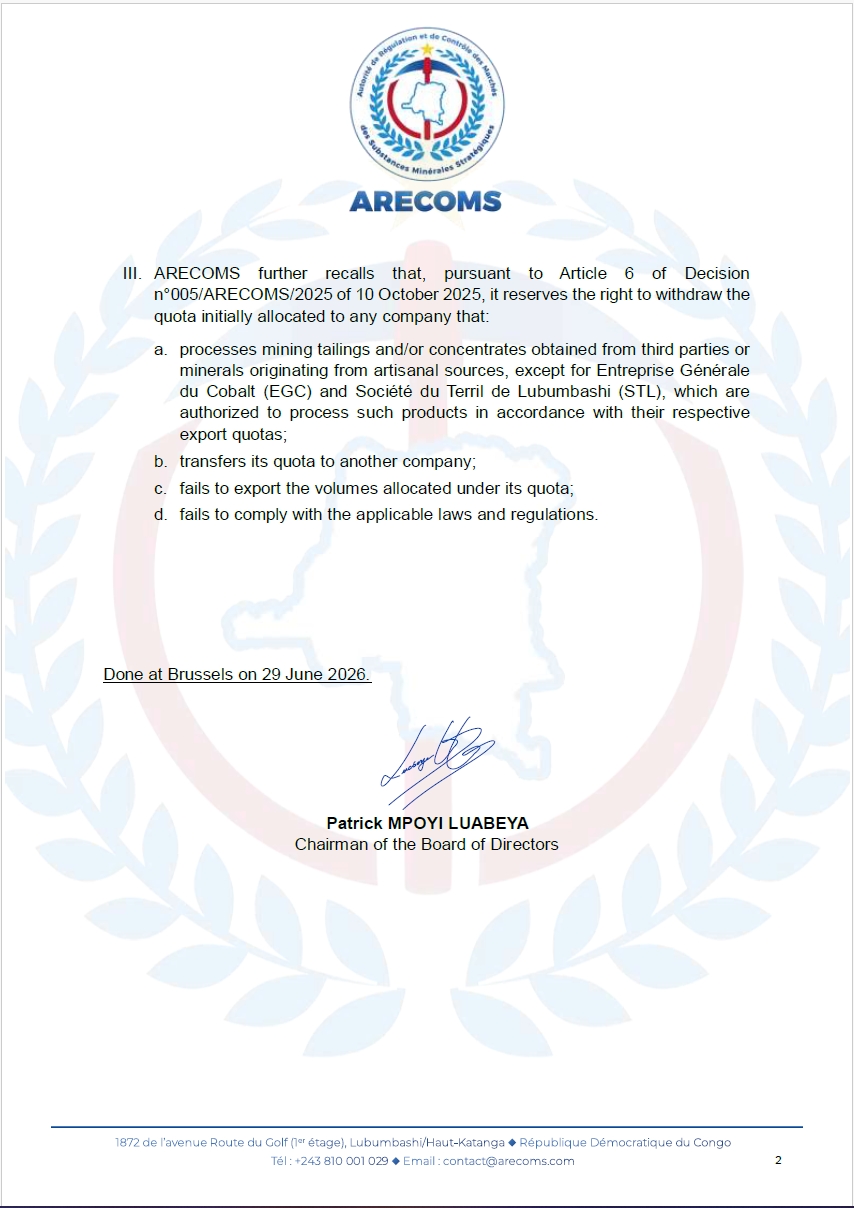
Recently, ARECOMS of the Democratic Republic of the Congo issued provisions governing unused export quotas for the first half of 2026. According to Press Release No. 2026/003 released by the Autorité de Régulation et de Contrôle des Marchés des Substances Minérales Stratégiques (ARECOMS), all unused quotas will be forfeited and reallocated to the strategic quota pool. The full text of the release is as follows:


Policy Impacts

Based on two core assumptions, SMM has calculated China’s supply of cobalt intermediate products (including supplementary high-cobalt recycled feedstock) for June–December 2026 and full-year 2027:

  1. Market statistics show that as of May 2026, mining enterprises have only paid advance payments for cobalt intermediates equivalent to roughly 32,000 metric tons of cobalt metal within the DRC. Factoring in a transit period of over three months for shipments from the DRC to China and volumes of cobalt resources designated for other overseas destinations, we assume China’s imports of cobalt intermediates will reach 46,000 metric tons of cobalt metal from June to December 2026, alongside domestic primary output of 500 metric tons. For 2027, we assume mining firms will allocate 80% of their 87,000-metric-ton cobalt intermediate quotas to China, translating to imports of approximately 70,000 metric tons of cobalt metal plus domestic primary production of 1,000 metric tons.
  2. Favorable economic margins have driven a sharp surge in China’s recycled cobalt output this year. High-grade recycled cobalt that can substitute for primary cobalt intermediates is factored in as supplementary feedstock: such recycled material will add 18,000 metric tons of cobalt metal supply between June and December 2026, and 36,000 metric tons in 2027.

China’s total demand for cobalt intermediates (including supplementary high-cobalt recycled feedstock) stands at around 58,000 metric tons of cobalt metal for June–December 2026, representing a mild surplus of 6,000 metric tons. This surplus will mainly emerge after August 2026 amid mass arrivals of intermediate cargoes at Chinese ports. For 2027, total demand for the same product category is estimated at 105,000 metric tons of cobalt metal, with a slight supply surplus of 3,000 metric tons.

However, this projected surplus is subject to notable uncertainties: First, after securing export approvals, mining operators may curtail circulating volumes to cap cobalt intermediate prices, which would keep the market relatively tight. Second, export approval procedures in the DRC remain sluggish, meaning miners may fail to fully utilize their baseline export quotas in the coming periods. Should actual import volumes fall short of forecasts, the domestic market will face a supply crunch.

Data Source Statement: Except for publicly available information, all other data are processed by SMM based on publicly available information, market communication, and relying on SMM's internal database model. They are for reference only and do not constitute decision-making recommendations.

For any inquiries or for more information, please contact: lemonzhao@smm.cn
For more information on how to access our research reports, please contact:service.en@smm.cn
Related News
Glencore Announces ASX Secondary Listing Date and Raises Full-Year Marketing Earnings Guidance
9 hours ago
Glencore Announces ASX Secondary Listing Date and Raises Full-Year Marketing Earnings Guidance
Read More
Glencore Announces ASX Secondary Listing Date and Raises Full-Year Marketing Earnings Guidance
【Glencore Announces ASX Secondary Listing Date and Raises Full-Year Marketing Earnings Guidance】Glencore announced that its secondary listing on the Australian Securities Exchange is expected to commence trading on Wednesday, October 14, 2026, under the ticker GLC, in the form of depositary interests with each interest corresponding to one ordinary share. The company also raised its earnings guidance, now expecting full-year 2026 adjusted marketing EBIT to exceed USD 5 billion, up from the approximately USD 4.9 billion indicative range provided alongside its interim results. Glencore additionally reset its long-term through-the-cycle marketing guidance from 2027, widening the range from USD 2.3–3.5 billion to approximately USD 2.8–4.2 billion with a midpoint of approximately USD 3.5 billion, based on readily marketable inventory of USD 32.2 billion and an assumed financing cost of approximately 5%.
9 hours ago
Solid-State Battery Next Decade Series, Part 7 of 9: Global Competitive Landscape—The "Patent Shadow War" and Industrialisation Race Among China, Japan and South Korea [SMM Analysis]
10 hours ago
Solid-State Battery Next Decade Series, Part 7 of 9: Global Competitive Landscape—The "Patent Shadow War" and Industrialisation Race Among China, Japan and South Korea [SMM Analysis]
Read More
Solid-State Battery Next Decade Series, Part 7 of 9: Global Competitive Landscape—The "Patent Shadow War" and Industrialisation Race Among China, Japan and South Korea [SMM Analysis]
[SMM Analysis: Solid-State Battery Next Decade Series, 7 of 9: Global Competitive Landscape—The "Patent Shadow War" and Industrialisation Race Among China, Japan, and South Korea] Is the development of global solid-state batteries measured by patents, determining the endpoint of each country's technological route? Currently, the global competition features China leading in quantity, while Japan and South Korea hold key patent positions. China is pursuing a dual-track approach, with solid-liquid batteries already in mass production and all-solid-state batteries catching up; Japan is doubling down on sulphide, South Korea is targeting dual markets, and Europe and the US are adopting technology imports plus local manufacturing. 2027-2028 is a critical window, with patents, industrialisation speed, and lithium sulphide capacity deciding the outcome.
10 hours ago
Third-Gen Ray-Ban Meta Smart Glasses Enter India Market, Camera-Free Audio Model Teased
Oct 02, 2026 14:04 (GMT+8)
Third-Gen Ray-Ban Meta Smart Glasses Enter India Market, Camera-Free Audio Model Teased
Read More
Third-Gen Ray-Ban Meta Smart Glasses Enter India Market, Camera-Free Audio Model Teased
【Third-Gen Ray-Ban Meta Smart Glasses Launch in India, Audio Model Teased for Market Entry】Meta announced that the third-generation Ray-Ban Meta smart glasses are now on sale in India, starting at INR 44,300, available through its official website, Ray-Ban India's official site, and local consumer electronics and eyewear retailers. The model offers up to 9 hours of battery life per charge — one hour more than its predecessor — along with a 12-megapixel camera supporting 3K ultra-HD video recording and a six-microphone array capable of eliminating over 90% of background noise, with 27 frame and lens combinations available. Meta also teased the upcoming India launch of the camera-free Ray-Ban Meta Audio, which weighs 43g and offers up to 12 hours of battery life per charge with an additional 48 hours via the charging case; pricing and launch date for India were not disclosed.
Oct 02, 2026 14:04 (GMT+8)