Hubei Yihua Signs 1 Mt/a Phosphogypsum-to-Sulfuric Acid Project amid Sulfur Supply Crisis

Published: Jun 30, 2026 13:59
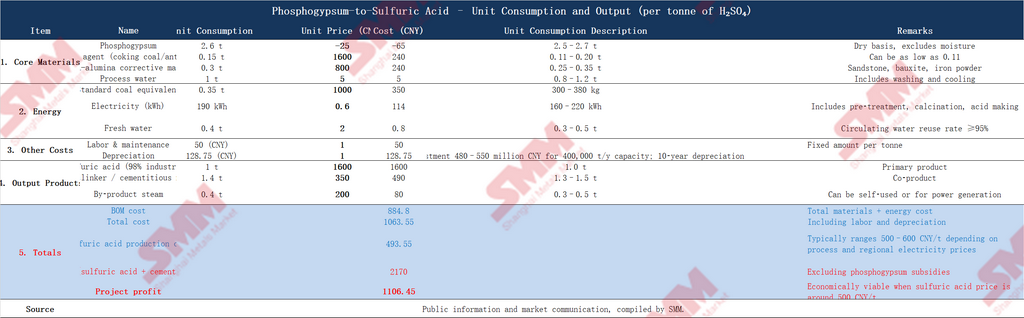
On 22 June 2026, China Wuhuan Engineering, Tianjin Cement Industry Design & Research Institute, and Hubei Yihua Chuxing Ecology signed a contract for a 1 Mt/a phosphogypsum-to-sulfuric acid project. The facility will produce 400,000 t/a of industrial sulfuric acid and cementitious admixtures using third-generation low-carbon calcination technology.

Hubei Yihua Signs 1 Mt/a Phosphogypsum-to-Sulfuric Acid Project amid Sulfur Supply Crisis

On 22 June 2026, China Wuhuan Engineering, Tianjin Cement Industry Design & Research Institute, and Hubei Yihua Chuxing Ecology signed a contract for a 1 Mt/a phosphogypsum-to-sulfuric acid project. The facility will produce 400,000 t/a of industrial sulfuric acid and cementitious admixtures using third-generation low-carbon calcination technology.

The project is a direct response to the May 2026 sulfur geopolitical crisis, when shipping disruptions in the Strait of Hormuz exposed China’s heavy reliance on imported sulfur for wet-process phosphoric acid. Phosphate acid prices surged over 70% to above 11,000 yuan/t. Phosphogypsum-based acid production becomes economically viable when sulfur prices exceed 1,500 yuan/t, replacing 0.3–0.35 t of imported sulfur per tonne of acid. The process creates a closed-loop cycle of solid waste, sulfur resources, and calcium materials.

China’s phosphogypsum-to-acid industry has moved from pilot to cluster stage. Existing capacity is about 1.2 Mt/a of sulfuric acid, with more than 4 Mt/a under construction or planning, concentrated in Hubei, Guizhou, Yunnan, and Sichuan. Hubei accounts for over 65% of national projects. Yihua has four projects totalling 4 Mt/a processing capacity, while Guizhou Phosphorus Group operates the largest 1.4 Mt/a flagship plant.

The project carries triple value: it alleviates the environmental burden (China generates >80 Mt/a phosphogypsum with <40% utilisation), hedges sulfur import risks, and turns a former liability into a profitable resource. Over the next three years, capacity is expected to double, significantly reducing sulfur import dependence and strengthening the resilience of China’s phosphorus chemical industry.


Note: If you have any further details to add regarding the points mentioned in this article, or if you have any questions on the phosphorus chemical industry (phosphate rock, phosphoric acid, iron phosphate, lithium iron phosphate, etc.) and solid-state batteries, please feel free to contact:

Tel: 021-20707860 (or add WeChat: 13585549799) – Yang Chaoxing. Thank you!

Data Source Statement: Except for publicly available information, all other data are processed by SMM based on publicly available information, market communication, and relying on SMM's internal database model. They are for reference only and do not constitute decision-making recommendations.

For any inquiries or for more information, please contact: lemonzhao@smm.cn
For more information on how to access our research reports, please contact:service.en@smm.cn
Related News
[SMM Analysis] Korea’s NEV Market Recovery Remains Mixed as ESS Emerges as a Key Growth Channel for Battery Makers
9 mins ago
[SMM Analysis] Korea’s NEV Market Recovery Remains Mixed as ESS Emerges as a Key Growth Channel for Battery Makers
Read More
[SMM Analysis] Korea’s NEV Market Recovery Remains Mixed as ESS Emerges as a Key Growth Channel for Battery Makers
[SMM Analysis] Korea’s NEV Market Recovery Remains Mixed as ESS Emerges as a Key Growth Channel for Battery Makers
Korea’s NEV market is recovering from late-2025 weakness, but the rebound remains HEV-led rather than BEV-driven. BEV share has improved, yet the recovery still lacks consistency. For Korean battery makers, domestic EV sales and export data alone are no longer sufficient indicators of demand recovery. ESS, supported by domestic policy demand and North American utility-scale projects, is emerging as a clearer growth channel.
9 mins ago
Eight Companies Including BYD Korea Disqualified From South Korea’s EV Subsidy Program
1 hour ago
Eight Companies Including BYD Korea Disqualified From South Korea’s EV Subsidy Program
Read More
Eight Companies Including BYD Korea Disqualified From South Korea’s EV Subsidy Program
According to the evaluation results for the selection of participants in South Korea’s EV deployment program announced by the Ministry of Climate, Energy and Environment on June 30, eight out of 35 manufacturers and importers, including BYD Korea, were disqualified.
1 hour ago
Samsung SDI to Cooperate With Forge Nano on North Carolina Gigafactory
1 hour ago
Samsung SDI to Cooperate With Forge Nano on North Carolina Gigafactory
Read More
Samsung SDI to Cooperate With Forge Nano on North Carolina Gigafactory
Samsung SDI will cooperate with U.S. battery technology company Forge Nano on the construction of a gigafactory in North Carolina. Forge Nano announced on June 25 local time that it signed a strategic partnership with Samsung SDI for U.S.-made battery production. Samsung SDI will support the construction of the plant, which will have an annual capacity of 3 GWh. Forge Nano will begin contract manufacturing Samsung SDI’s cylindrical battery cells from 2028.
1 hour ago
Hubei Yihua Signs 1 Mt/a Phosphogypsum-to-Sulfuric Acid Project amid Sulfur Supply Crisis - Shanghai Metals Market (SMM)