2026-07-20, Customs Data. In June 2026, China's phosphate ore imports reached 137,000 tonnes, up 4.5% MoM from May's 131,000 tonnes. Import value totaled USD 12.57 million, up 2.8% MoM. Average import price stood at USD 91.5/tonne, down 1.7% MoM from USD 93.0/tonne in May.
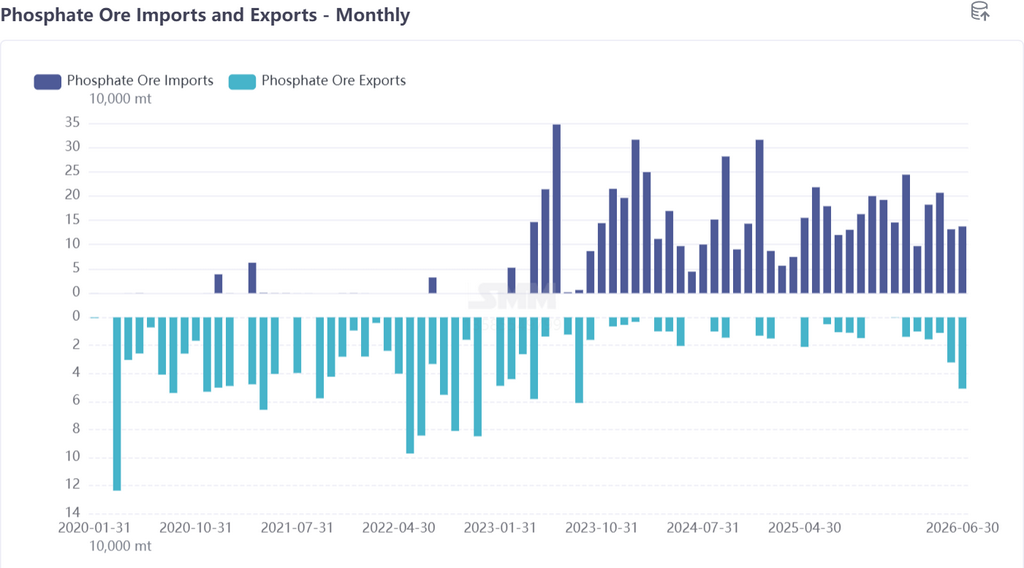
In May 2026, China imported 131,000 mt of phosphate ore, down 36.4% from April, with the average price easing 2.6% to $93/mt. The sharp decline was driven by the sudden halt of Peruvian and Jordanian supplies – both major sources in April – leaving Egypt as the sole dominant supplier (128,000 mt, 98% share). Meanwhile, Hubei, which had topped provincial imports in April, recorded zero imports in May, while Guangxi rebounded to first place with 78,000 mt. Exports more than doubled to 32,000 mt, led by Hubei's return to the market.
I. May 2026 Recap
May imports plunged 36.4% MoM to 131,000 tonnes, with value down 38.1% to USD 12.23 million and average price easing 2.6% to USD 93.0/tonne. Egypt dominated with 128,000 tonnes (+31.7% MoM), accounting for 97.7% of total imports. Peru and Jordan recorded zero shipments. Key event: On May 13, Egypt's Ministry of Petroleum and Mineral Resources announced it would stop signing new phosphate ore export contracts, pivoting toward higher-value phosphate fertilizer exports. Egypt's import price rose 14.1% MoM to USD 93.0/tonne, with CFR China (26-27% grade) at USD 95-100/tonne. By province, Guangxi reclaimed the top spot with 78,000 tonnes (+65.9% MoM); Hubei, April's leader at 157,000 tonnes, recorded zero imports in May (-100% MoM).
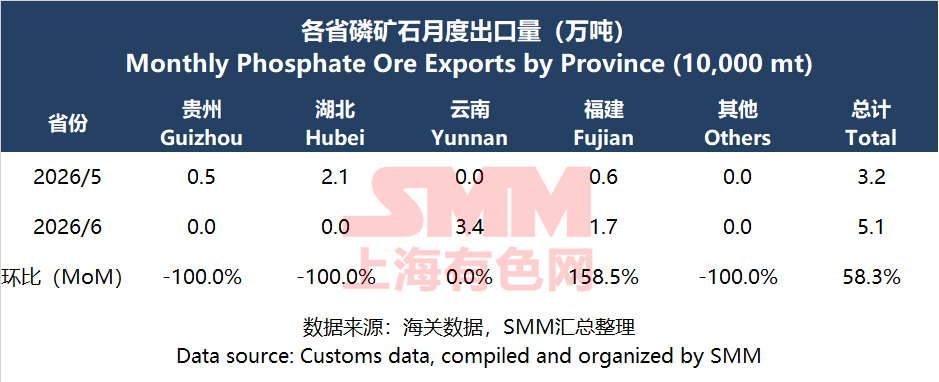
May exports surged 189.6% MoM to 32,000 tonnes, led by Hubei (21,000 tonnes), Fujian (6,000 tonnes, -40.6% MoM), and Guizhou (5,000 tonnes).
II. June 2026 Analysis
1. Imports: Slight Volume Rebound, Prices Edge Down
June imports edged up 4.5% MoM to 137,000 tonnes; value rose 2.8% to USD 12.57 million; average price dipped 1.7% to USD 91.5/tonne. The modest volume recovery alongside softening prices signals a transition phase of "volume recovery, source diversification" following Egypt's policy shock.
2. Source Country Restructuring: Egypt Share Drops to 61%, Jordan/Morocco/Kazakhstan Fill the Gap
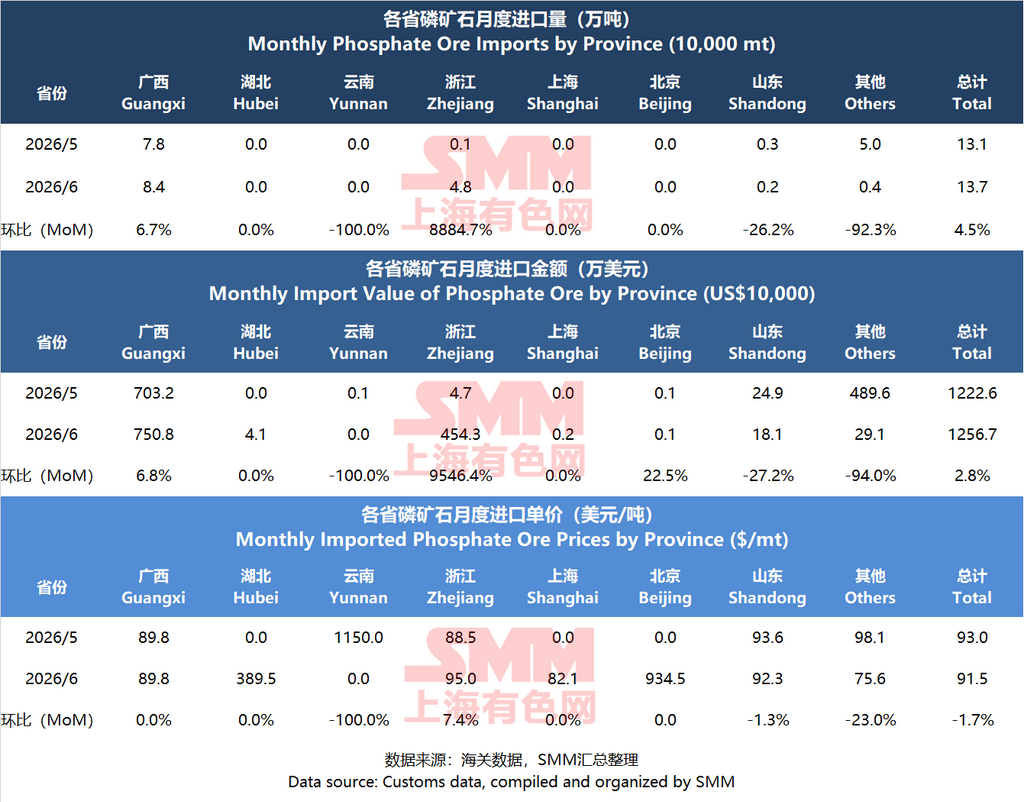
The single-source concentration of May was sharply reversed. Egypt imports fell from 128,000 tonnes to 84,000 tonnes (-34.7% MoM) but retained the top spot; its share plunged from 97.7% to ~61%, reflecting the real impact of the May 13 export ban. Jordan imports exploded from a near-zero base (~1 tonne) to 48,000 tonnes, a roughly 48-million-fold MoM increase, climbing to second place; its import price was USD 95/tonne. Pakistan shipped 6,000 tonnes (+71.6% MoM). Morocco, Kazakhstan, Peru, and Lebanon contributed a combined ~2,000 tonnes, with Morocco commanding an exceptionally high USD 5,050/tonne and Kazakhstan USD 2,895.2/tonne for premium-grade ores.
The widening gap between value (+2.8% MoM) and volume (+4.5% MoM) further confirms the structural price decline driven by Egypt's reduced share.
3. Provincial Pattern: Guangxi Holds Top, Zhejiang Soars ~89-fold, Hubei Returns at Premium
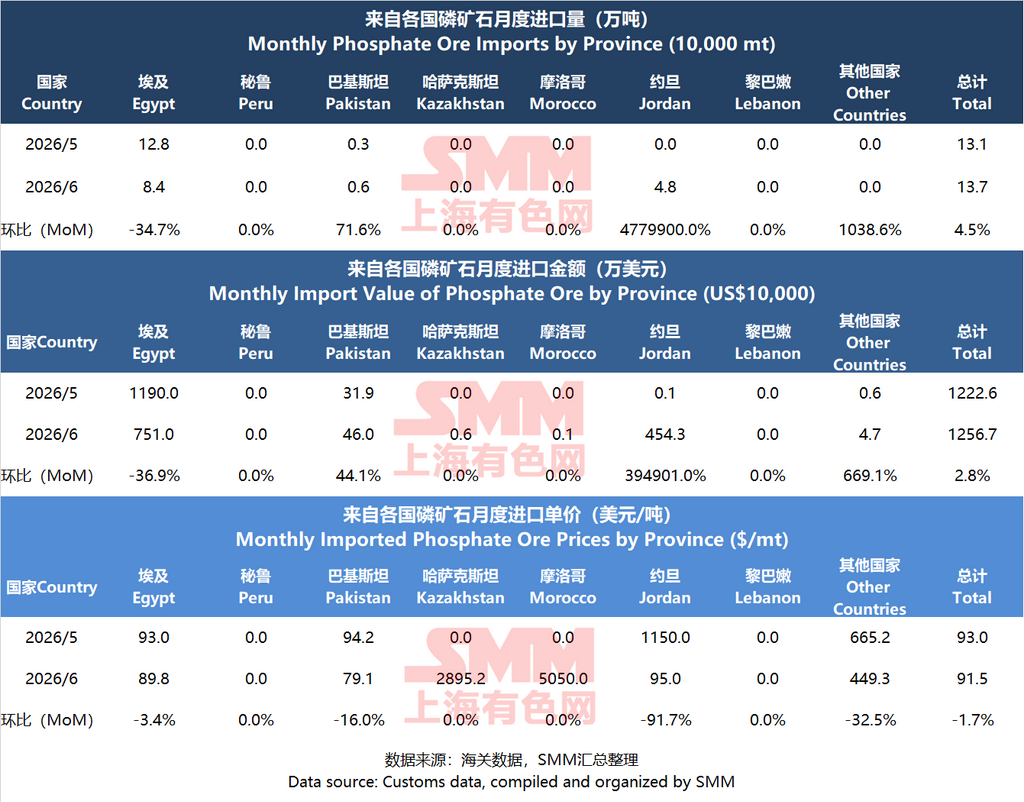
Guangxi retained the top spot with 84,000 tonnes (+6.7% MoM), import value USD 7.51 million (+6.8% MoM). Zhejiang imports surged from ~500 tonnes to 48,000 tonnes (+8,884.7% MoM, ~89-fold), with value up 9,546.4% to USD 4.54 million, reflecting rapid channel switching by Yangtze River Delta importers to Jordan and alternative sources. Hubei resumed partial imports at USD 389.5/tonne, far above the national average, indicating premium-grade procurement. Beijing posted the highest provincial price at USD 934.5/tonne. Yunnan recorded zero imports (-100% MoM).
4. Exports: 51,000 Tonnes, +58.3% MoM, Led by Yunnan and Fujian
June exports jumped 58.3% MoM to 51,000 tonnes. Yunnan led with 34,000 tonnes (zero in May), driven by concentrated delivery of pre-existing orders by Yunnan Phosphate Group and Yuntianhua. Fujian exported 17,000 tonnes (+158.5% MoM). Guizhou and Hubei recorded zero exports. The export surge reflects tight domestic supply amid strong winter stockpile expectations and accelerating LFP demand from the new energy chain.
III. Market Outlook
June phosphate ore imports show four features: (1) Slight volume rebound but recovery below expectations; (2) Sharp source diversification — Egypt's share plunged from 97.7% to ~61%, with Jordan, Pakistan and Morocco stepping in; (3) Accelerated provincial channel restructuring — Guangxi holds, Zhejiang soars 89-fold, Hubei returns at premium; (4) Exports surged 58.3% on Yunnan and Fujian strength, indicating tight domestic supply.
Q3 Outlook: Egypt's export ban impact will continue to transmit. July-August imports are expected at 130,000-150,000 tonnes, with prices in the USD 90-100/tonne range. Three key watchpoints: (1) Supply stability and grade mix of alternative sources (Jordan, Morocco, etc.); (2) Pace of domestic phosphate fertilizer and LFP seasonal demand pull-through; (3) Export policy and customs rhythm shifts ahead of the October-November winter stockpile season. Q3 average import price is forecast at USD 90-100/tonne, with Q4 volume set to rebound and price center potentially shifting up to USD 95-105/tonne as winter stockpile demand materializes.
Note: If you have any further details to add regarding the points mentioned in this article, or if you have any questions on the phosphorus chemical industry (phosphate ore, phosphoric acid, iron phosphate, lithium iron phosphate, etc.) and solid-state batteries, please feel free to contact:
Tel: 021-20707860 (or add WeChat: 13585549799) – Yang Chaoxing. Thank you!

![[Lithium Battery: Mitsubishi Motors Plans To Build Battery Plant In Philippines]](https://imgqn.smm.cn/usercenter/fblvS20251217171729.png)
![[Lithium Battery: Environmental Impact Assessment For A Lithium Battery Anode Material Project In Guizhou Announced]](https://imgqn.smm.cn/usercenter/nVnLo20251217171728.jpg)