Key Points:
CATL launched the Qilin Condensed Battery (350 Wh/kg, fully charged in 6 min 27 sec) with a condensed electrolyte that achieves "no liquid flammability". BYD's second-generation Blade Battery has an energy density of 162 Wh/kg (a 5% increase), charges from 10% to 70% in 5 minutes and to 97% in 9 minutes, with a cell cost of only RMB 0.65/Wh. BYD plans 20,000 flash charging stations (vs. CATL's 4,000), with a single-gun peak power of 1500 kW. On solid-state batteries: CATL's condensed battery is a semi-solid (solid-liquid hybrid) battery already in production; no all-solid-state battery was mentioned this time. BYD has not announced mass production of semi-solid (hybrid) or all-solid-state batteries.

Introduction
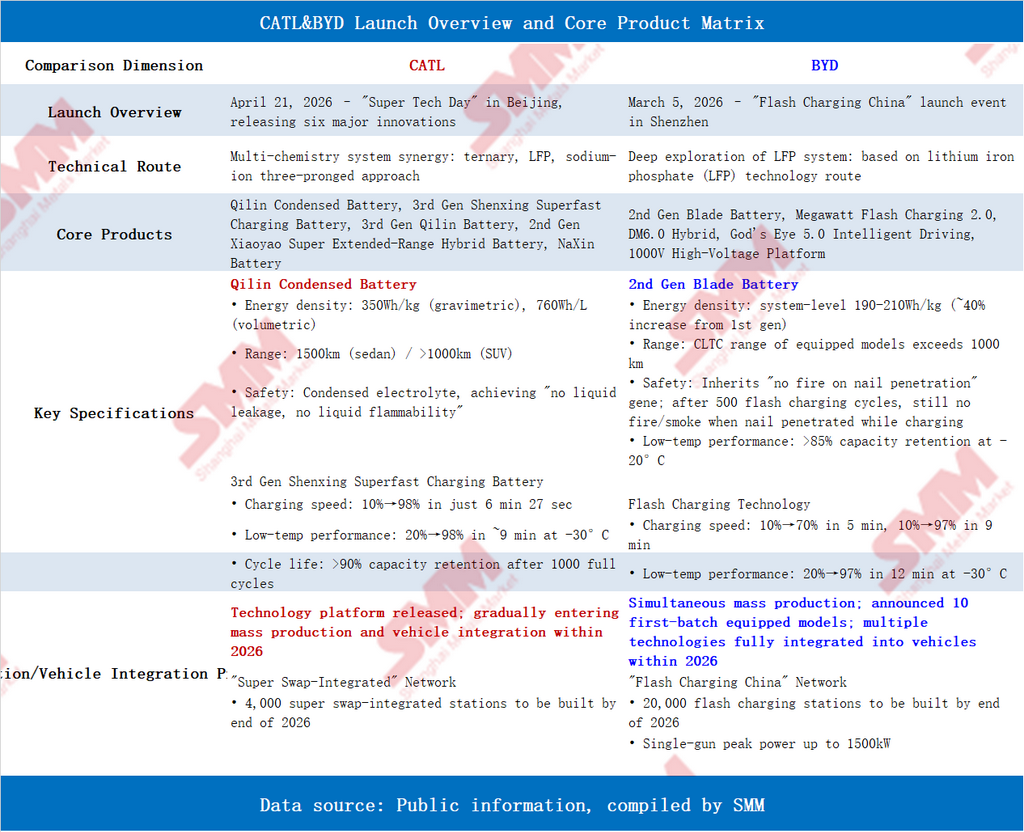
On April 21, 2026, CATL unveiled the Qilin Condensed Battery, the third-generation Shenxing Superfast Charging Battery, the third-generation Qilin Battery, the second-generation Xiaoyao Super Extended-Range Hybrid Battery, the NaXin Battery, and the "Super Swap-Integrated" charging network plan at its "Super Tech Day" in Beijing.
One month earlier, on March 5, 2026, BYD held the "Flash Charging China" launch event in Shenzhen, introducing the second-generation Blade Battery, Megawatt Flash Charging 2.0, DM6.0 Hybrid, God's Eye 5.0 Intelligent Driving, and the 1000V high-voltage platform. While the core technical specifications of the two launches differ significantly, examining their respective progress in solid-state batteries reveals an even more critical next-generation competition.
I. Launch Overview and Core Product Matrix
(The table from the original text is omitted here; only the textual description is provided.)
II. Detailed Comparison of Battery Technology Routes and Core Specifications
1. Energy Density: Extreme Breakthrough vs. In‑Depth System Exploration
CATL: The Qilin Condensed Battery sets a new mass‑production record with a gravimetric energy density of 350 Wh/kg, marking the first time that aerospace‑grade condensed technology has been applied to passenger vehicles. This high energy density relies primarily on high‑nickel cathodes and silicon anodes, but at a higher cost – the third‑generation Qilin battery has a cell cost of approximately RMB 0.78/Wh.
BYD: The second‑generation Blade Battery achieves a system energy density of 162 Wh/kg within the LFP system, an increase of about 5% over the first generation. This breakthrough mainly depends on the combined use of fourth‑generation LFP materials and silicon‑carbon anodes. Although the absolute value is lower than that of ternary systems, it approaches the level of some medium‑nickel ternary batteries. More importantly, its cell cost is only about RMB 0.65/Wh, significantly lower than that of the Qilin Condensed Battery, providing a foundation for bringing the technology down to the RMB 150,000‑class vehicle segment.
2. Charging Speed: Full‑Range Efficiency vs. Extreme Full Charge
In terms of charging speed, the two companies represent the highest level in the industry today, but with different strategies:
BYD – "Full‑Range Efficiency": The second‑generation Blade Battery adopts a strategy of "5 minutes for a good charge, 9 minutes for a full charge". It takes only 5 minutes to charge from 10% to 70%, and 9 minutes to reach 97%. Its advantage lies in extremely fast replenishment at low state‑of‑charge, and a smoother overall charging curve, effectively solving the traditional pain point of slow charging in the last 20%.
CATL – "Extreme Full Charge": The third‑generation Shenxing Superfast Charging Battery achieves an equivalent 10C rate and a peak of 15C, charging from 10% to 98% in just 6 minutes and 27 seconds. This speed leads BYD in the "full charge" dimension, but its low‑SOC charging efficiency (reaching about 40‑50% in the first 5 minutes) is less aggressive than BYD's "70% in 5 minutes" approach.
3. Safety: Chemical‑Level Safety vs. Engineering‑Level Safety
CATL: The Qilin Condensed Battery upgrades the electrolyte from liquid to condensed state, achieving "no liquid leakage, no liquid flammability" at the chemical system level, fundamentally eliminating the risk of leakage and fire.
BYD: Carrying forward the structural safety genes of the Blade Battery, it has passed extreme tests far exceeding national standards – after 500 flash charging cycles (simulating about 15 years of use), the battery is still nail‑penetrated while charging, with no fire, smoke, or explosion. In a thermal diffusion test, four cells are short‑circuited simultaneously, and the surrounding cells remain stable. This "structural and material system‑based safety" approach offers a greater cost advantage on the LFP route.
III. Mass Production and Technology Popularisation
CATL: The technology platform released in April is expected to gradually enter mass production and vehicle integration within 2026, with the specific pace depending on the development cycles of downstream automakers.
BYD: Simultaneous mass production was announced at the launch, with 10 first‑batch equipped models unveiled, covering the Yangwang, Denza, Dynasty, and Ocean brands. More importantly, its flash charging technology has already been brought down to the mainstream RMB 150,000‑200,000 segment – models such as the Sealion 06 EV (RMB 159,900‑179,900) and Seal 07 EV (RMB 169,900‑189,900) are already equipped with the second‑generation Blade Battery and flash charging technology.
IV. Charging Infrastructure Construction
CATL: Adopts a "Super Swap‑Integrated" solution that combines charging and swapping, planning to build 4,000 super swap‑integrated stations by the end of 2026, emphasising operational efficiency with equipment utilisation above 85%.
BYD: Focuses on pushing charging speed to the extreme – with a single‑gun peak power of 1500 kW, it is a global leader, and is expanding its "Flash Charging Station" network at an astonishing pace: 20,000 flash charging stations to be built by the end of 2026, five times the scale of CATL. Combined with its integrated storage‑charging "solar‑storage‑charging" solution, BYD enables rapid deployment of a high‑power charging network without major grid upgrades. In addition, BYD announced that its flash charging stations are open to all brands, and offers the first batch of flash charging vehicle owners one year of free flash charging.
V. Concluding Remarks
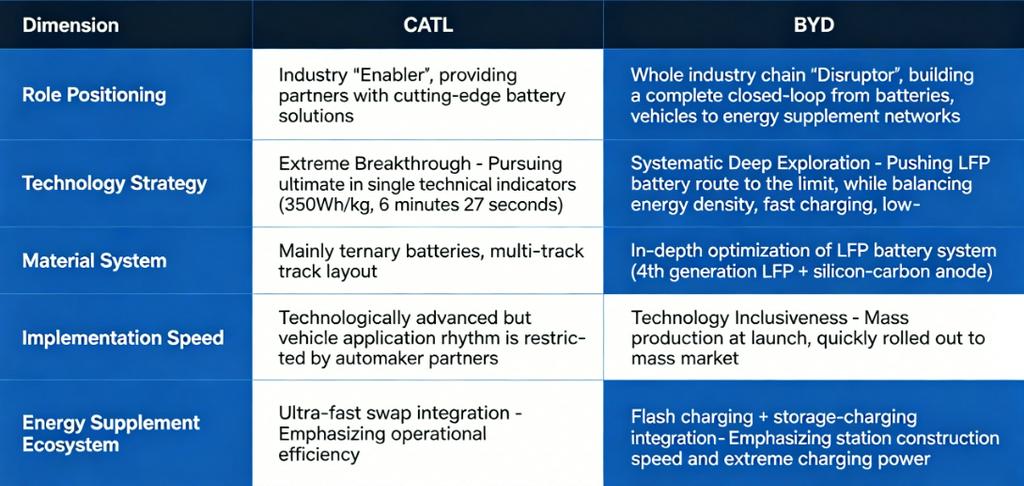
SMM believes that this peak clash between CATL and BYD is essentially a collision of two strategic mindsets, as illustrated in the comparison chart below.
Regarding solid‑state batteries (all‑solid‑state and semi‑solid/hybrid):
CATL’s Qilin Condensed Battery, launched at the "Super Tech Day" on April 21, 2026, uses a semi‑solid electrolyte and belongs to the category of solid‑liquid hybrid batteries (quasi‑solid/semi‑solid) that represent a transition from liquid lithium batteries to all‑solid‑state batteries. This battery has an energy density exceeding 350 Wh/kg and significantly improved safety, and is currently aimed at high‑end electric vehicles, flying cars, and similar applications. BYD did not disclose any new progress on solid‑state (hybrid) batteries during its recent launch, and has not yet introduced a vehicle‑grade solid‑state (hybrid) battery that meets mass‑production requirements. However, both CATL and BYD are advancing their solid‑liquid hybrid battery product portfolios in the energy storage sector.
According to SMM forecasts, all-solid-state battery shipments will reach 13.5 GWh by 2028, while semi-solid-state battery shipments will reach 160 GWh. Global lithium-ion battery demand is projected to reach approximately 2,800 GWh by 2030, with the EV sector's lithium-ion battery demand showing a CAGR of around 11% from 2024 to 2030, ESS lithium-ion battery demand at a CAGR of about 27%, and consumer electronics lithium battery demand at a CAGR of roughly 10%. Global solid-state battery penetration is estimated at about 0.1% in 2025, with all-solid-state battery penetration expected to reach around 4% by 2030, and global solid-state battery penetration potentially approaching 10% by 2035.
**Note:** For further details or inquiries regarding solid-state battery development, please contact:
Phone: 021-20707860 (or WeChat: 13585549799)
Contact: Chaoxing Yang. Thank you!
![Solid-State Battery Next Decade Series, Part 9 of 9: A Brand-New Track, Not a "Simple Sequel" to Liquid Lithium Batteries [SMM Analysis]](https://imgqn.smm.cn/usercenter/ezoBg20251217171730.jpg)
![[Solid-state: Chunli New Energy's 1GWh solid-state battery plant starts production in Jiangxi]](https://imgqn.smm.cn/usercenter/MaxcL20251217171730.jpg)