Middle East Escalation: Copper Prices Under Pressure Amid Rising Supply Risks in Africa

Published: Mar 10, 2026 10:00
Tensions in the Middle East have escalated again recently, as the conflict between Israel and Iran continues to intensify, drawing renewed global attention to energy transportation security in the Gulf region.Given the high level of uncertainty surrounding the development of the situation, market risks are clearly skewed to the upside. This article provides a brief analysis of how the current conflict may affect the copper market going forward.

Tensions in the Middle East have escalated again recently, as the conflict between Israel and Iran continues to intensify, drawing renewed global attention to energy transportation security in the Gulf region. The key transmission channel currently being watched by the market is energy supply, particularly shipping through the Strait of Hormuz. This waterway accounts for roughly one-fifth of global seaborne oil trade, and any disruption to traffic would have a direct impact on global energy supply. Given the high level of uncertainty surrounding the development of the situation, market risks are clearly skewed to the upside. This article provides a brief analysis of how the current conflict may affect the copper market going forward.

From a macroeconomic perspective, the surge in energy prices represents the main transmission mechanism through which the conflict affects the global economy. Rising oil prices not only push up global inflation, but also erode real household income and weigh on consumption, thereby dragging down economic growth. Market estimates suggest that if oil prices remain around $80 per barrel, global GDP growth in 2026 could be reduced by about 0.1 percentage points; if prices temporarily spike to $100 per barrel, the drag could widen to around 0.4 percentage points. At the same time, higher oil prices would also push up overall global inflation, potentially adding between 0.2 and 0.7 percentage points under a high-price scenario. Against this backdrop, markets are repricing expectations for the Federal Reserve’s rate-cutting path and global financial conditions. If energy prices remain elevated, the easing cycle could be delayed, and tighter financial conditions would place pressure on cyclical assets. For the copper market, this macro transmission channel implies short-term downside pressure on prices. As the conflict drives oil prices higher, concerns about inflation and tighter monetary policy have increased, risk appetite has declined, and some speculative long positions have begun to unwind, putting pressure on copper prices. Over the longer term, however, the copper market continues to face structural supply constraints, meaning that the current macro shock is more likely to manifest as sentiment-driven volatility rather than a fundamental reversal of the supply-demand trend.

At the same time, developments in the Middle East may affect the copper market through another supply-chain channel: the indirect impact on the hydrometallurgical copper production system in the Democratic Republic of Congo (DRC). A significant portion of DRC refined copper production relies on hydrometallurgical processes, which depend heavily on sulfuric acid supply. According to SMM, sulfuric acid consumption for producing one tonne of refined copper locally ranges from about 2 to 6 tonnes; assuming an average of roughly 4 tonnes, annual sulfuric acid consumption in the DRC is estimated at around 10 million tonnes. The global sulfur trade is closely linked to energy transportation routes, and the Middle East serves both as a critical energy transit corridor and an important node in global sulfur trade. If transport in the Gulf region is disrupted, sulfur trade flows may be affected, potentially pushing up sulfuric acid prices. At present, delivered sulfuric acid prices in the DRC have already exceeded $1,000 per tonne, with a significant supply shortfall still present. Local smelters are reportedly holding only about four to six weeks of inventory. If geopolitical tensions ease in the near term, the impact may remain limited. However, rising raw material costs or tightening supply would increase the risk of production disruptions, potentially affecting the stability of African copper supply and contributing to a rebound in regional copper premiums that had previously been declining.
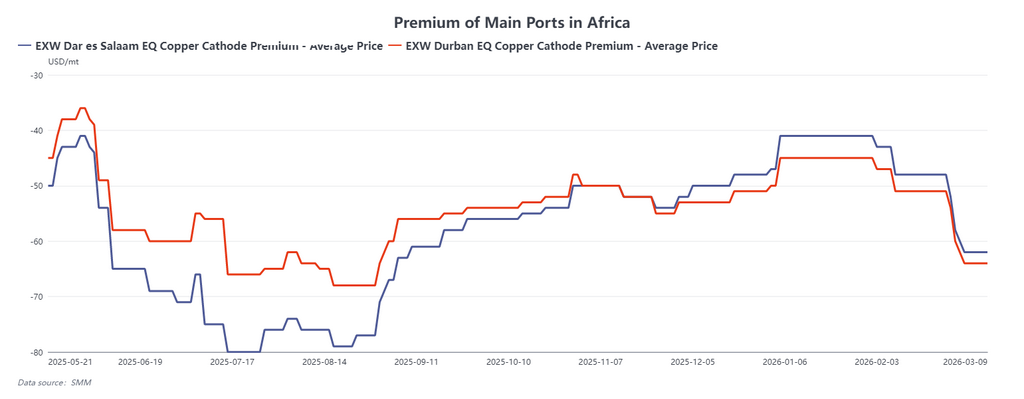
Overall, the Middle East conflict is affecting the copper market through two main channels. On one hand, higher oil prices are increasing inflationary pressure and tightening financial conditions, weighing on copper and other cyclical assets. On the other hand, if energy and sulfur transport disruptions persist, the cost structure and supply stability of African hydrometallurgical copper production could be affected. The future trajectory of copper prices will therefore depend on the duration of the conflict, movements in oil prices, and changes in global financial conditions, while potential disruptions to African supply chains may emerge as another key variable for the market to watch.

Data Source Statement: Except for publicly available information, all other data are processed by SMM based on publicly available information, market communication, and relying on SMM's internal database model. They are for reference only and do not constitute decision-making recommendations.

For any inquiries or for more information, please contact: lemonzhao@smm.cn
For more information on how to access our research reports, please contact:service.en@smm.cn
Related News
Zambia's Hichilema Re-elected, Focus Shifts to Copper Production Growth and Infrastructure Challenges
9 hours ago
Zambia's Hichilema Re-elected, Focus Shifts to Copper Production Growth and Infrastructure Challenges
Read More
Zambia's Hichilema Re-elected, Focus Shifts to Copper Production Growth and Infrastructure Challenges
President Hakainde Hichilema’s re-election provides greater policy continuity for Zambia’s mining sector, but the focus is now shifting from investment commitments and macroeconomic stabilisation toward whether the country can translate its expanding copper project pipeline into sustained production growth.​ Official results confirmed Hichilema’s second-term victory on August 18, with around 60% of the vote. For mining investors, the result reduces uncertainty around the policy direction that has underpinned Zambia’s recent push to attract capital into copper and other strategic minerals.​ Zambia is targeting annual copper production of 3 million tonnes by 2031, nearly triple current output levels. The strategy depends on a combination of brownfield expansions, new mine developments and continued exploration, making execution over the next several years critical to determining whether the target can be achieved.​ The main constraint is increasingly infrastructure rather than geological potential. Mining companies have highlighted electricity availability as one of the most important risks to future production growth, with industry estimates indicating that roughly 2,000 MW of additional power capacity will be required to support the planned expansion of the mining sector.​ Climate risk adds further complexity. Zambia’s heavy dependence on hydropower leaves the system exposed to weak rainfall and reservoir inflows, while the developing 2026–27 El Niño raises the possibility of renewed pressure on electricity supply. Reuters notes that previous drought-related shortages constrained mining activity and remain an important risk to the country’s copper-growth outlook.​ From a copper-market perspective, Hichilema’s second term therefore represents a transition from policy continuity to delivery. Zambia has attracted renewed mining investment and built a substantial project pipeline, but reaching the 3 million-tonne target will depend on whether new mines and expansions can be brought online alongside sufficient power, infrastructure and financing.​The next phase of Zambia’s copper story will therefore be measured less by announced investment and more by actual tonnes produced.
9 hours ago
After Delivery, Sharp Drop in Copper Prices Curbs Suppliers' Shipments [SMM Secondary Copper Daily Review]
15 hours ago
After Delivery, Sharp Drop in Copper Prices Curbs Suppliers' Shipments [SMM Secondary Copper Daily Review]
Read More
After Delivery, Sharp Drop in Copper Prices Curbs Suppliers' Shipments [SMM Secondary Copper Daily Review]
15 hours ago
LME Copper Inventories Rise by More Than 10kt in Two Days, Copper Prices Touch $14,000 at Low Levels
15 hours ago
LME Copper Inventories Rise by More Than 10kt in Two Days, Copper Prices Touch $14,000 at Low Levels
Read More
LME Copper Inventories Rise by More Than 10kt in Two Days, Copper Prices Touch $14,000 at Low Levels
LME copper inventories increased for two consecutive trading sessions. On August 14, LME copper inventories increased by 2,850 mt to 207,800 mt, and on August 17, inventories further increased by 15,700 mt to 223,600 mt. The cumulative increase over the two trading sessions was 18,600 mt, representing a growth rate of about 9.1%. In particular, warehouse inflows reached 17,500 mt on August 17, driving a sharp rebound in inventories that day. In terms of warrant structure, as of August 17, LME copper registered warrants increased to 123,100 mt, up by 20,000 mt from August 14. Registered warrants increased significantly and the ratio of cancelled warrants declined; as inventories increased, intraday copper prices touched a low of around $14,000/mt.
15 hours ago
Middle East Escalation: Copper Prices Under Pressure Amid Rising Supply Risks in Africa - Shanghai Metals Market (SMM)