[SMM Analysis] 2025 Recycled Copper Raw Material Import Market Review & 2026 Outlook

Published: Dec 26, 2025 14:48 (GMT+8)
Source: SMM
According to data from the General Administration of Customs, China's cumulative import volume of recycled copper raw materials reached 1.8956 million physical tonnes from January to October 2025, representing a year-on-year increase of 1.97% and maintaining a relatively stable overall scale.

I. Import Scale Analysis: Total Volume Growth and Structural Shifts
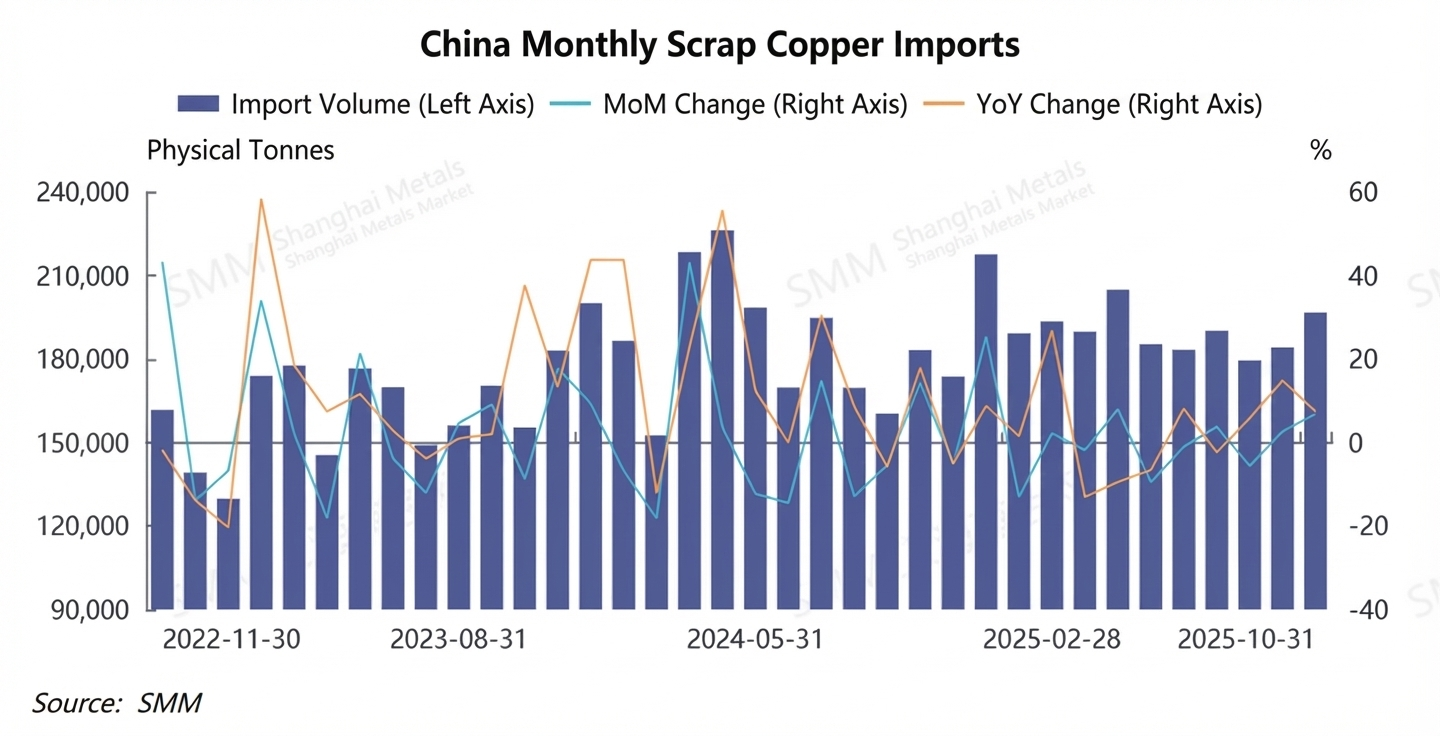
According to data from the General Administration of Customs, China's cumulative import volume of recycled copper raw materials reached 1.8956 million physical tonnes from January to October 2025, representing a year-on-year increase of 1.97% and maintaining a relatively stable overall scale. In October 2025, imports saw a significant surge, rising from 179,000 physical tonnes in September to 196,000 physical tonnes. While import volumes had previously declined between May and July due to trade frictions, particularly affecting supply from the United States. The market recovered steadily from August through October. This rebound was primarily driven by disruptions in copper concentrate supply and high primary copper prices which increased the demand for scrap as a substitute, alongside increased exports from major non-US suppliers such as Japan, Thailand, and South Korea. Furthermore, a slight improvement in China-US trade relations and a bullish sentiment among enterprises leading to aggressive stockpiling contributed to the spike in volume. Although domestic prices did not fully mirror international gains, the inability of overseas consumers to absorb the high supply volume forced international yards to continue exporting to China. However, SMM predicts a pullback in November as downstream inventories reach saturation and processors resist higher prices amid a generally loose supply environment.

II. Annual Price Trends of Imported Copper Scrap
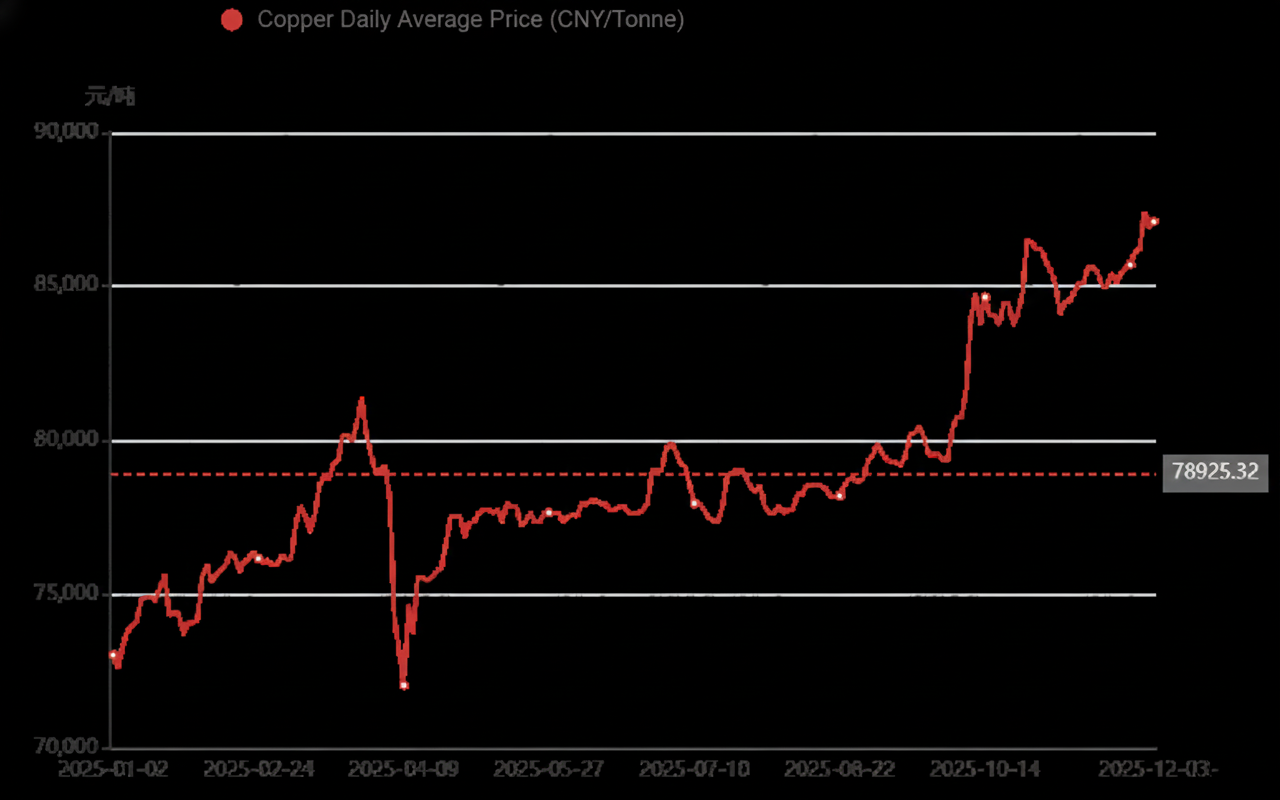
Throughout 2025, the price of imported copper scrap remained closely linked to LME copper prices, characterized by intense volatility followed by a powerful upward trajectory. During the first quarter, prices experienced a significant rally in February and March fueled by optimistic global macroeconomic expectations and loose liquidity, only to plummet in April as escalating China-US trade tensions triggered panic across the commodities market. By the second and third quarters, the market bottomed out and began an oscillating ascent, with Zhejiang Millberry prices stabilizing between 77,000 and 79,000 RMB per tonne. This recovery was bolstered by positive macro sentiment and expectations of Federal Reserve rate cuts, which enhanced market liquidity and speculative demand.

The trend culminated in a during the fourth quarter, where Zhejiang Millberry prices surged from approximately 79,400 RMB per tonne in September to a historic peak of 87,400 RMB per tonne. This cumulative increase of 8,000 RMB per tonne was catalyzed by a combination of frequent mining accidents tightening raw material supply, ongoing macro rate-cut expectations, and anticipated production cuts by Chinese smelters, all of which drove LME copper to new heights and pulled scrap prices up in tandem.

III. Future Outlook: Policy Risks and Resource Protectionism

Looking toward the future, the landscape of the recycled copper market is being reshaped by significant shifts in international trade policy that introduce long-term uncertainty. The United States has not only imposed tariffs on copper semi-finished products but has also announced a mandate starting in 2027 requiring at least 25% of high-quality recycled copper to remain within its domestic market. Simultaneously, the European Union has begun restricting the export of untreated or "problematic" recycled metals to non-OECD countries, requiring stringent pre-treatment before any cross-border movement. These actions signal a rising tide of resource protectionism as major economies move to secure their internal supply chains, which is expected to accelerate the regionalization of the global recycled copper trade and potentially limit the volume of transoceanic circulation. Under these complex and evolving conditions, many traders are preparing for a volatile and fragmented market in 2026, anticipating a period characterized by heightened confusion and structural uncertainty.

Data Source Statement: Except for publicly available information, all other data are processed by SMM based on publicly available information, market communication, and relying on SMM's internal database model. They are for reference only and do not constitute decision-making recommendations.

For any inquiries or for more information, please contact: lemonzhao@smm.cn
For more information on how to access our research reports, please contact:service.en@smm.cn
Related News
Copper futures see slight correction as macro and fundamentals intertwine [SMM Copper Morning Comment]
3 mins ago
Copper futures see slight correction as macro and fundamentals intertwine [SMM Copper Morning Comment]
Read More
Copper futures see slight correction as macro and fundamentals intertwine [SMM Copper Morning Comment]
3 mins ago
Centinela Strike Could Cut November Copper Output by Half, Unions Say
10 hours ago
Centinela Strike Could Cut November Copper Output by Half, Unions Say
Read More
Centinela Strike Could Cut November Copper Output by Half, Unions Say
A workers’ strike at Antofagasta’s Centinela copper mine in Chile could reduce the operation’s November copper production by around 50% if the work stoppage continues, according to union representatives. The strike began on October 7 after two unions rejected further negotiations with Antofagasta Minerals following the failure of government-mediated talks to produce an agreement. The labour groups represent more than half of Centinela’s critical mine operators and more than 60% of equipment maintenance workers. The unions said the initial operational impact is expected to worsen gradually because mining and mine-development activities have been affected, while a large volume of waste rock still needs to be removed. They expect the full effect of the strike to become more visible in November, when production could fall by as much as half. Antofagasta has said it continues to maintain its production guidance despite the strike and declined to comment on the unions’ estimate of the potential November production impact. The dispute centres on differences in pay and benefits between union groups. Labour representatives are seeking equivalent benefits for employees regardless of union affiliation, while Antofagasta has said bargaining schedules have been separated since 2020 and wage adjustments have been negotiated at different times. The union estimate of a potential 50% decline in November production materially increases the supply significance of the Centinela strike compared with the initial work stoppage. However, the estimate has not been confirmed by Antofagasta, which continues to maintain its production guidance. The scale of any actual copper loss will therefore depend on the duration of the strike, the extent of disruption to mining and maintenance activities, and whether negotiations resume before November.
10 hours ago
Magna Mining Approves Levack Mine Restart, Targets Mid-2028 Commercial Production
10 hours ago
Magna Mining Approves Levack Mine Restart, Targets Mid-2028 Commercial Production
Read More
Magna Mining Approves Levack Mine Restart, Targets Mid-2028 Commercial Production
Magna Mining has approved the restart of its fully permitted Levack Mine in Ontario, Canada, following completion of a Preliminary Economic Assessment that outlines 7.3 years of commercial production and estimated initial capital requirements of C$70.1 million. The PEA outlines average annual payable production of approximately 36.8 million lb of copper-equivalent over the commercial production period, with output comprising nickel, copper and precious metals. Magna is targeting the start of commercial production in mid-2028. The study estimates an after-tax NPV at a 7% discount rate of C$227.0 million, an after-tax IRR of 92.4%, and a payback period of 0.6 years under the base-case assumptions used in the PEA. The development plan involves restarting the existing underground operation and utilizing established mine infrastructure. Following board approval, Magna plans to advance detailed engineering, underground development and other activities required to support the proposed restart schedule. The PEA includes approximately 2.1 million short tons of Inferred Mineral Resources. Magna cautioned that the assessment is preliminary in nature and that the restart decision was not based on a feasibility study of Mineral Reserves demonstrating economic and technical viability. The board approval moves Levack from technical evaluation toward restart execution, with commercial production targeted for mid-2028 and initial capital estimated at C$70.1 million. The strong PEA economics indicate potentially attractive project returns under the study assumptions, but the inclusion of Inferred Mineral Resources and the absence of a feasibility-level reserve case mean execution and economic uncertainty remain material. Attention will now turn to detailed engineering, underground development and capital deployment as Magna advances toward the planned restart.
10 hours ago