November 30, 2025:
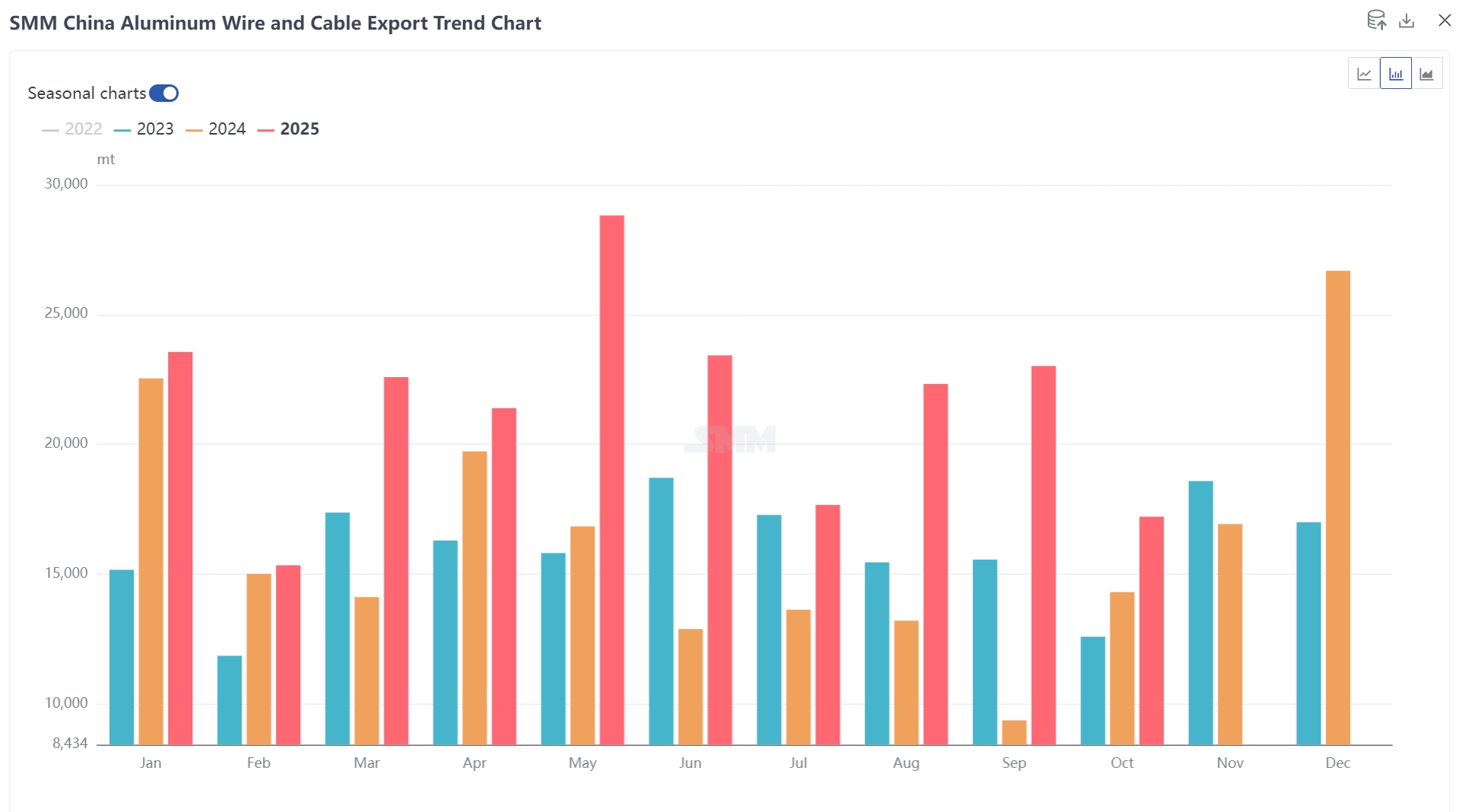
Customs data shows that China’s aluminum cable exports in October 2025 reached 17,200 metric tons, down 25.2% month-over-month but up 20.3% year-over-year. Cumulative exports from January to October 2025 totaled 215,000 metric tons, a 42% increase compared to 151,600 metric tons during the same period in 2024. By product type, steel-reinforced aluminum stranded conductors accounted for 10,500 metric tons—down 33% month-over-month but up 23% year-over-year—while aluminum stranded conductors totaled 6,700 metric tons, a 10% month-over-month decline but a 16% year-over-year increase. (HS codes: 76141000, 76149000)
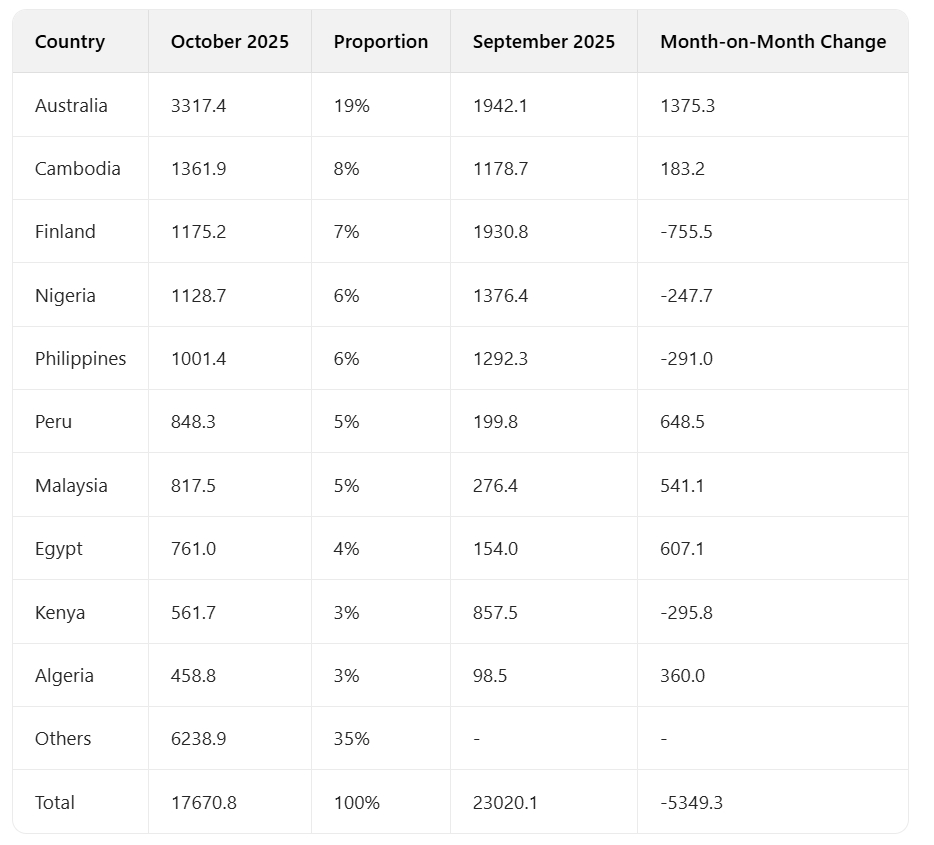
In October 2025, China’s aluminum cable export market underwent notable structural shifts. Australia emerged as the top destination with exports of 3,317.4 metric tons (19% of total volume), surging by 1,375.3 metric tons from the previous month and becoming the largest incremental market. This growth was driven by Australia’s recently announced “Solar Sharer” initiative (officially unveiled on November 14, 2025), which will launch a “three hours of free electricity per day” policy in July 2026 to encourage consumption during peak solar generation periods. Coupled with the ongoing “Rewiring the Nation” national grid upgrade program—a AUD 20 billion initiative launched in 2022 and running through 2030—demand for high-conductivity aluminum cables has intensified significantly. Cambodia ranked second with 1,361.9 metric tons (8% share), up 183.2 metric tons month-over-month, benefiting from its National Assembly’s approval of 27 new energy projects (including 13 solar plants), which accelerated grid infrastructure development. Meanwhile, Finland’s imports declined to 1,175.2 metric tons (7% share), down 755.5 metric tons from September, reflecting a temporary adjustment in European markets. Overall, global trends toward renewable energy adoption and grid modernization continue to drive demand, with Australia and Cambodia emerging as key growth markets, while Europe enters a phase of seasonal recalibration.
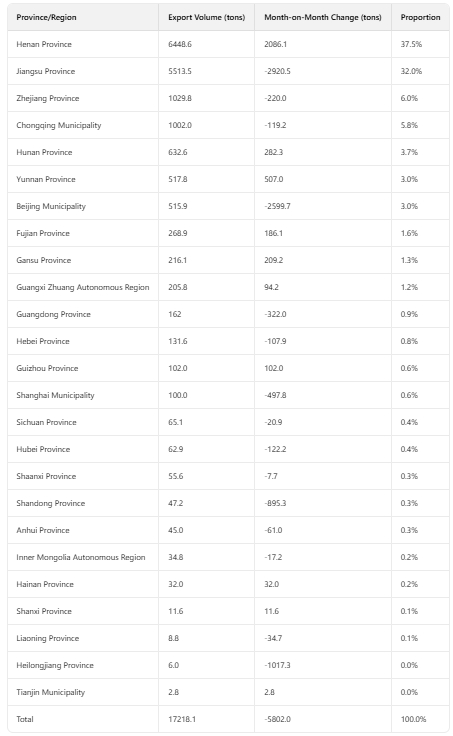
From a domestic regional perspective, China’s aluminum cable exports in October showed strong concentration. Henan Province led with 6,448.6 metric tons (37.5% of total exports), a sharp month-over-month increase of 2,086.1 metric tons, making it the top exporting province. Jiangsu Province followed closely with 5,513.5 metric tons (32.0% share), despite a month-over-month drop of 2,920.5 metric tons, maintaining its position thanks to its robust manufacturing base. Zhejiang Province ranked third with 1,029.8 metric tons (6% share). Together, Henan and Jiangsu accounted for nearly 70% of total exports, underscoring their role as the core pillars of China’s aluminum cable export capacity and highlighting significant industrial clustering effects.
SMM Commentary:Overall, China’s aluminum cable exports have maintained strong growth momentum in 2025. Exports from January to October reached 215,000 metric tons—already far exceeding the full-year 2024 total. Although October’s export volume dipped 25.2% month-over-month to 17,200 metric tons, the 20.3% year-over-year increase confirms resilient underlying overseas demand. Product-wise, the ratio of steel-reinforced aluminum stranded conductors to aluminum stranded conductors remained around 2:1 in October, clearly indicating that export growth is primarily fueled by overseas grid upgrades and renewable energy infrastructure projects. As countries worldwide strive to meet renewable energy targets, the road ahead for new energy installations and grid construction remains long—providing medium- to long-term support for China’s aluminum cable exports. Looking ahead to the final two months of 2025, exports may experience seasonal declines due to winter-related slowdowns in grid construction activities in certain regions. Nevertheless, on an annual basis, China’s total aluminum cable exports are well-positioned to approach or even surpass the 250,000-metric-ton mark.
![[Auto Summit] Sichuan Samsung New Materials Invites You to SMM ASCC2026 (The 8th) Automotive Supply Chain Conference](https://imgqn.smm.cn/usercenter/kRRxA20251217171652.jpg)
![SHFE Aluminum Closed Slightly Lower and Consolidated to Digest, Alumina Release of Selling Pressure Continues Weak Pattern [SMM Aluminum Daily Review]](https://imgqn.smm.cn/usercenter/ceevU20251217171653.jpg)