[SMM Analysis: New National Standards Drive Material Revolution, Magnesium Alloy Becomes the Core Engine for Lightweighting of E-bikes]

Published: Aug 6, 2025 18:11
Source: SMM
[SMM Analysis: New National Standards Drive Material Revolution, Magnesium Alloy Becomes the Core Engine for Lightweighting of E-bikes]Driven by the new national standard for e-bikes (GB 17761—2024) implemented on September 1, 2025, magnesium alloy, with its "dual advantages of lightweight performance and cost," is reshaping the material system of the industry.

New National Standard Drives Material Revolution: Magnesium Alloy Becomes Core Engine for Lightweighting of E-bikes

The implementation of the new national standard for e-bikes is beneficial for the expansion of magnesium alloy applications
The mandatory national standard "Safety Technical Specifications for E-bikes" (GB 17761—2024), revised by the Ministry of Industry and Information Technology in conjunction with the Ministry of Public Security, the Ministry of Emergency Management, the State Administration for Market Regulation, and the National Fire and Rescue Administration, will be implemented on September 1, 2025, replacing the old standard (GB 17761—2018).

The new national standard significantly improves and enhances aspects such as vehicle mass, motor power limits, fire resistance, plastic content, and tamper-proofing. Specifically, GB17761—2024 mandates that the mass of plastic parts in e-bikes shall not exceed 5.5% of the total vehicle mass, with the mass of plastic parts for lithium battery car models ≤3.025 kg and for lead-acid battery car models ≤3.465 kg. Additionally, the maximum vehicle mass is set at 55 kg (63 kg for lead-acid battery car models). During the transition period for standard implementation, producers adjust product designs and manufacturing processes, and complete testing and certification in accordance with the new national standard requirements. Driven by the new national standard policy, magnesium alloy has become a key force in the "material revolution" of the e-bike industry, thanks to its excellent lightweighting performance and outstanding cost advantages.

Magnesium Alloy Lightweighting Revolution: Years of Technological Accumulation Reshaping the EV Industry Landscape

Magnesium alloy has accumulated profound technological expertise in the EV field. According to SMM, Yadi Group, a top-tier enterprise in the electric two-wheeler sector, has applied magnesium alloy parts in batch production for over 10 million vehicles, achieving vehicle weight reduction through lightweighting of components such as wheel hubs and handlebars. From the perspective of e-bike applications, magnesium alloy wheel hubs currently cover 60% of the shared e-bike market share. If wheel hub systems are used as a breakthrough point, the penetration rate of magnesium alloy in the entire electric two-wheeler market could be increased to 30%. Moreover, technological breakthroughs in shock absorption and rust prevention, along with continuous market penetration into high-end car models and off-road scenarios, are expected. Currently, collaborative innovation across the industry chain is promoting the upgrade of magnesium alloy from single components to lightweighting system solutions for entire vehicles, continuously expanding the development and application of magnesium alloy parts to components such as handlebars, rear luggage racks, pedals, and backrest supports, aligning with the efficient and low-carbon development trends of the new energy industry.

State-owned enterprises enter the market to ensure supply stability, initiating a new cycle of low-price and stable supply in the magnesium market

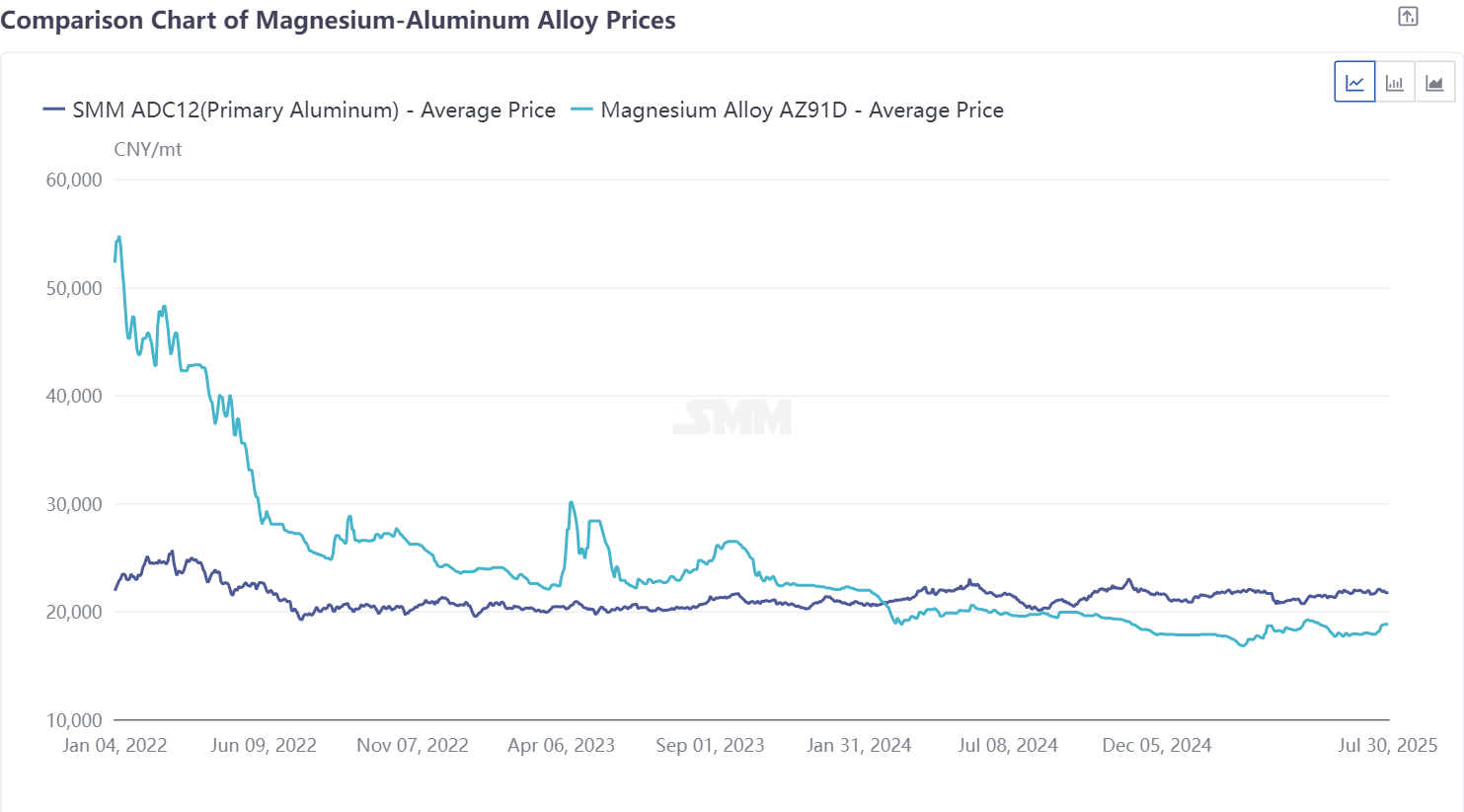
State-owned enterprises such as Baowu Magnesium Industry and Wuchan Zhongda Group have strengthened their control over the industry chain through mergers, acquisitions, and capacity expansions. Enterprises in the main production areas have maintained stable production and upgraded the industry chain, ensuring the long-term stability of magnesium ingot supply. Additionally, as of the time of writing, the mainstream quotations for 99.90% magnesium ingot in the main production areas have stabilized at 17,200 yuan/mt, with the magnesium-to-aluminum price ratio remaining below 1 (currently at 0.93), significantly enhancing the cost competitiveness of magnesium alloys among lightweight materials. Driven by the new national standard for e-bikes (GB 17761—2024), which will be implemented on September 1, 2025, magnesium alloys, leveraging their "dual advantages of lightweight performance and cost," are reshaping the material system of the industry.
Data Source Statement: Except for publicly available information, all other data are processed by SMM based on publicly available information, market communication, and relying on SMM's internal database model. They are for reference only and do not constitute decision-making recommendations.

For any inquiries or for more information, please contact: lemonzhao@smm.cn
For more information on how to access our research reports, please contact:service.en@smm.cn
Related News
Cost-Driven Magnesium Prices Shot Up, Weak Demand Makes Rally Unsustainable [SMM Magnesium Weekly Review]
2 hours ago
Cost-Driven Magnesium Prices Shot Up, Weak Demand Makes Rally Unsustainable [SMM Magnesium Weekly Review]
Read More
Cost-Driven Magnesium Prices Shot Up, Weak Demand Makes Rally Unsustainable [SMM Magnesium Weekly Review]
[SMM Magnesium Weekly Review: Cost Push Drives Magnesium Prices Up, Weak Demand Limits Gains] This week, mainstream quotations for 99.90% magnesium ingot in major production areas stood at 16,050-16,150 yuan/mt, up 300 yuan/mt WoW, with FOB prices at $2,280-2,380/mt and an average of $2,330/mt. Magnesium ingot prices shot up during the week, driven by rising coal and ferrosilicon costs, coupled with some restocking at higher prices in foreign trade. However, the overall market remained characterized by strong supply and weak demand, with sluggish transactions at high prices and signs of a pullback emerging in the latter part of the week. Overseas demand has not shown any substantial recovery, with market activity dominated by tentative inquiries, limited actual order volumes, and evident buyer pressure for lower prices, keeping trading sluggish. Downstream magnesium powder and magnesium alloy prices followed the cost-driven increase in magnesium ingot, but end-use demand for magnesium powder remained weak, with some enterprises cutting production or suspending operations, exports constrained, and inventory levels rising. Spot inventory of magnesium alloy was ample, competition among peers was intense, and die-casting enterprises faced insufficient orders and declining operating rates, keeping processing fees under pressure. In the short term, cost support and weak demand are locked in a tug-of-war, and the upward momentum in magnesium prices is losing steam, with the market likely to return to consolidation. Going forward, close attention should be paid to the release of domestic and overseas orders.
2 hours ago
Cost Support Unable to Offset Weak Demand; Magnesium Ingot Market Turns Weak Under Pressure [SMM Magnesium Ingot Spot Report]
2 hours ago
Cost Support Unable to Offset Weak Demand; Magnesium Ingot Market Turns Weak Under Pressure [SMM Magnesium Ingot Spot Report]
Read More
Cost Support Unable to Offset Weak Demand; Magnesium Ingot Market Turns Weak Under Pressure [SMM Magnesium Ingot Spot Report]
[Cost support insufficient to offset weak demand; magnesium ingot market turns subdued under pressure] China's magnesium ingot transaction center moved toward 16,000 yuan/mt today, with FOB quotes holding steady at $2,280-2,380/mt. Affected by sluggish high-price deals and insufficient domestic and overseas demand follow-through, the market shifted from holding prices firm to subdued under pressure, and is likely to consolidate on a subdued note in the short term.
2 hours ago
Magnesium Ingot Prices Rise Despite Weak Demand, Inventory Accumulates Amid Cost Support
2 hours ago
Magnesium Ingot Prices Rise Despite Weak Demand, Inventory Accumulates Amid Cost Support
Read More
Magnesium Ingot Prices Rise Despite Weak Demand, Inventory Accumulates Amid Cost Support
【SMM Magnesium Flash】This week, the social inventory of magnesium ingots increased by 2.19% month-on-month, showing a continuous pattern of accumulation. Under the support of costs, domestic magnesium ingot prices continued to rise this week. Driven by the mentality of "buying when prices rise and not buying when prices fall" and some demand for delivery documents, traders made a small amount of stockpiling and follow-up purchases. However, after the price surge, market transactions significantly weakened, and downstream fear of high prices gradually became prominent. Currently, there has been no substantial recovery in terminal demand at home and abroad. Some traders store purchased goods in port warehouses for delivery documents and to cope with market fluctuations, while most traders choose to remain on the sidelines. Even though there is strong support from the cost side and expectations of price increases in the market, the willingness to make new purchases remains limited. Multiple factors have jointly contributed to the slight accumulation of social inventory this week.
2 hours ago
[SMM Analysis: New National Standards Drive Material Revolution, Magnesium Alloy Becomes the Core Engine for Lightweighting of E-bikes] - Shanghai Metals Market (SMM)