According to JCC Construction News: Recently, the 50,000 mt secondary copper smelting project in Shandong Jinxin, undertaken by Jiangxi Copper Corporation (Guixi) Metallurgical Chemical Engineering Co., Ltd., achieved a significant milestone—the nation's first horizontal-swing refining furnace for copper anode production successfully yielded its first batch of anode plates. This innovative achievement, characterized by its "high efficiency, intelligence, and environmental protection" process features, has set a new benchmark for the industry.
As a complete process output equipment for device manufacturing and production services, the project accomplished a full-process system upgrade: from the dismantling of the old reverberatory furnace and civil construction to furnace body manufacturing and installation, customized refractory material laying; from secondary combustion chamber integration to intelligent control system debugging, and finally to the revamping and upgrading of the wheel casting machine, along with the full integration of pyrometallurgical equipment and processes. The metallurgical chemical engineering team overcame multiple technical challenges to successfully develop this groundbreaking new refining furnace with industry-leading significance.
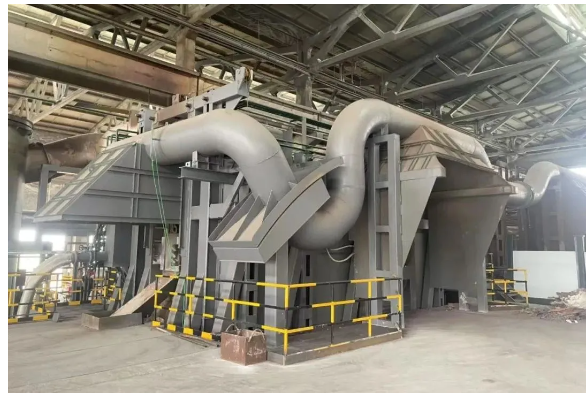
It is reported that the horizontal-swing furnace is a refining furnace featuring a hydraulic tilting structure, particularly suitable for blister copper refining, effectively removing impurities to produce high-quality copper anode plates. Its most distinctive feature lies in the adjustable head-tail swing system, breaking through the traditional fixed-angle mode to achieve flexible adjustment of slag outlet and discharge port positions, significantly enhancing operational adaptability. Compared to conventional fixed anode furnaces, the horizontal-swing furnace demonstrates notable advantages in energy consumption, operation, and environmental protection.
High Efficiency and Energy Saving, Outstanding Capacity
The horizontal-swing furnace adopts a multi-zone, multi-point heating design with high thermal efficiency, fast charging and melting speed, and significantly improved slagging efficiency. By precisely controlling the position and depth of the tuyeres, stirring effectiveness is enhanced, operational dead zones are reduced, and the contact between flux and metal becomes more thorough, greatly improving smelting efficiency. The casting process, regulated by furnace body swinging, ensures smooth slag discharge and precise control, resulting in high casting qualification rates, low rejection rates, and stable, reliable product quality.
Meanwhile, the coordinated heating of primary and auxiliary fuels ensures full combustion and uniform heat distribution. The single-furnace operation time is short, furnace door opening/closing frequency is low, heat loss is minimal, and energy consumption is significantly lower than similar equipment. The furnace lining refractory material experiences less wear, extending furnace lifespan and delivering considerable economic benefits to enterprises.
Intelligent Control, User-Friendly Operation
The horizontal-swing furnace provides a solid foundation for mechanization and automation. Through its intelligent control system, it achieves automated and even intelligent management of operational processes. The swinging design simplifies critical operations such as slag tapping and oxidation-reduction, making them safer and significantly reducing labour intensity, operational risks, and improving manual work efficiency. The side-inclined tuyere design also effectively reduces tuyere wear.
Green and Environmentally Friendly, Safe and Reliable
The horizontal-swing furnace exhibits strong sealing during operation, with minimal furnace gas and dust leakage, low-level pollution in the working area, and overall environmental friendliness. The flue system is equipped with replaceable ash and slag hoppers to prevent blockages, ensure smooth flue gas emission, and improve the working environment. In addition, the frequency of furnace door openings is reduced, further minimizing heat loss and pollutant emissions, thus comprehensively meeting the development needs of green metallurgy.
In summary, the swing furnace integrates high efficiency, energy conservation, environmental protection, and intelligence, representing the direction of technological innovation in copper smelting equipment. Its unique design philosophy, combined with years of practical experience, demonstrates significant advantages in energy conservation, emission reduction, quality improvement, and efficiency enhancement, providing strong support for the upgrading of furnace types in the metallurgical industry. In the future, the swing furnace is expected to be promoted and applied in a wider range of fields, helping China's metallurgical industry move towards a new era of high-quality development.