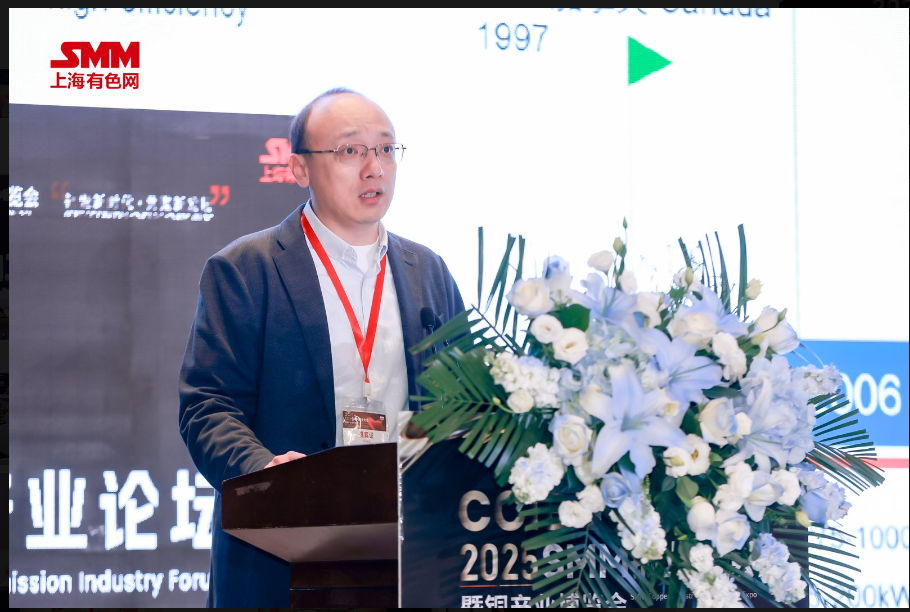
On April 22, at the CCIE 2025 SMM (20th) Copper Industry Conference & Copper Industry Expo - Electric Power Transmission and Distribution Industry Forum, hosted by SMM Information & Technology Co., Ltd., SMM Metal Trading Center, and Shandong Aisi Information Technology Co., Ltd., with Jiangxi Copper Corporation and Yingtan Land Port Holdings Co., Ltd. as the main sponsors, Shandong Humon Smelting Co., Ltd. as the special co-organizer, and Xinhuang Group and Zhongtiaoshan Nonferrous Metals Group Co., Ltd. as co-organizers, Liang Dong, Chief Representative of the International Copper Association Beijing Office and Project Leader for Low-Carbon Drive / Senior Engineer, delivered a speech with the theme "Development Trends of Copper-Based Winding Materials in the Motor and Transformer Industry."
Introduction to Copper Applications in Electric Motors and Transformers
Classification and Application Areas of Wire and Cable Products
Application Areas of Winding Wires
Research Trends in Copper Alloy Winding Wires
High-Performance Conductors: Low-Oxygen Content Conductors, High Flexibility, High Strength and High Conductivity.
Copper Applications in Electric Motors and Transformers
He cited examples of copper applications in electric motors and transformers to illustrate his points.
Development Trends in Electric Motors and Transformers
Global Trend Towards Decarbonization
• EU: Reduce greenhouse gas emissions by 55% compared to 1990 levels by 2030, and achieve carbon neutrality by 2050
• Japan: Achieve carbon neutrality by 2050
• UK: Achieve net-zero emissions by 2045, and carbon neutrality by 2050
• Canada: Achieve carbon neutrality by 2050
• China: Peak carbon emissions by 2030, and achieve carbon neutrality by 2060
• As of September 2023, over 150 countries have committed to carbon neutrality, covering more than 80% of global CO2 emissions, GDP, and population.
The process of peaking carbon emissions and achieving carbon neutrality is a process of electrification and re-electrification across society.
Re-electrification requires further improvement in energy efficiency on the demand side.
The process of peaking carbon emissions and achieving carbon neutrality is a process of electrification and re-electrification across society; electrification refers to the transition from traditional energy sources (such as coal and oil) to electric power; re-electrification involves further optimization, such as using renewable energy for power generation or improving the efficiency of the power system.
Efficiency of Different Drive Systems
The estimated thermal efficiency of steam engines in 1840 was around 3%, while later condensing steam engines reached 8%, with the highest thermal efficiency of steam engines not exceeding 20%. ⇒ The thermal efficiency of gasoline engines in passenger cars is generally below 40%, while diesel engines can reach 40-46%.
Electric drive systems have the highest efficiency, typically above 90%, and can exceed 95%.
Thermal Efficiency of Internal Combustion Engines
• The upper limit of thermal efficiency for internal combustion engines is the Carnot cycle, meaning that the greater the temperature difference between the high-temperature heat source and the low-temperature heat source, the higher the thermal efficiency;
• For an engine to achieve 95% Carnot cycle efficiency, the high-temperature heat source would need to be 23,000°C;
• The Carnot cycle is an ideal process, and in reality, the higher the temperature, the more difficult it is to achieve adiabatic conditions, resulting in actual efficiency being much lower than the Carnot cycle;
• The only drive method with an energy efficiency exceeding 95% in practice is the electric motor system.
Development Directions for High-Efficiency Electric Motors and Transformers
➢ "Guiding Opinions on Coordinating Energy Conservation, Carbon Reduction, and Recycling to Accelerate the Update and Transformation of Key Product Equipment": By 2025, the proportion of high-efficiency, energy-saving motors in operation (efficiency level 2 and above) will increase by more than 5 percentage points compared to 2021, and the proportion of newly added high-efficiency, energy-saving motors will increase by 15 percentage points compared to 2021, with the proportion of high-efficiency, energy-saving transformers increasing by more than 10 percentage points.
➢ "Action Plan for Industrial Energy Efficiency Improvement": Focus on general energy-consuming equipment such as motors, transformers, and boilers, and continuously carry out energy efficiency improvement actions, increasing the application of high-efficiency energy-consuming equipment.
➢ "Energy Conservation and Carbon Reduction Action Plan for 2024-2025": By 2025, the proportion of high-efficiency, energy-saving motors and high-efficiency, energy-saving transformers in operation will each increase by more than 5 and 10 percentage points, respectively.
➢ "Implementation Guidelines for Motor Update, Transformation, and Recycling (2023 Edition)": Encourage motor manufacturers to increase innovation and improve energy efficiency, and promote key industry enterprises to check the energy efficiency and maintenance status of their equipment, updating and transforming motors with energy efficiency below the entry level (efficiency level 3).
Global Trends in High-Efficiency Electric Motors
He provided a detailed introduction to the development trends of high-efficiency electric motors in multiple countries globally.
Ways to Improve Electric Motor Efficiency
Increase the use of effective materials, reduce winding and iron losses; use better magnetic materials and process measures to reduce iron losses; reduce fan size to lower ventilation losses; reduce stray losses through design and process measures; apply computer-aided optimization design to reduce losses and improve efficiency; use permanent magnet rotors and copper rotors to reduce rotor losses; combine information technology and power electronics to improve system efficiency.
New-Type Electric Motor – Dual-Rotor Electric Motor
The stator of a dual-rotor motor is located in the middle, with one rotor inside the stator and one rotor outside the stator.
• The inner and outer rotors rotate synchronously.
• Electromagnetic wires are installed on the central stator to generate a magnetic field.
• The main advantages of dual-rotor motors are their significant efficiency and substantial reduction in material consumption (primarily electrical steel).
Hollow Cup Electric Motor
• Hollow cup motors are named after the design of their rotor. The rotor of a hollow cup motor breaks away from the traditional motor structure, using a coreless rotor, which is a hollow, cup-shaped structure with windings and magnets inside.
• This rotor structure completely eliminates eddy current losses caused by the core, significantly reducing weight and rotational inertia, thereby decreasing mechanical energy losses in the rotor itself.
• In 1958, DFFaumhaber in Germany developed the oblique winding coil technology, and after continuous development and improvement, obtained the patent for the oblique winding technology of the hollow cup motor rotor in 1965, marking the birth of the hollow cup motor.
• Hollow cup motors are mainly used in dexterous hand joints.
Requirements for Copper Materials in New-Type Electric Motor Systems
► Hollow Cup Electric Motor
• Conductivity Requirements: The windings of hollow cup motors typically use high-conductivity copper wire to reduce resistance and energy loss, improving the motor's efficiency and performance.
• Strength Requirements: Although the windings of hollow cup motors primarily emphasize conductivity, the copper wire also needs a certain level of mechanical strength to withstand the electromagnetic forces and centrifugal forces during motor operation. Additionally, components such as commutators and brushes may use copper alloys, such as silver-copper and chromium-zirconium copper, which maintain high conductivity while offering better strength and wear resistance, suitable for frequent brush contact and current transmission.
► Dual-Rotor Electric Motor
• Conductivity Requirements: The rotor windings of dual-rotor motors typically use high-conductivity copper materials to reduce winding resistance, minimize energy loss, and enhance the motor's efficiency and power density. Copper's excellent conductivity effectively conducts current, ensuring the normal operation of the motor.
• Strength Requirements: The rotor structure of dual-rotor motors is relatively complex and must withstand high mechanical stress and electromagnetic forces. Therefore, the copper material needs to have sufficient strength and toughness to ensure the stability and reliability of the rotor under high-speed rotation and load variations. Some high-performance dual-rotor motors may use copper alloys, which provide higher strength and hardness while maintaining a certain level of conductivity.
Development Trends of Copper-Based Materials
High-Efficiency Motors - Copper Flat Wires
In the field of EV drive motors, flat wire motors are currently the mainstream form of motor windings.
Compared to round wires, flat wires facilitate an increase in the slot fill factor of motors. Generally, the slot fill factor of round wire motors is around 50%, while that of flat wire motors can exceed 70%.
The use of flat wires allows for more copper wires to be filled within the same stator slot space, enabling higher current flow, generating a stronger magnetic field, and thereby enhancing power density.
It also provides an example comparing the performance of round and flat wires in a certain drive motor.
High-Efficiency Motors - Copper Rotors
Improving efficiency, reducing temperature rise, ensuring reliable operation, reducing size and weight, and lowering motor costs.
He compares a 75KW-2 motor with a copper rotor and an aluminum rotor.
Copper rotors also face issues such as numerous welding points, complex processes, unstable strength, difficult quality control, poor consistency, the need for separate processing of end rings and bars (leading to high costs), low production efficiency, and difficulties in large-scale production.
He also introduces rare earth die-cast copper alloys and high-strength, high-conductivity copper alloys (generally referring to alloys with σb ≥ 600MPa and conductivity ≥80% IACS).
High-Efficiency Copper Solutions - Improving Conductivity
"Super Copper" is made by stacking graphene (known for its conductivity and mechanical properties) with copper sheets, achieving a complementary advantage of graphene and copper. Currently, the conductivity of super copper can be increased to 106-108% IACS.