After the Inflation Bubble Burst in April, How Did the Price Reduction of Auxiliary Materials Reshape the Cost Structure of Modules? [SMM In-Depth Analysis]

Published: Apr 18, 2025 11:31
【0.006 Yuan/W Non-Silicon Cost Reduction Aids Module Cost Reduction】SMM data indicates that the full cost of integrated module companies (wafer-cell-module) has decreased, primarily due to the price reduction of most auxiliary materials except glass, resulting in a non-silicon cost reduction of 0.006 yuan/W. The cost of main materials remained largely unchanged as the average price of polysilicon was not adjusted.

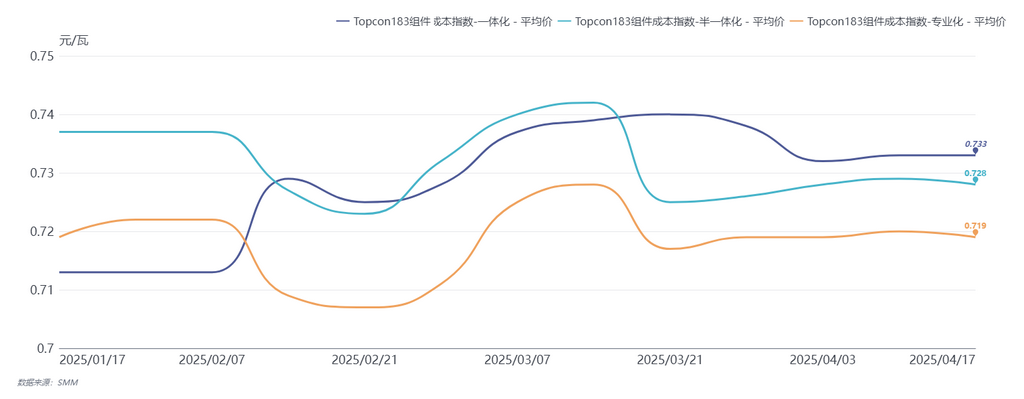
The full cost of integrated enterprises (wafer-cell-module) dropped to 0.733 yuan/W.

The full cost of semi-integrated enterprises (cell-module) rose to 0.728 yuan/W.

The full cost of specialized enterprises (module) rose to 0.719 yuan/W.
SMM data shows:

Auxiliary material segment: the price of 2.0mm double-layer coated glass increased by 0.25 yuan/m²; the price of 36-inch quartz crucibles decreased by 240 yuan/piece; the price of solar cell busbar front-side silver paste decreased by 313.8 yuan/kg; the price of solar cell rear-side silver paste decreased by 209.4 yuan/kg; the price of PV frames decreased by 1,182 yuan/mt.

Main material segment: the price of N-type wafer-183mm increased by 0.08 yuan/piece; the price of monocrystalline TOPCon cell-183mm increased by 0.007 yuan/W.

[Non-silicon cost reduction of 0.006 yuan/W helps module cost reduction]

The full cost of integrated module enterprises (wafer-cell-module) decreased, mainly due to the price reduction of most auxiliary materials except glass, resulting in a non-silicon cost reduction of 0.006 yuan/W. The main material cost remained largely unchanged as the average price of polysilicon was not adjusted. During the phased downward cycle of the PV industry chain, the phenomenon of cost inversion between specialized module enterprises and integrated enterprises continues, but the price spread shows a narrowing trend. This week, the spot selling price of modules (excluding freight) has approached the full cost, and some forward orders for May delivery have already fallen below the full cost. Some low-price orders have incurred losses of 0.01-0.02 yuan/W.

[After the inflation bubble bursts, auxiliary material prices usher in a cyclical reversal]

Looking ahead, after the inflation bubble bursts, commodities are expected to experience a cyclical reversal. Under the dual effects of continuously declining auxiliary material prices and the drag of the PV cycle downturn on main materials (polysilicon/wafer/cell), module costs are expected to further decrease. In addition, with the accelerated iteration of new technologies such as BC and HJT, as well as the release of scale effects and vertical integration advantages of integrated enterprises, the cost structure difference between specialized and integrated enterprises will gradually narrow, and even reverse.

View SMM PV industry chain database

Data Source Statement: Except for publicly available information, all other data are processed by SMM based on publicly available information, market communication, and relying on SMM‘s internal database model. They are for reference only and do not constitute decision-making recommendations.

For any inquiries or to learn more information, please contact: lemonzhao@smm.cn
For more information on how to access our research reports, please contact:service.en@smm.cn
Related News
China Approves 17.44 GW Power Plan for Qaidam Desert Base, Including Solar, Wind, and Energy Storage Projects
17 hours ago
China Approves 17.44 GW Power Plan for Qaidam Desert Base, Including Solar, Wind, and Energy Storage Projects
Read More
China Approves 17.44 GW Power Plan for Qaidam Desert Base, Including Solar, Wind, and Energy Storage Projects
It is understood that the National Energy Administration has officially approved the power source allocation plan for the "Qaidam Desert Base (East Golmud) Base". The planned construction scale of the power source projects at this base is 17.44 million kilowatts, including 10 million kilowatts of photovoltaic power, 5 million kilowatts of wind power, 2.64 million kilowatts of coal-fired power, 0.1 million kilowatts of solar thermal power, and 1.5 million kilowatts (for 4 hours) of electrochemical energy storage. The total investment in the projects is about 86 billion yuan. The new energy will be transmitted to Guangxi through the "Qinghai-Guangxi DC" UHV power transmission project. Currently, significant progress has been made in the preliminary work of the "Qinghai-Guangxi DC" project, w
17 hours ago
[SMM PV News] Armenia Hits 1.1 GW Solar Capacity,
Feb 6, 2026 09:17
[SMM PV News] Armenia Hits 1.1 GW Solar Capacity,
Read More
[SMM PV News] Armenia Hits 1.1 GW Solar Capacity,
[SMM PV News] Armenia Hits 1.1 GW Solar Capacity,
Armenia’s cumulative solar capacity has surged to 1.1 GW following the addition of approximately 615 MW in 2025. This rapid expansion has pushed solar's share of electricity generation to around 15%, effectively meeting the country's 2030 target years ahead of schedule. The growth is heavily driven by a net-metering scheme supporting over 50,000 autonomous producers (totaling 650 MW), though the government ended loan subsidies for rooftop solar in July to shift focus toward battery storage.
Feb 6, 2026 09:17
Spot Market and Domestic Inventory Brief Review (February 5, 2026) [SMM Silver Market Weekly Review]
Feb 5, 2026 17:36
Spot Market and Domestic Inventory Brief Review (February 5, 2026) [SMM Silver Market Weekly Review]
Read More
Spot Market and Domestic Inventory Brief Review (February 5, 2026) [SMM Silver Market Weekly Review]
Feb 5, 2026 17:36