Why Did China's Stainless Steel Crude Steel Production Increase in March and Slightly Decrease in April?

Published: Apr 1, 2025 08:22
In March 2025, the domestic stainless steel market was well-supplied, with crude steel production reaching a record high. Driven by the anticipated peak demand season of "Golden March and Silver April" and high raw material prices, producers actively increased production, and both steel mills and spot merchants raised prices. However, downstream demand fell short of expectations, with few new orders, and only maintained essential restocking, leading to slow shipments, high inventory, and an oversupply in the market. In April, some companies carried out equipment renovation and maintenance due to environmental protection policies, affecting production.

April 1,

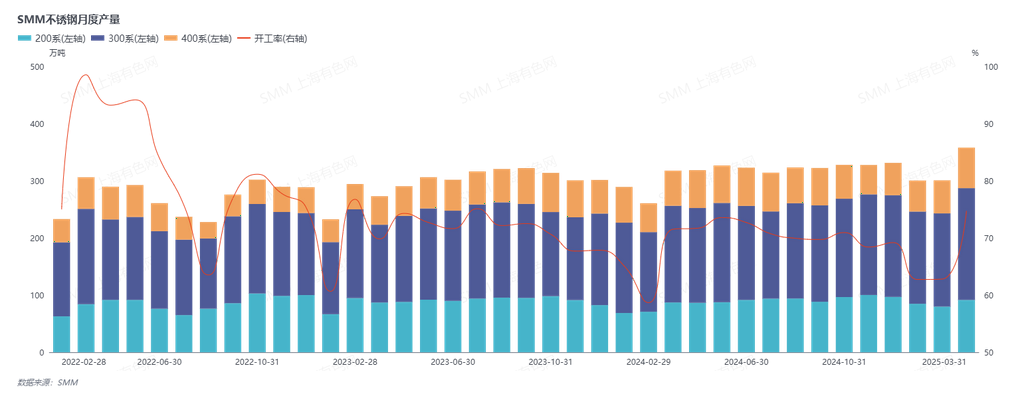
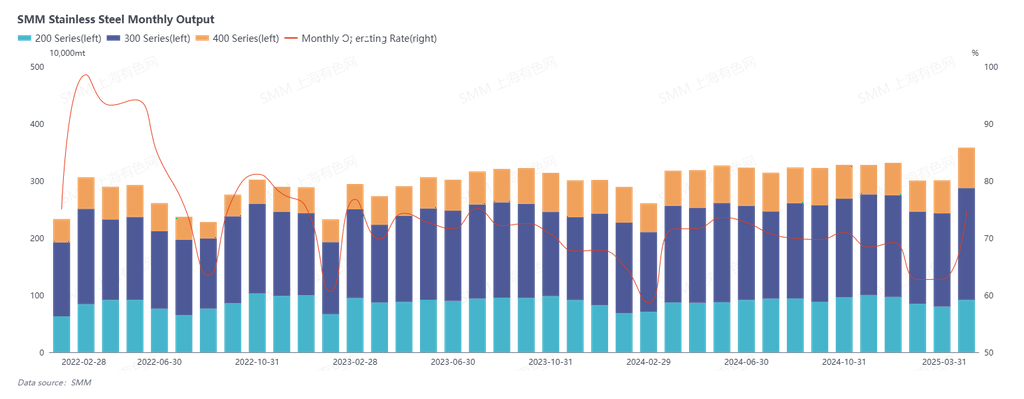
According to SMM data, domestic crude stainless steel production in March 2025 saw a significant increase, with total production up 19.02% MoM and a notable 12.67% YoY growth. By product series, the production of 200-series, 300-series, and 400-series stainless steel rose sharply by 14.64%, 19.89%, and 22.63% MoM, respectively.

The market supply was ample in March. On one hand, the industry had high expectations for the traditional peak demand season of "Golden March and Silver April," which greatly stimulated the production enthusiasm of stainless steel producers. On the other hand, raw material prices remained high for a long time, solidifying the production costs of stainless steel. Under these dual effects, steel mills and spot merchants raised prices, attempting to pass on cost pressures downstream. However, the reality was that downstream demand in March fell far short of expectations, with new orders being scarce. Downstream enterprises only maintained essential restocking operations, unable to drive prices significantly higher. Even though stainless steel prices rose slightly in March, the overall shipment pace remained slow, and inventories stayed high, making the market's oversupply characteristics increasingly evident.

Entering April, some stainless steel producers initiated equipment upgrades and maintenance due to environmental protection emission policy requirements, which affected production to some extent. However, as stainless steel prices continued to rise, the loss situation of enterprises was effectively alleviated, with some even achieving profitability, keeping production enthusiasm at a high level. Notably, as downstream inventories gradually deplete, the previously sluggish demand is expected to improve, and market demand may see growth opportunities in April.

Overall, stainless steel production in April is expected to show a slight decline, down 0.61% MoM, but still maintaining an 11.87% YoY growth. By product series, 200-series production will see a slight increase of 3.17% MoM, while 300-series and 400-series production will decline by 1.89% and 1.98% MoM, respectively.

SMM Analysis: In March 2025, domestic crude stainless steel production hit a new high. However, downstream market demand failed to interact well with the supply side, with new orders being scarce. Downstream enterprises only responded with essential restocking, leading to a lack of demand support for price increases, slow overall shipment speeds, and increasingly severe inventory accumulation. This indicates a prominent supply-demand imbalance in the stainless steel market in March. In April, environmental protection emission policies prompted some stainless steel producers to carry out equipment upgrades and maintenance, which to some extent suppressed production growth. Destocking and standing firm on quotes may be the themes of April.
Data Source Statement: Except for publicly available information, all other data are processed by SMM based on publicly available information, market communication, and relying on SMM's internal database model. They are for reference only and do not constitute decision-making recommendations.

For any inquiries or for more information, please contact: lemonzhao@smm.cn
For more information on how to access our research reports, please contact:service.en@smm.cn
Related News
[SMM Stainless Steel Market Flash] EU Adds 'Melt and Pour' Origin Rule to Curb Steel Rerouting, Phased to 2028
1 hour ago
[SMM Stainless Steel Market Flash] EU Adds 'Melt and Pour' Origin Rule to Curb Steel Rerouting, Phased to 2028
Read More
[SMM Stainless Steel Market Flash] EU Adds 'Melt and Pour' Origin Rule to Curb Steel Rerouting, Phased to 2028
[SMM Stainless Steel Market Flash] EU Adds 'Melt and Pour' Origin Rule to Curb Steel Rerouting, Phased to 2028
Under the EU's new steel trade regime, importers must prove the 'country of melt and pour'—where steel or iron was first produced in liquid form and cast into its first solid state—to improve supply-chain traceability. Evidence such as a mill test certificate is required from 1 October 2026; melt-and-pour data will feed into country quota distribution from 1 October 2027; and by 30 June 2028 the Commission will assess whether to make melt-and-pour the basis for quota eligibility, possibly via a legislative proposal. The rule targets origin-washing, raising the cost of routing non-EU steel—including Chinese stainless—through third countries to dodge quotas and duties.
1 hour ago
[SMM Stainless Steel Market Flash] EU Sets Stainless Quotas (496,342t CR, 153,186t HR) and 50% Over-Quota Duty
1 hour ago
[SMM Stainless Steel Market Flash] EU Sets Stainless Quotas (496,342t CR, 153,186t HR) and 50% Over-Quota Duty
Read More
[SMM Stainless Steel Market Flash] EU Sets Stainless Quotas (496,342t CR, 153,186t HR) and 50% Over-Quota Duty
[SMM Stainless Steel Market Flash] EU Sets Stainless Quotas (496,342t CR, 153,186t HR) and 50% Over-Quota Duty
The EU's new steel trade regime (Regulation 2026/1384) applies from 1 July 2026, replacing the 2019 safeguard that expires 30 June and lifting the out-of-quota duty to 50% from 25%. Within an 18.35 million-tonne total annual tariff-rate quota, stainless gets category-specific caps: cold-rolled sheets and strips 496,342 t, hot-rolled sheets and strips 153,186 t, hot-rolled quarto plate 17,025 t, bars and light sections 133,595 t, wire rod 40,462 t, and seamless tubes and pipes 32,967 t—about 873,577 t of stainless in total. Quotas run 1 July–30 June and are administered quarterly. Once a category's quota fills, further imports face the 50% duty, double the prior 25% penalty, tightening access for non-EU stainless.
1 hour ago
[SMM Stainless Steel Flash] EU New Steel Trade Regime Effective 1 July; Country Quota Allocations Still Pending
3 hours ago
[SMM Stainless Steel Flash] EU New Steel Trade Regime Effective 1 July; Country Quota Allocations Still Pending
Read More
[SMM Stainless Steel Flash] EU New Steel Trade Regime Effective 1 July; Country Quota Allocations Still Pending
[SMM Stainless Steel Flash] EU New Steel Trade Regime Effective 1 July; Country Quota Allocations Still Pending
The European Commission published Regulation (EU) 2026/1384, establishing the EU steel trade regime that takes effect 1 July 2026 and replaces the safeguard measures expiring 30 June. The new framework sets annual tariff-rate quotas of 18.3 million mt with a 50% out-of-quota duty, and adds a melt-and-pour origin requirement to curb circumvention. Crucially, the country-specific quota allocations are not yet set: they will come via a separate implementing act that has not been published, even as talks with several FTA partners reportedly continue. The gap leaves importers and supply chains uncertain about how the quota system will function from day one, with stainless mills among those watching the final country splits.
3 hours ago