Copper Anode Imports Declined in January and February 2025, Accumulated YoY Down by 11.58% [SMM Analysis]

Published: Mar 21, 2025 15:00 (GMT+8)
Source: SMM
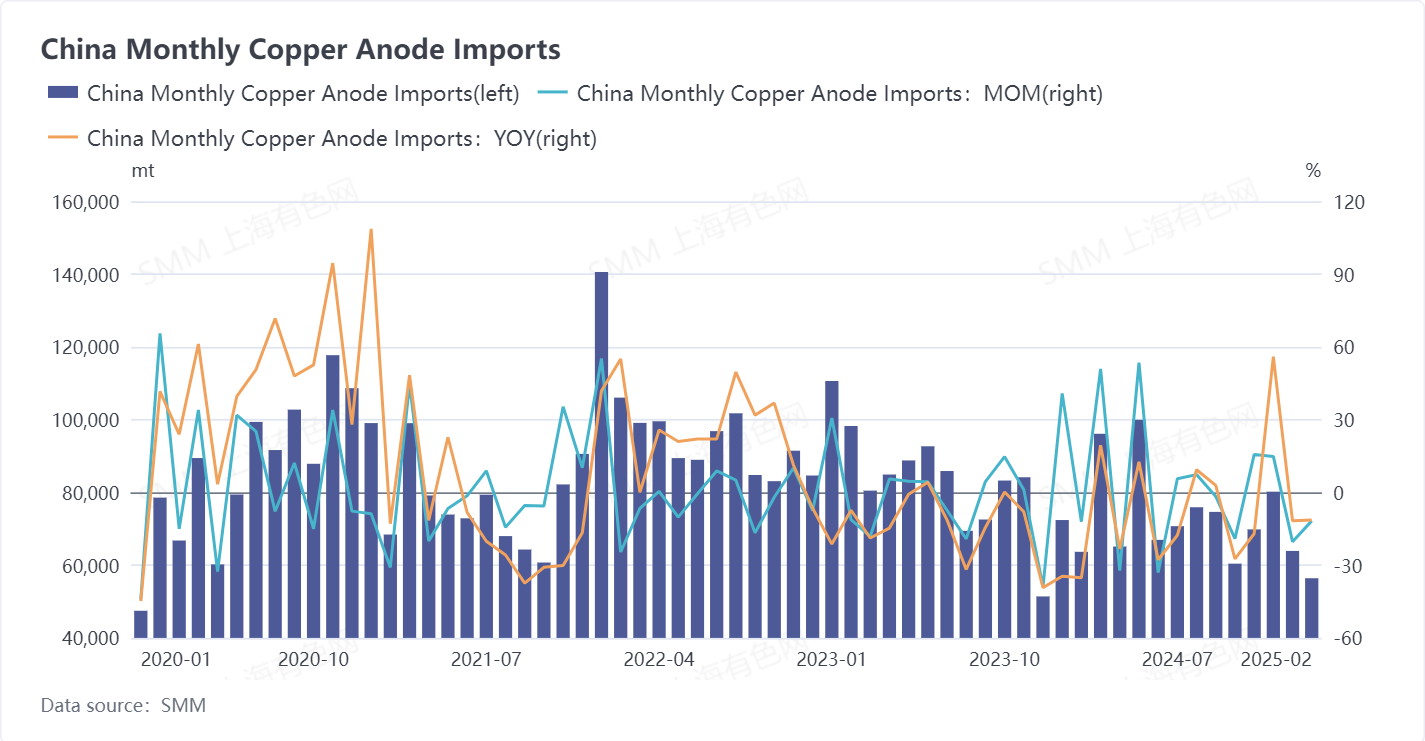
SMM Analysis: Copper Anode Imports Declined in January-February 2025, Accumulated YoY Down 11.58% According to data from the General Administration of Customs, China imported 63,900 mt of copper anode in January 2025, down 20.31% MoM and 11.73% YoY; in February, imports were 56,400 mt, down 11.74% MoM and 11.41% YoY...

SMM March 21 news:

According to data from the General Administration of Customs, China imported 63,900 mt of copper anode in January 2025, down 20.31% MoM and 11.73% YoY; 56,400 mt in February, down 11.74% MoM and 11.41% YoY; cumulative imports for January-February 2025 were 120,300 mt, down 11.58% YoY.
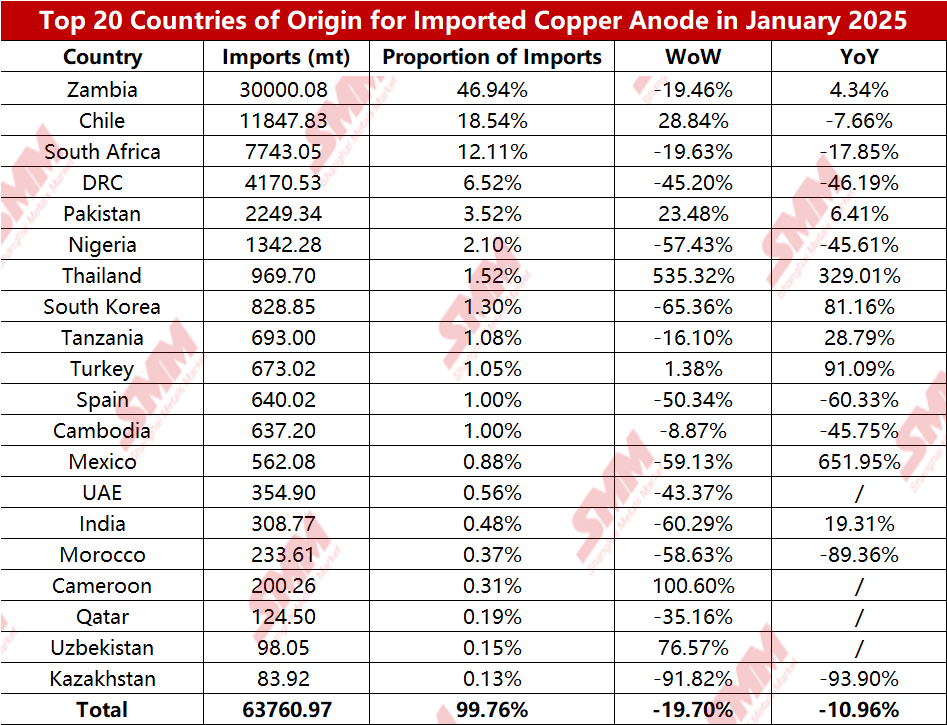
By country, in January 2025, China imported 30,000 mt of copper anode from Zambia, accounting for 46.94% of total imports, down 19.46% MoM and up 4.34% YoY; 11,800 mt from Chile, accounting for 18.54%, up 28.84% MoM and down 7.66% YoY; 7,700 mt from DRC, accounting for 12.11%, down 19.63% MoM and 17.85% YoY.
In February 2025, China imported 29,400 mt of copper anode from Zambia, accounting for 52.16% of total imports, down 1.93% MoM and up 51.52% YoY; 7,500 mt from Chile, accounting for 13.33%, down 36.51% MoM and 40.40% YoY; 4,000 mt from South Africa, accounting for 7.14%, down 3.41% MoM and 1.72% YoY.
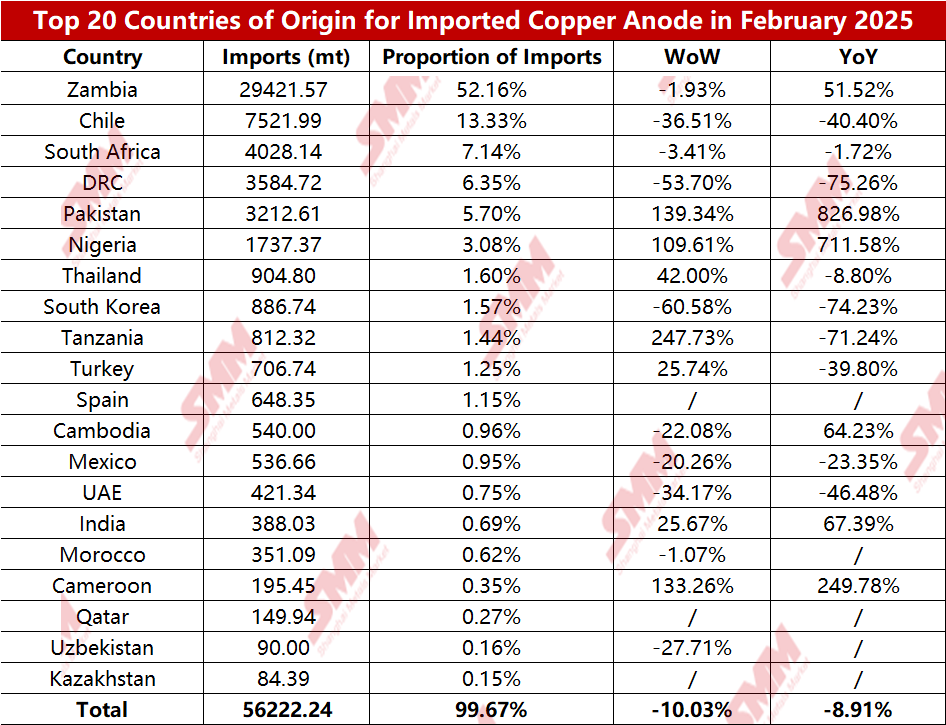
Copper anode imports to China in January and February 2025 decreased, although affected by the period around Chinese New Year. On a YoY basis, they remained at a low level in recent years. Imports from traditional major sources such as Chile, DRC, and South Africa all declined to varying degrees, mainly due to tight supply of copper ore raw materials and transportation issues.
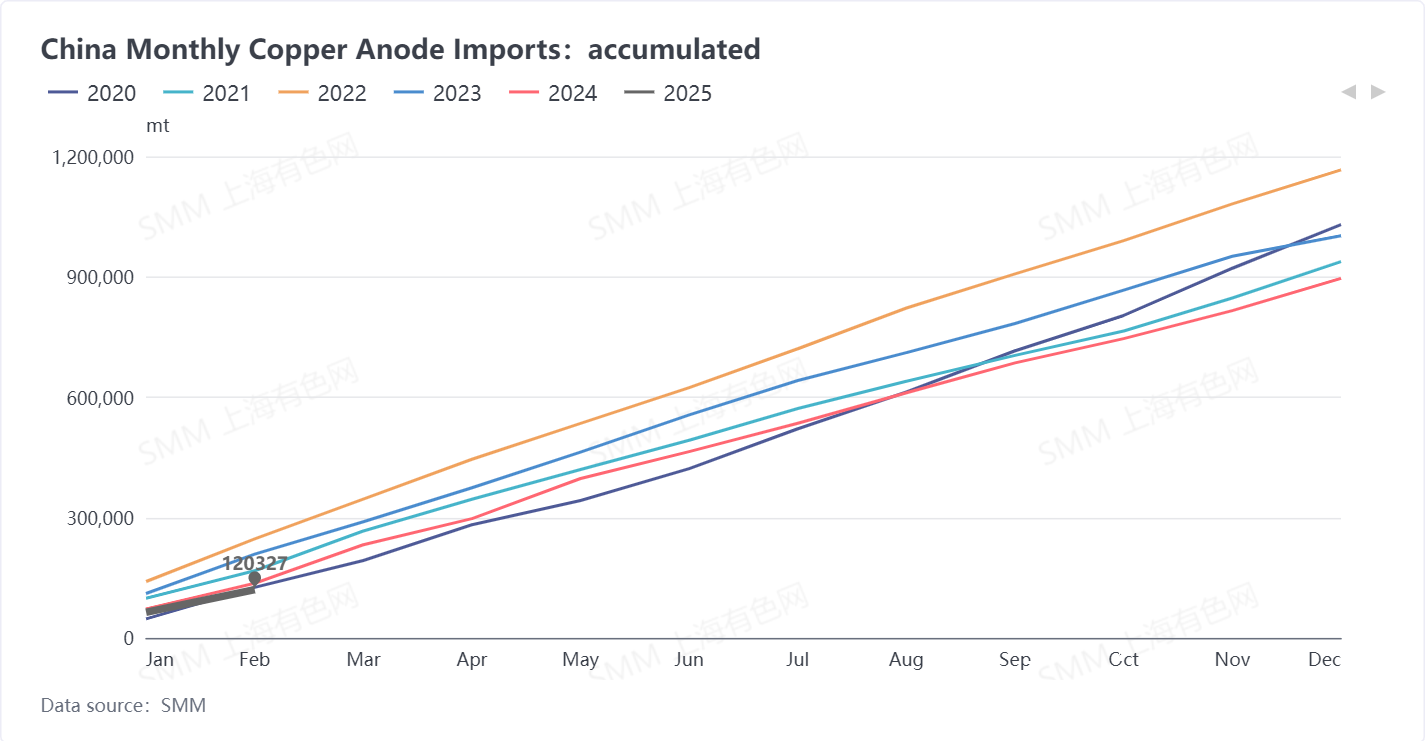
The increase in overseas copper anode supply in 2025 will mainly come from new copper anode capacity at a large smelter in DRC, but its actual commissioning time is estimated to be in H2 2025. Since February, the SHFE/LME price ratio has been inverted, while domestic blister copper RCs are moderate, leading to low interest from smelters in imported sources. In late January, unrest in DRC may have impacted imports from the region. Overall, it is expected that China's copper anode imports in H1 2025 will remain at a low level.

Data Source Statement: Except for publicly available information, all other data are processed by SMM based on publicly available information, market communication, and relying on SMM's internal database model. They are for reference only and do not constitute decision-making recommendations.

For any inquiries or for more information, please contact: lemonzhao@smm.cn
For more information on how to access our research reports, please contact:service.en@smm.cn
Related News
Sparse market trading before the holiday; watch for spot inventory changes after the holiday [SMM Shandong copper cathode spot weekly review]
6 mins ago
Sparse market trading before the holiday; watch for spot inventory changes after the holiday [SMM Shandong copper cathode spot weekly review]
Read More
Sparse market trading before the holiday; watch for spot inventory changes after the holiday [SMM Shandong copper cathode spot weekly review]
6 mins ago
Tighter China Customs Inspections Delay Copper Scrap Cargoes, Nearly 10,000 Tonnes Queuing in Hong Kong
12 mins ago
Tighter China Customs Inspections Delay Copper Scrap Cargoes, Nearly 10,000 Tonnes Queuing in Hong Kong
Read More
Tighter China Customs Inspections Delay Copper Scrap Cargoes, Nearly 10,000 Tonnes Queuing in Hong Kong
Chinese customs inspections on imported recycled copper raw materials have continued to tighten, leaving a growing volume of non-compliant copper scrap held up at ports. According to SMM market checks, nearly 10,000 tonnes of copper scrap are currently waiting in Hong Kong for entry into Guangdong. Longer customs clearance times are increasing inventory and working-capital pressure on some traders. The affected cargoes are mainly No.2 copper originating from Latin America and Southern Europe. With customs inspections remaining stringent, disruptions to scrap inflows are reducing the effective availability of imported copper scrap in the Chinese market and adding to near-term supply tightness.
12 mins ago
China Copper Scrap Pricing Coefficients Rise, Higher Chinese Bids Lift Overseas Markets
14 mins ago
China Copper Scrap Pricing Coefficients Rise, Higher Chinese Bids Lift Overseas Markets
Read More
China Copper Scrap Pricing Coefficients Rise, Higher Chinese Bids Lift Overseas Markets
China's copper scrap pricing coefficients moved broadly higher this week, supported by tight invoice availability, elevated refined copper spot premiums and disruptions to overseas scrap imports. Tight domestic feedstock availability has prompted Chinese buyers to raise bids. Millberry is currently quoted at around 98.5%–99.5% of LME copper, No.1 copper at 97.5%–98.5%, and No.2 copper at around 96.5%, while some No.2 material containing gold and silver can reach around 98%. Higher Chinese bids are increasingly feeding through to overseas markets, strengthening sellers' pricing expectations and pushing up copper scrap coefficients in several regions. With China's invoice constraints yet to ease materially and imported scrap availability remaining tight, copper scrap pricing coefficients are expected to remain well supported in the near term.
14 mins ago