Supply situation, please refer to the previous post~[SMM Hot Topic] Analysis of the Current State of the Steel Industry in Southeast Asia — Thailand (Part 1) | SMM
Thailand Steel Demand Situation
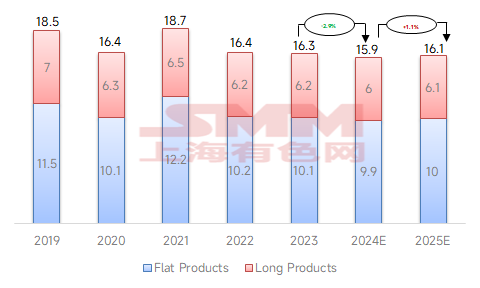
From the perspective of finished steel consumption structure, in 2023, Thailand's flat steel consumption was 10.1 million mt, and long steel consumption was 6.2 million mt, with the demand for flat and long steel accounting for 62% and 38%, respectively. Due to construction activities, domestic steel demand is expected to increase by 1.1% YoY in 2025.
Figure 7 - Thailand's Steel Demand by Product (million mt) Over the Last 7 Years
Data Source: ISIT, SMM
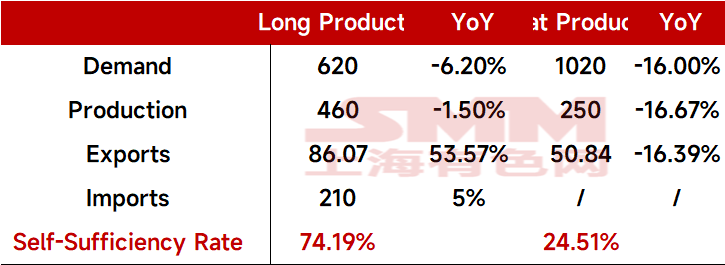
Specifically, Thailand has a strong self-sufficiency rate for long steel, while flat steel relies more on imports, with a self-sufficiency rate of 74.19% for long steel and only 24.51% for flat steel.
Table 2 - Self-Sufficiency of Flat and Long Steel in Thailand (10,000 mt) in 2022
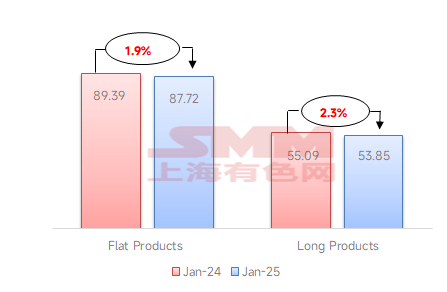
In January 2025, due to increased demand for both flat and long steel, Thailand's finished steel consumption increased. According to the Iron and Steel Institute of Thailand (ISIT), Thailand consumed 1.45 million mt of finished steel in January, up 2% YoY. Among this, flat steel demand grew by 1.9% to 893,920 tons, and long steel demand increased by 2.3% to 550,910 tons. It is understood that the consumption of most types of steel showed an upward trend, while a few products saw a decline. These products include wire rod (down 14.9% YoY), hot-rolled sheet (down 5.3% YoY), and galvanized sheet (down 7.3% YoY).
Figure 8 - Thailand's Flat and Long Steel Demand in January 2025 (10,000 mt)
Data Source: ISIT, SMM
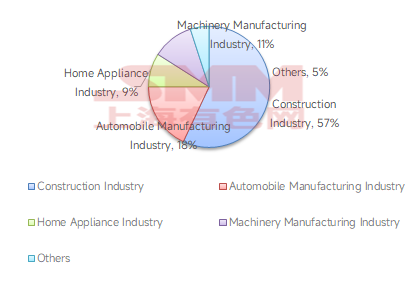
According to data from the Southeast Asia Iron and Steel Institute, the main end-user market in Thailand is currently the construction materials market, accounting for about 60%, while manufacturing sectors such as automotive, appliances, and machinery equipment account for around 40%.
Figure 9 - Thailand's Steel Consumption by Industry
Data Source: ISIT, SMM
The construction industry in Thailand is expected to show mild growth over the next few years, and thus, driven by the development of the construction sector, steel demand in Thailand will also grow steadily. Additionally, the automotive industry accounts for 17% of total steel usage in Thailand, and under the Thailand 4.0 Vision, the automotive sector is one of the five key industrial sectors, which is expected to become a significant source of increased steel demand in the future.
Figure 10 - Thailand's Auto Production Data (units) 2022-2024
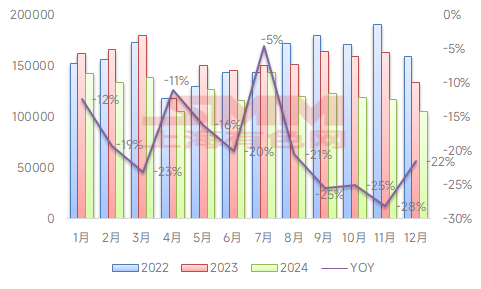
Data Source: Federation of Thai Industries, SMM
Figure 11 - Thailand's Auto Sales Data (units) 2022-2024
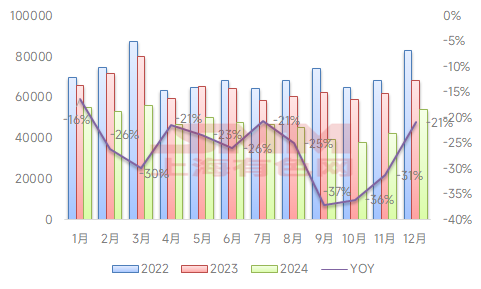
Data Source: Federation of Thai Industries, SMM
According to statistics and calculations from national statistical bureaus and customs websites, per capita crude steel consumption in Southeast Asia is around 110 kg/person, with Malaysia, Vietnam, and Thailand having relatively higher consumption levels, exceeding 200 kg/person. In 2023, this figure was 242 kg. Worada Jangbangsakae, an industry analyst at the Iron and Steel Institute of Thailand, expects that apparent steel consumption in Thailand will increase by 1.9% YoY in 2025, reaching 16.64 million mt.
Thailand Steel Import and Export Situation
Imports
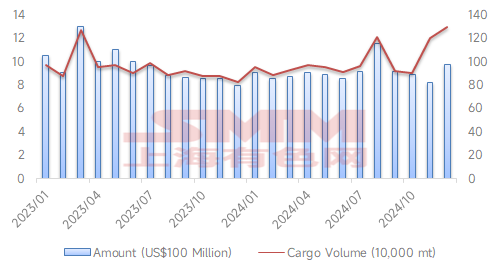
Thailand does not have large integrated steel mills, and domestic capacity growth is limited, requiring a large amount of steel imports annually to meet the needs of the construction, machinery manufacturing, and other industries. Imports were over 10 million mt in both 2023 and 2024.
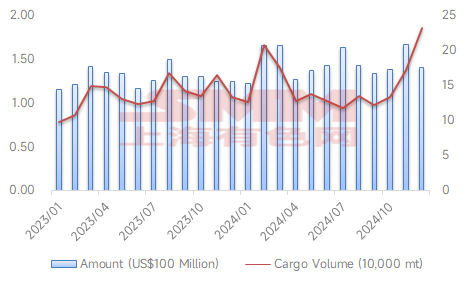
In December 2024, Thailand's steel import value reached $975 million, up 22.64% YoY. From January to December 2024, the steel import value was $10.975 billion, down 5.5% YoY. In December 2024, the volume of steel imports was 1.297 million mt, up 57.02% YoY. From January to December 2024, the volume of steel imports was 11.3454 million mt, down 6.66% YoY.
Figure 12 - Monthly Trend of Thailand's Steel Import Value and Volume 2023-2024
Data Source: Thai Customs, SMM
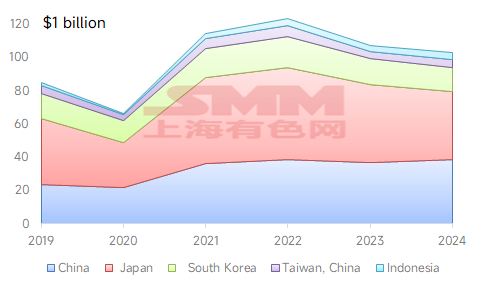
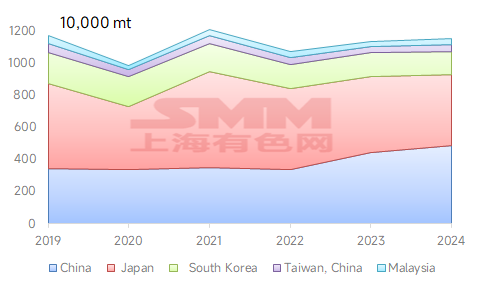
In terms of import sources, the top 5 trading partners for Thailand's steel imports in 2024 by value were China, Japan, South Korea, Taiwan, China, and Indonesia. The top 5 trading partners for Thailand's steel imports in 2024 by volume were China, Japan, South Korea, Taiwan, China, and Malaysia.
Figure 13 - Top 5 Trading Partners for Thailand's Steel Imports by Value and Historical Trends (US$ billion)
Data Source: Thai Customs, SMM
Figure 14 - Top 5 Trading Partners for Thailand's Steel Imports by Volume and Historical Trends (10,000 mt)
Data Source: Thai Customs, SMM
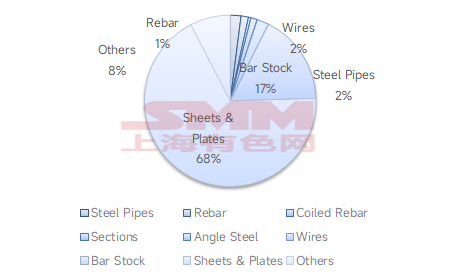
By product type, the most imported variety in 2024 was sheets & plates, totaling 8.21 million mt, accounting for 68% of total imports, followed by bars, totaling 2.08 million mt, accounting for 17% of total imports, and then wire rod, totaling 270,000 mt, accounting for 2% of total imports.
Figure 15 - Thailand's Steel Import by Product Type
Data Source: Thai Customs, SMM
Exports
In December 2024, Thailand's steel export value was $140 million, up 12.72% YoY. From January to December 2024, the steel export value was $1.742 billion, up 12.65% YoY. In December 2024, the volume of steel exports was 232,400 mt, up 74.13% YoY. From January to December 2024, the volume of steel exports was 1.8102 million mt, up 11.40% YoY.
Figure 16 - Monthly Trend of Thailand's Steel Export Value and Volume 2023-2024
Data Source: Thai Customs, SMM
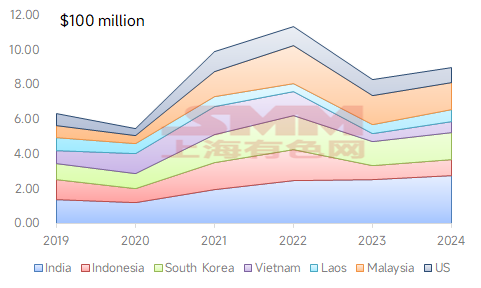
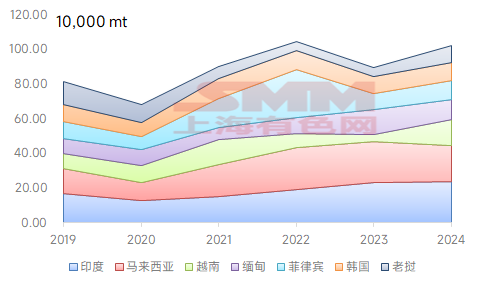
In terms of export destinations, the top 7 trading partners for Thailand's steel exports in 2024 by value were India, South Korea, Malaysia, Indonesia, US, Laos, and Vietnam. The top 7 trading partners for Thailand's steel exports in 2024 by volume were India, Malaysia, Vietnam, Myanmar, Philippines, South Korea, and Laos.
Figure 17 - Top 7 Trading Partners for Thailand's Steel Exports by Value and Historical Trends (US$ billion)
Data Source: Thai Customs, SMM
Figure 18 - Top 7 Trading Partners for Thailand's Steel Exports by Volume and Historical Trends (10,000 mt)
Data Source: Thai Customs, SMM
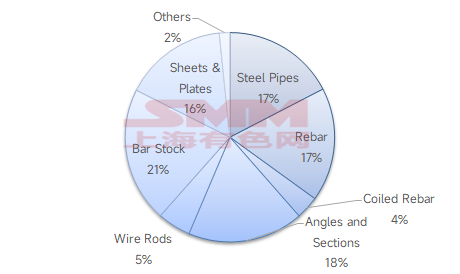
By product type, the scale of Thailand's steel product exports is relatively small, with a balanced distribution across various types. In 2024, the most exported variety was bars, totaling 380,000 mt, accounting for 21% of total exports, followed by angles, totaling 320,000 mt, accounting for 18% of total exports, and then pipes and rebar, each totaling 320,000 mt, each accounting for 17% of total exports.
Figure 19 - Thailand's Steel Export by Product Type
Data Source: Thai Customs, SMM
Summary
According to a survey by the World Steel Association (WSA), the main reason for the consistently low capacity utilization rate of steel in Thailand is due to the reliability, efficiency, and cost of production at steel mills. In 2024, the local steel capacity utilization rate in Thailand was less than 30%, still requiring a large number of imports to meet domestic steel demand, keeping the country in a net import position. At the same time, the absolute value of per capita crude steel consumption in Thailand remains at a relatively low level, with significant room for growth. With low local crude steel capacity utilization, in January 2025, the Board of Investment (BOI) of Thailand announced the latest version of the investment promotion guidelines, indicating the cancellation of new project applications for long and flat steel products, allowing only existing projects to apply for investment incentives based on smart and sustainable industrial standards, and adjusting the incentive level from the old A4 or B grade to B grade, reflecting the difficulty in increasing new steel capacity. Therefore, although some anti-dumping investigations have been initiated, the status as a net importer may be difficult to change in the short term!
SMM tracks real-time information on steel imports and exports. For more information, please follow the SMM official account!

![[SMM Daily Hot-Rolled Coil Trading] Spot Trading Moved Sideways](https://imgqn.smm.cn/usercenter/JAnHq20251217171716.jpg)