Stainless Steel Raw Material Support Shows Initial Strength, Ferrochrome and NPI Prices Rebound [SMM Analysis]

Published: Jan 17, 2025 17:00
[SMM Analysis: Stainless Steel Raw Material Support Strengthens Initially, Ferrochrome and NPI Prices Rebound] This week, stainless steel electronic trading fluctuated rangebound and trended upward, driving spot prices to continue rising. The weekly average price of private 304 cold-rolled stainless steel reached 13,030 yuan/mt this week, up by approximately 120 yuan/mt compared to last week.

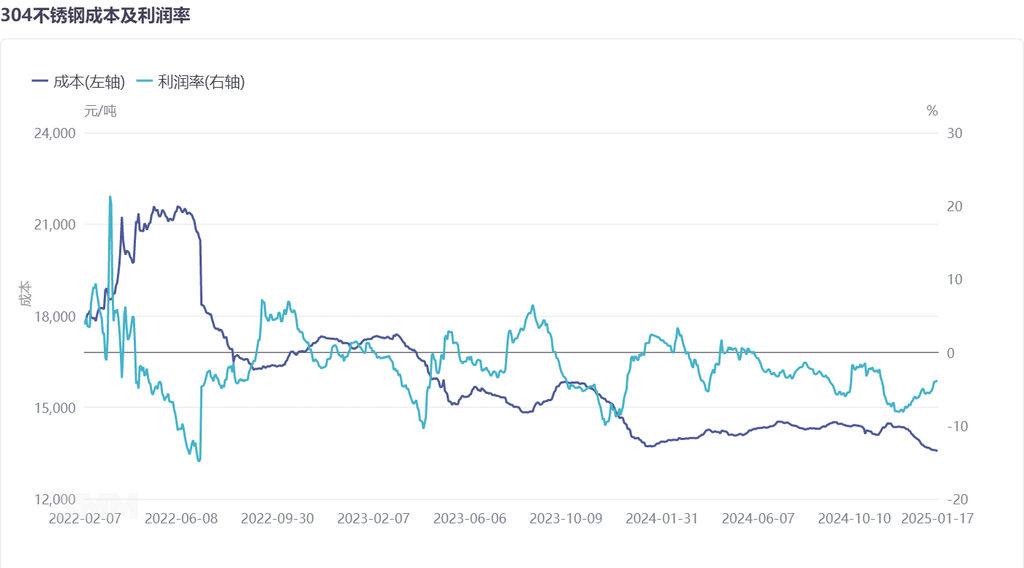
This week, stainless steel futures fluctuated rangebound with an upward trend, driving spot prices to continue rising. The weekly average price of private 304 cold-rolled stainless steel reached 13,030 yuan/mt, up by approximately 120 yuan/mt WoW. As the Chinese New Year holiday approaches, although the prices of 304 cold-rolled finished products slightly rebounded, steel mill production in east and south China decreased, downstream market sentiment stabilized, and shipments remained limited, resulting in overall sluggish market transactions. The integrated nickel cost for 304 cold-rolled stainless steel was approximately 1,021.01 yuan/mtu, up by about 0.22% WoW. Ferrochrome prices stood at 7,300 yuan/mt, rising slightly by 33.33 yuan, while stainless steel scrap prices remained stable at around 9,300 yuan/mt. Raw material costs began to strengthen, with the daily cash cost of integrated raw materials at approximately 13,541 yuan/mt. Based on the stainless steel mill price of 13,050 yuan/mt, the cash cost incurred a loss of about 3.63%, while the full cost resulted in a loss of 7.85%. Stainless steel finished product prices are expected to remain stable or rise slightly next week.
》Click to View SMM Stainless Steel Spot Historical Prices

》Click to View SMM Stainless Steel Industry Chain Database


Data Source Statement: Except for publicly available information, all other data are processed by SMM based on publicly available information, market communication, and relying on SMM's internal database model. They are for reference only and do not constitute decision-making recommendations.

For any inquiries or for more information, please contact: lemonzhao@smm.cn
For more information on how to access our research reports, please contact:service.en@smm.cn
Related News
International Molybdenum Oxide Prices Firm, China-Overseas Price Spread Widens 【SMM Molybdenum Analysis】
8 hours ago
International Molybdenum Oxide Prices Firm, China-Overseas Price Spread Widens 【SMM Molybdenum Analysis】
Read More
International Molybdenum Oxide Prices Firm, China-Overseas Price Spread Widens 【SMM Molybdenum Analysis】
SMM, September 11: Recently, international molybdenum oxide prices have continued to consolidate on a strong note, with the center of quotations in markets outside China moving somewhat higher. Meanwhile, China's molybdenum market has remained relatively cautious overall, presenting a pattern of being in the doldrums. The trends in Chinese and overseas markets have shown some divergence, and the price spread between Chinese and overseas markets has widened further.
8 hours ago
Finished steel weakness drags raw materials downward; steel mills remain inverted, stainless steel cost center shifts lower overall [SMM Analysis]
9 hours ago
Finished steel weakness drags raw materials downward; steel mills remain inverted, stainless steel cost center shifts lower overall [SMM Analysis]
Read More
Finished steel weakness drags raw materials downward; steel mills remain inverted, stainless steel cost center shifts lower overall [SMM Analysis]
[SMM Analysis] Weakness in Finished Steel Drags Down Raw Materials; Steel Mills Remain in Losses as Stainless Steel Cost Center Shifts Lower Overall This week, stainless steel finished product and raw material prices pulled back in tandem, industry smelting profits remained in a loss-making pattern, and the overall cost side center shifted further downward. Based on 304 cold-rolled category calculations, profit pressure at steel mills continued to be prominent this week, with a profit margin of -0.25% based on current raw material accounting and -2.56% based on inventory raw material accounting. Losses on inventory raw materials were deeper, and production and operating pressure at steel mills continued to intensify. Overall, finished steel prices weakened along with futures, and raw materials followed the decline, but against the backdrop of a weak market, industry-side demand and procurement continued to contract, and the industry's loss-making pattern was not repaired. Nickel-based raw material prices came under further downward pressure this week, with pessimistic trading sentiment dominating market movements. The expected recovery during the September-October peak season for stainless steel has completely failed to materialize, end-user rigid demand has remained sluggish, and steel mills have been mired in cost-inversion losses for a long time. Their acceptance of high-priced nickel raw materials has remained persistently low, and procurement sentiment has turned cautious. Meanwhile, high-grade NPI port inventory has stayed high, and the loose supply pattern has not changed, further amplifying weak market expectations and driving continued pullbacks in nickel pig iron quotes. As of this Friday, the delivered duty-paid price of China's 10-12% grade Indonesian high-grade NPI fell by 25 yuan per nickel unit to 1,085 yuan per nickel unit, with nickel-based cost support continuing to weaken. This week, stainless steel scrap prices also remained in the doldrums, and its cost substitution advantage was insufficient to offset bearish fundamental pressure. During the week, SS futures continued to hit bottom, finished steel and nickel pig iron prices moved down in tandem, and the bearish resonance between futures and spot markets persisted, with overall market sentiment...
9 hours ago
Cost Advantages Fail to Offset Weak Sentiment, Stainless Steel Scrap Prices Remain Under Pressure and Pull Back [SMM Stainless Steel Scrap Market Weekly Review]
9 hours ago
Cost Advantages Fail to Offset Weak Sentiment, Stainless Steel Scrap Prices Remain Under Pressure and Pull Back [SMM Stainless Steel Scrap Market Weekly Review]
Read More
Cost Advantages Fail to Offset Weak Sentiment, Stainless Steel Scrap Prices Remain Under Pressure and Pull Back [SMM Stainless Steel Scrap Market Weekly Review]
[SMM Stainless Steel Scrap Weekly Review] Cost Advantages Fail to Offset Bearish Sentiment, Stainless Steel Scrap Prices Remain Under Pressure and Pull Back This week, 304 stainless steel scrap off-cuts prices in east China pulled back, with a quotation range of 9,900-10,000 yuan/mt; 304 stainless steel scrap off-cuts prices in the Foshan area fell in tandem, with a price range of 9,900-10,200 yuan/mt. From the perspective of raw material production costs, the current cost of producing stainless steel entirely from stainless steel scrap is approximately 14,004.41 yuan/mt, while the production cost using only high-grade NPI reaches 14,493.57 yuan/mt. The price spread between the two remains stable, and stainless steel scrap continues to hold a clear economic substitution advantage over high-grade NPI. This week, stainless steel scrap prices trended lower overall. During the week, SS futures continued to slide and hit bottom, with bearish sentiment spreading in the market and transmitting to the spot end, dragging spot prices of stainless steel products down in tandem; substitute raw material high-grade NPI prices also remained in the doldrums, forming a linked downward pattern across futures and raw materials, with overall market trading sentiment leaning bearish. Although stainless steel scrap maintained favorable substitution economics supported by the cost spread, industry fundamentals continued to weaken, making it difficult to support firm price performance. The expected recovery of the "September peak season" for stainless steel products failed to materialize, end-user rigid demand remained sluggish, and steel mills remained in a state of losses over the long term, with prominent production profit pressure. In September, steel mill production schedules are expected to pull back somewhat, and raw material purchase willingness continued to cool. Overall, the inherent cost substitution advantage of stainless steel scrap is difficult to offset the current multiple bearish pressures. Peak season demand fell short of expectations, leading to weak destocking of finished products...
9 hours ago