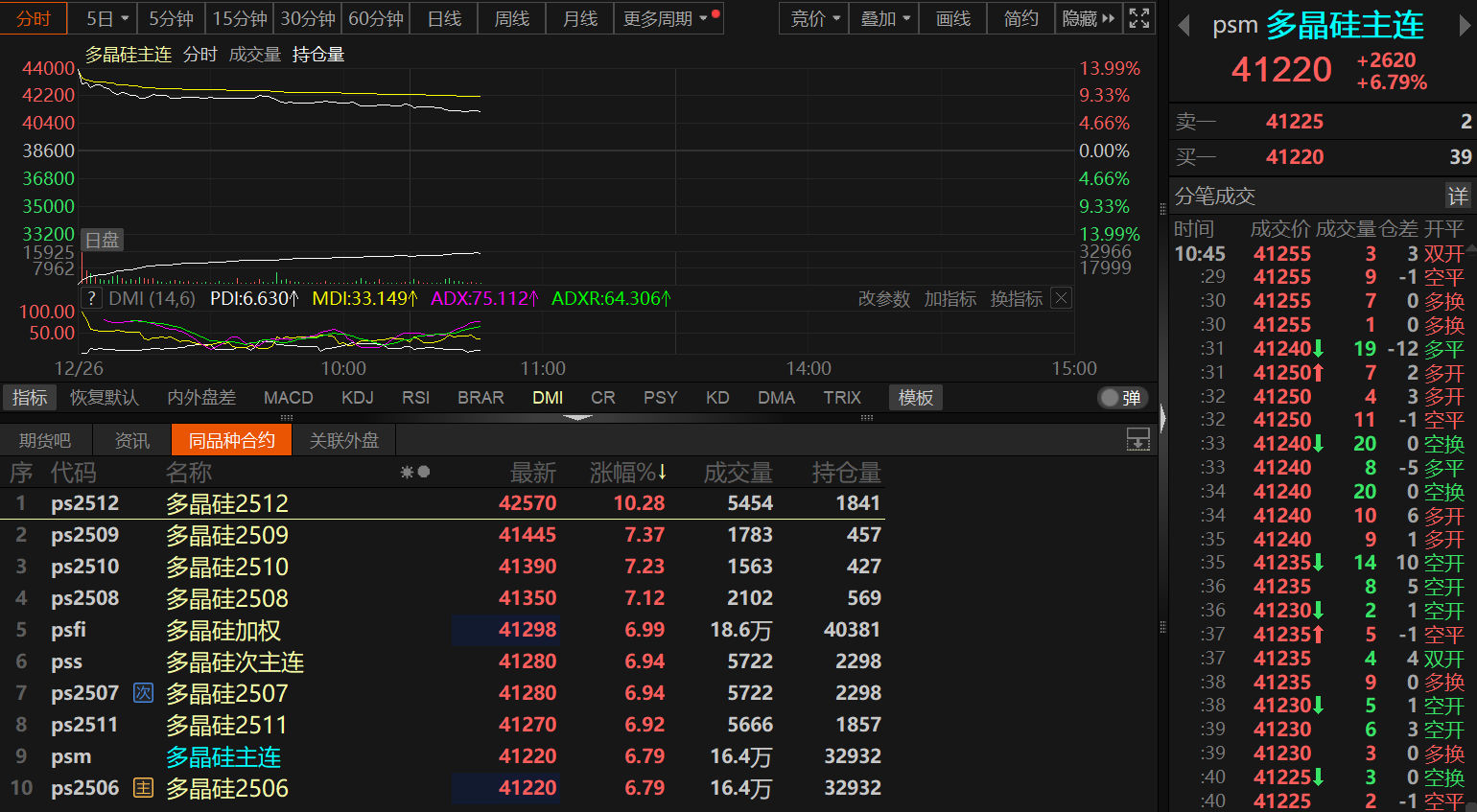
SMM, December 26: Today, polysilicon futures were finally listed on the Guangzhou Futures Exchange amid much anticipation. The benchmark listing price for the futures was 38,600 yuan/mt. At 9 a.m., upon opening, the main polysilicon futures contract surged by as much as 13.99%, hitting the upper limit at 44,000 yuan/mt. However, the momentum weakened slightly afterward, with the increase narrowing to around 7%, and prices stabilizing at approximately 41,000 yuan/mt.
Notably, two leading domestic polysilicon enterprises, Tongwei and Daqo New Energy, announced production cuts just two days before the listing of polysilicon futures. Both companies stated that under the current market conditions, production cuts and maintenance would help reduce losses in their high-purity polysilicon businesses and are expected to positively impact their overall operations and profitability.
Additionally, according to SMM, GCL Technology also responded that it would undertake production cuts and maintenance during the same period. SMM learned that the combined polysilicon capacity of these three companies exceeds 1.6 million mt, with Tongwei's high-purity polysilicon capacity exceeding 900,000 mt, ranking first globally in market share for consecutive years.
The production cuts led by leading enterprises align with the self-regulation convention previously issued by the China Photovoltaic Industry Association. Lu Jinbiao, Deputy Director of the Silicon Industry Expert Group of the China Nonferrous Metals Industry Association and Joint Secretary General of the SEMI China PV Standards Committee, stated that the current polysilicon cash cost is inverted. Only by reducing the load of leading enterprises can the supply-demand relationship improve, facilitating inventory digestion and bringing prices back to a reasonable range.
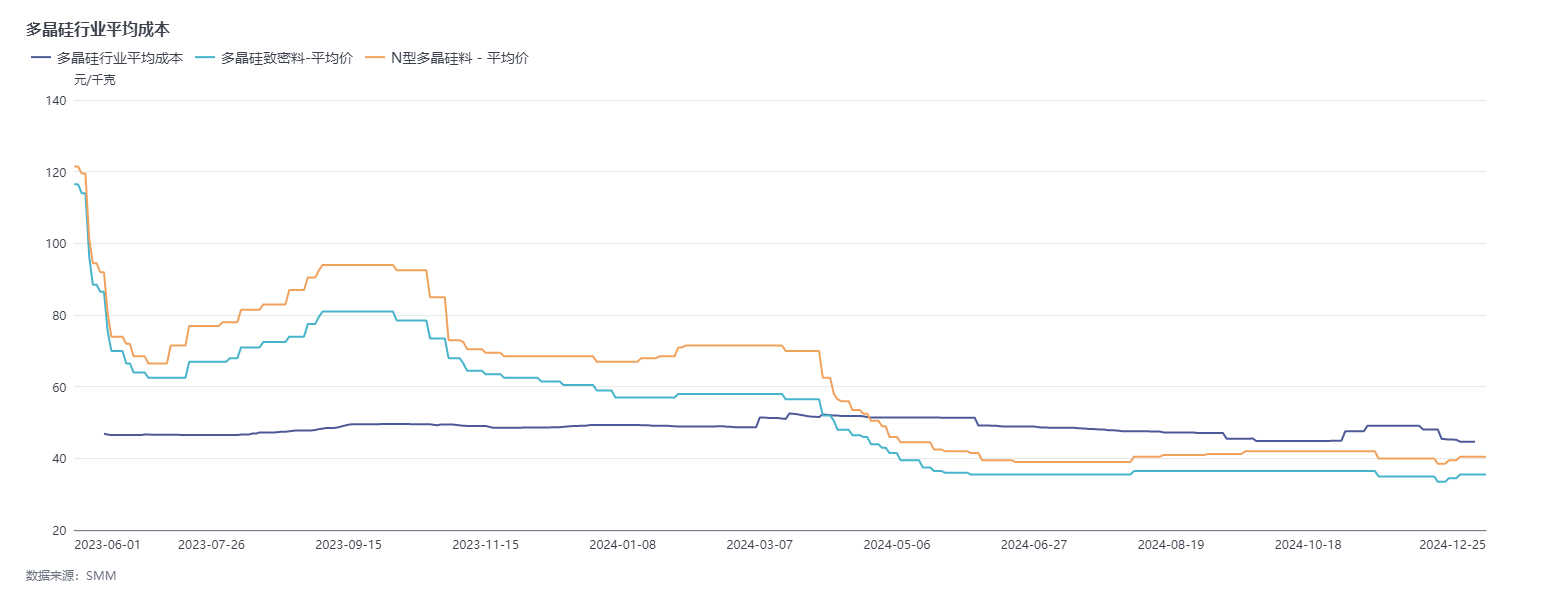
According to SMM data, as early as April 19, 2024, the average prices of dense polysilicon and N-type polysilicon had already fallen below the industry's average cost line, and the market has remained in a loss-making phase since then. By late November, SMM's survey indicated that December would see a significant reduction or suspension of production by polysilicon enterprises, with production schedules significantly lower than in November. Leading enterprises contributed the majority of the reductions. Previously, SMM estimated that domestic polysilicon production in December would be approximately 94,600 mt, down 15.2% MoM from November. Detailed data will be released around January 7, 2025—stay tuned!
》Click to view SMM PV product prices
Institutional Comments
Guoyuan Futures Before the listing of polysilicon futures, Guoyuan Futures predicted that the recent announcements by leading polysilicon enterprises Tongwei and Daqo (with a combined capacity of approximately 1.2 million mt) to phase out capacity had fueled bullish market sentiment. They believed that polysilicon futures were likely to surge upon opening. However, from a fundamental perspective, the industry remains in a cycle of overcapacity, with additional capacity expected to come online in 2025. This creates significant resistance for polysilicon prices. Contracts PS2506, PS2507, PS2508, and PS2509 correspond to the rainy season in south-west China, and their listing prices are relatively overestimated. Polysilicon prices are expected to pull back after an initial rise. In the short term, the inter-month price spread may exhibit a backwardation structure, which could later shift to a contango structure.
CITIC Futures CITIC Futures stated that current polysilicon prices have fallen to around 40,000 yuan/mt, the industry's average cost line. The industry's operating rate has dropped to approximately 35%. With the PV industry's self-regulation agreement and the two major companies' announcements of phased production cuts and maintenance, the market may prematurely or excessively price in expectations of easing supply-demand imbalances. This could result in high volatility in polysilicon futures prices shortly after listing. From an intertemporal strategy perspective, considering the delivery system, the exemption system for registered brands simplifies the seller's delivery process. However, some downstream enterprises have higher requirements for product traceability and other additional factors, raising their barriers to participating in delivery purchases. This design may lead to a gradual buildup of polysilicon warehouse warrants, with near-month contract prices potentially declining before concentrated cancellations. The near-far month price spread may widen, with particular attention to reverse arbitrage opportunities in contracts PS2511 and PS2512.
Huarong Futures Huarong Futures commented that on the supply-demand side, delays in commissioning new polysilicon capacity are common, and operating rates remain low. Production growth is expected to slow significantly in the future. However, with downstream demand growth being moderate and market sentiment subdued, total polysilicon inventory continues to accumulate. As a result, the overall supply-demand pattern remains weak. Regarding spot prices, polysilicon spot prices have been running at low levels with relatively small fluctuations over the past six months, essentially reaching a floor. Last night, leading polysilicon enterprises such as Tongwei and Daqo simultaneously announced production cuts, which will significantly reduce future polysilicon production. Compared to the futures listing price of 38,600 yuan/mt announced by the Guangzhou Futures Exchange, the current price of N-type polysilicon is around 41,000 yuan/mt, with recent signs of price increases, including quotes reaching 45,000 yuan/mt. In the short term, futures prices are expected to be boosted. However, given the high inventory levels, the upward space beyond the first-day limit price of 44,000 yuan/mt remains constrained.
Huarong Futures Huarong Futures also noted that after the listing of polysilicon futures, with the involvement of spot-futures funds, investment funds, and even stock funds, market sentiment is expected to improve. For polysilicon enterprises, taking advantage of high market sentiment to sell futures at high prices for hedging purposes will help smooth daily production activities. For downstream monocrystalline pulling enterprises, buying futures at low prices for hedging purposes will aid in raw material inventory management. In the short term, prices are expected to be influenced by news, but attention should be paid to the rebound in terminal module prices and changes in the PV industry chain's operating rates.
Yide Futures Yide Futures stated that polysilicon futures might experience a volatile rebound after listing. However, given the current high inventory levels and the downstream off-season, the upward momentum remains weak. The market is still in a bottoming process, and attention should be paid to the gap between the opening price and the current price. In the short term, prices are expected to fluctuate between 38,000-42,000 yuan/mt.
Zhang Hang, Senior Analyst at Guotai Junan Futures Zhang Hang commented that the theoretical valuation of deliverable brands for June 2025 is between 43,000-44,000 yuan/mt, while the listing price for polysilicon futures is 38,600 yuan/mt. From a valuation perspective, polysilicon futures are highly likely to open higher on the first day of listing. However, he also cautioned that the initial bullish sentiment might lead to a high opening followed by a downward trend.
Guotou Futures Guotou Futures stated that on December 25, 2024, the SMM average price for N-type polysilicon was 40,500 yuan/mt, while the listing prices for contracts PS2506-2512 were all 38,600 yuan/mt, with a spot-futures price spread of -1,900 yuan/mt. On the first day of listing, market information is limited, and irrational fluctuations may occur, with a tendency to correct the spot-futures price spread. The likelihood of a first-day price increase is higher. The current average cost for the polysilicon industry is estimated at 46,500 yuan/mt, but the market's fair cost is not uniform, with a reference range of 40,000-48,000 yuan/mt. Considering the listing price, the first-day strategy leans towards going long near the cost floor. Due to high inventory levels and the involvement of spot-futures forces, hedging pressure near the cost ceiling is expected to suppress futures prices.
China Securities Futures China Securities Futures stated that considering the cash costs of leading enterprises among registered brands and the polysilicon cost with tax corresponding to module bid prices not lower than costs, the theoretical lower limit for PS2506 prices is estimated to be close to 39,000 yuan/mt. From the perspective of arbitrage opportunities with alternative deliverable brands, the theoretical upper limit for PS2506 prices is estimated to be around 46,000 yuan/mt. Based on the minimum price corresponding to spot-futures arbitrage participation, the price center for PS2506 is expected to range between 42,000-43,000 yuan/mt. Thus, the reasonable price range for PS2506 in the initial listing period is projected to be 39,000-46,000 yuan/mt, with a price center between 42,000-43,000 yuan/mt.
For the long-term trend of polysilicon futures, GF Futures stated that looking ahead to 2025, under the framework of the industry self-regulation agreement, the production enthusiasm of polysilicon enterprises is expected to remain low, and the price center is likely to gradually move upward. Additionally, the demand for futures warehouse warrants may help digest high polysilicon inventory and even drive demand growth, leading to price increases.
![[Солнечная энергия: Бангладеш вводит тариф $0,086/кВт·ч для кровельных солнечных установок с чистым учётом и целью 5 ГВт]](https://imgqn.smm.cn/usercenter/zvkUO20251217171743.jpg)
![[Солнечная энергия: австралийская Frontier Energy заключила контракты на гибридный солнечно-аккумуляторный проект Waroona в Западной Австралии]](https://imgqn.smm.cn/usercenter/JNxfy20251217171742.jpg)
![[Солнечная энергетика: Малайзия запускает национальную солнечную программу LSS6 с 2,5 ГВт солнечных мощностей и 1,25 ГВт накопителей]](https://imgqn.smm.cn/usercenter/PkttC20251217171742.jpg)