

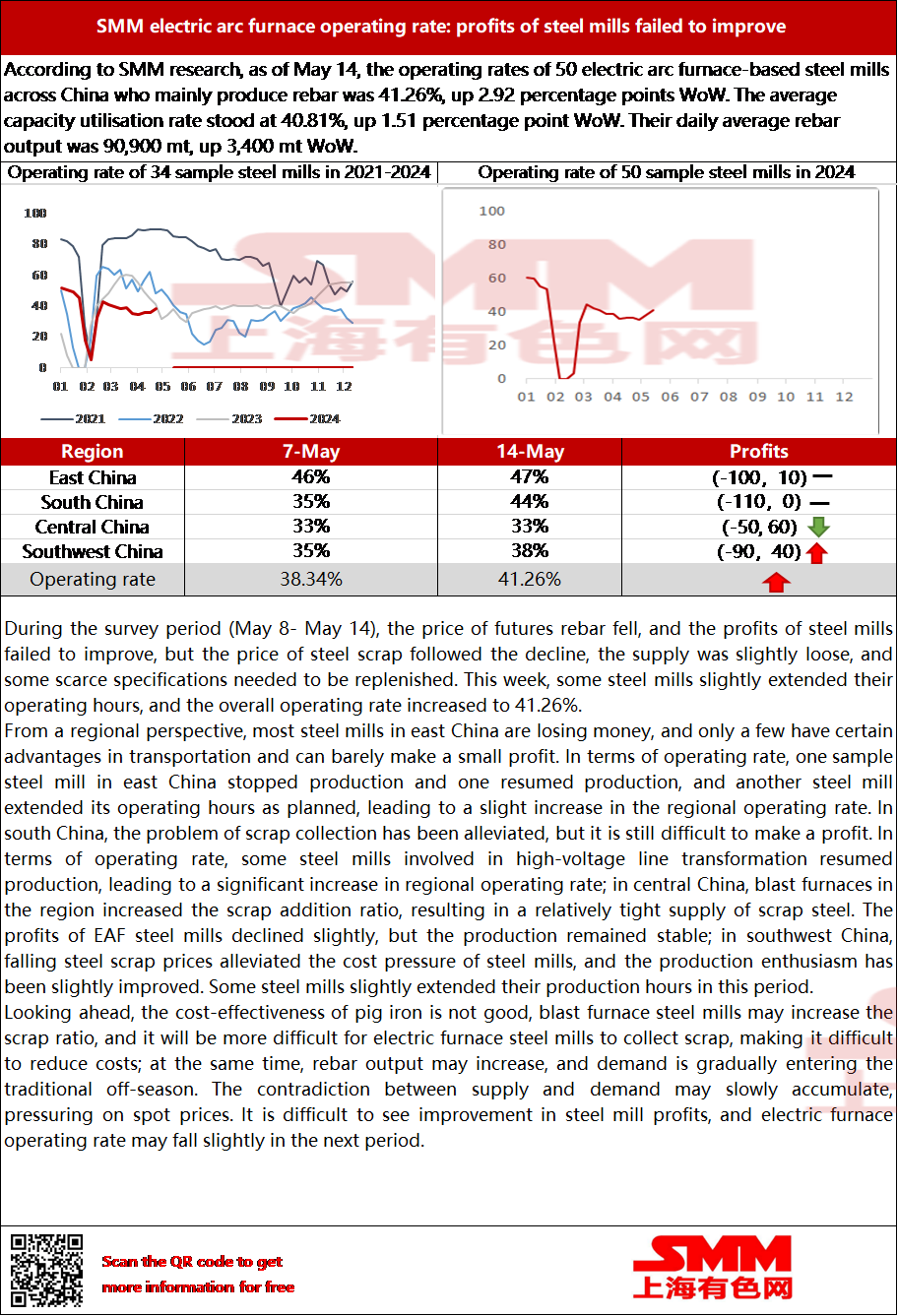
SMM electric arc furnace operating rate: profits of steel mills failed to improve
According to SMM research, as of May 14, the operating rates of 50 electric arc furnace-based steel mills across China who mainly produce rebar was 41.26%, up 2.92 percentage points WoW. The average capacity utilisation rate stood at 40.81%, up 1.51 percentage point WoW. Their daily average rebar output was 90,900 mt, up 3,400 mt WoW.
Data Source Statement: Except for publicly available information, all other data are processed by SMM based on publicly available information, market communication, and relying on SMM's internal database model. They are for reference only and do not constitute decision-making recommendations.
For any inquiries or for more information, please contact: lemonzhao@smm.cn
For more information on how to access our research reports, please contact:service.en@smm.cn
Related News
![[Tata Steel: India steel demand seen up 8-10%, in talks with Dutch government on steel production]](https://imgqn.smm.cn/usercenter/rKOND20251217171716.jpg)
2 hours ago
[Tata Steel: India steel demand seen up 8-10%, in talks with Dutch government on steel production]
Read More
[Tata Steel: India steel demand seen up 8-10%, in talks with Dutch government on steel production]
Tata Steel's CEO told the Indian Foundation for Quality Management (IFQM) Symposium 2026 in Delhi that India's domestic steel demand should grow 8-10% this year, as all consuming sectors remain strong, and said the company is positive on the industry outlook. On the proposed Netherlands project, he said Tata Steel is in active talks with the Dutch government to resolve outstanding issues before any binding agreement can be signed, including the closure of coke ovens and the classification and handling of steel slag. Tata Steel's IJmuiden plant in the Netherlands has installed capacity of about 7 million tonnes per year; the company has launched a transformation programme to install lower-carbon steelmaking processes, lift production efficiency, cut fixed costs and optimise product mix and margins.
2 hours ago
![[UK scrap gap: 7.3 Mt capacity shortfall needs two Port Talbots of new EAF capacity]](https://imgqn.smm.cn/usercenter/rBCZR20251217171716.jpg)
2 hours ago
[UK scrap gap: 7.3 Mt capacity shortfall needs two Port Talbots of new EAF capacity]
Read More
[UK scrap gap: 7.3 Mt capacity shortfall needs two Port Talbots of new EAF capacity]
UK steel faces an unavoidable EAF transition. On Western European cost benchmarks, scrap-based EAF already beats blast furnace steelmaking — cheaper and faster to build, set to gain from grid decarbonisation — and the old grade-capability gap has narrowed sharply. Largely exported UK scrap is a feedstock the shift would retain.
Consumption is set to rise 54% by 2050 on construction, offshore wind, transmission and automotive demand, but projected domestic output falls 7.3 Mt short: about 118 billion USD (93 billion GBP) of opportunity to 2050 that imports would fill without new capacity. Closing it would need over two Port Talbots' worth of new EAF capacity.
UK mill power costs in 2025/26 ran 7.7 USD/tonne (6.10 GBP/tonne) above German rivals and 10.0 USD/tonne (7.90 GBP/tonne) above French peers.
2 hours ago
![[Japan Adds Steel Products to Russia Export Ban List]](https://imgqn.smm.cn/usercenter/fvyjO20251217171715.jpg)
2 hours ago
[Japan Adds Steel Products to Russia Export Ban List]
Read More
[Japan Adds Steel Products to Russia Export Ban List]
Japan has announced additions to its export ban list against Russia, with steel products included among the newly listed categories. The move further tightens Tokyo's existing sanctions framework, formally closing export channels for the affected steel grades and steel products. Japanese exporters will need to redirect those volumes towards alternative markets such as Southeast Asia and the Middle East. As Japan's steel shipments to Russia are limited in volume, the direct trade impact is manageable, but the signal is stronger: G7 controls on industrial goods including steel continue to tighten, and downstream finished products and metallurgical equipment may be covered next. The full commodity code list and the effective date have not yet been published, so the practical impact will depend on the final official ordinance.
2 hours ago
Related News
[Tata Steel: India steel demand seen up 8-10%, in talks with Dutch government on steel production]
Oct 06, 2026 17:18 (GMT+8)
[UK scrap gap: 7.3 Mt capacity shortfall needs two Port Talbots of new EAF capacity]
Oct 06, 2026 17:18 (GMT+8)
[Japan Adds Steel Products to Russia Export Ban List]
Oct 06, 2026 17:18 (GMT+8)
[SMM Steel] Indian HRC Prices Largely Stable; European Offer Targets Rise
Oct 06, 2026 16:45 (GMT+8)