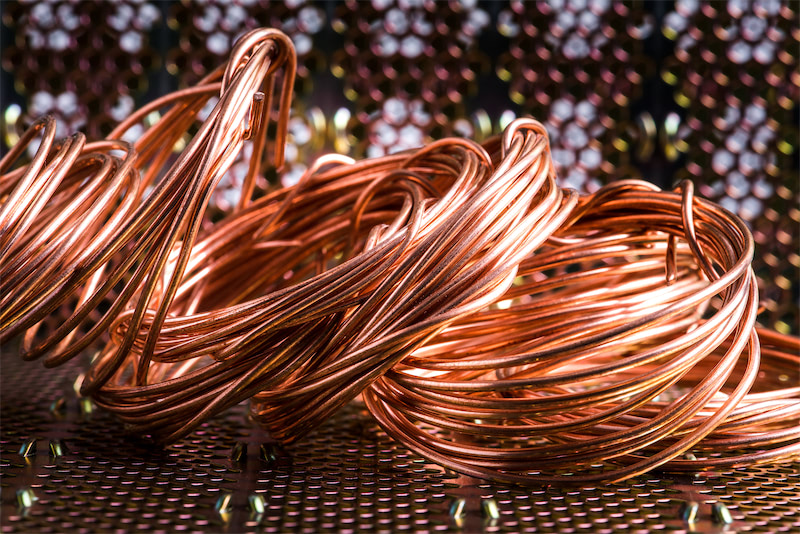
At the 2024 (19th) SMM Copper Industry Conference and Copper Industry Expo - Copper Raw Materials and Consumption Development Forum, jointly organized by SMM and Shandong Humon Smelting Co., Ltd., SMM Copper Senior Analyst Liang Kaihui analyzed China's copper scrap recycling, utilization and prospects.
Brief introduction of copper scrap industry chain
Copper scrap recycling
The recycling process for automobiles, household appliances and electronic products is the most complicated, with the most market participants;
Cars and ships have the shortest recycling system. Copper scrap products removed from ships and cars can go directly to smelters or processing plants.
Copper scrap with higher grade will enter the processing industry, while copper scrap with lower grade will enter the smelting industry.
Flow direction of copper scrap
The buyer traders are usually only responsible for buying the goods, and are not responsible for the communication and docking with the downstream copper plants. They will supply the purchased goods to the traders who need to deliver goods.
The profit margin of the buyer traders is relatively low, only around 100 yuan/mt;
The upstream and downstream are completely different. The upstream recycling plants are scattered and numerous, while the downstream copper processing plants are few and concentrated.
Copper scrap output and flow direction
Copper scrap supply
For imported copper scrap, usually, after the goods are loaded, it takes 2 months for them to arrive in China from Europe and the United States, and 1-2 months from Southeast Asia.
Domestic scrap is mainly dismantled by dismantlers, and then various types of copper scrap are sold to downstream scrap-user enterprises according to their copper content.
The supply and consumption of domestic copper scrap have maintained a tight balance or even supply shortage for a long time. Due to the limited amount of domestic scrap resource recycling, the supply of domestic copper scrap is in short supply.
Number of domestic scrap dismantling plants
There were 183 long-term tracking enterprise samples in 2022, which dropped to 166 in 2023. There is excess dismantling capacity and insufficient domestic supply of scrap;
The production capacity is relatively fixed, with the dismantling volume of medium and large enterprises being 300,000-400,000 sets, and that of small and medium-sized enterprises being around 200,000 sets;
The government’s financial capacity is limited, subsidy disbursement is delayed, and the purchase of used home appliances often requires advance payment. These led to a break in the capital chain of some companies.
The amount of copper scrap flowing to the processing and smelting industries
Every year from April to June, smelters begin to carry out equipment maintenance. In order to ensure that the output of copper cathode does not decline sharply, smelters need to purchase anode plates as raw materials to produce copper cathode. In the traditional peak season of the fourth quarter, demand from processing industry increases significantly, with more copper scrap flowing to copper processing companies.
55% of copper scrap is consumed by smelters, and 45% by downstream copper processing enterprises. Among the downstream copper scrap processing enterprises, copper rod plants using copper scrap as raw material account for 50%, copper billet plants account for 30%, copper plates and strips plants account for 10%, and others account for 10%.
Status quo of copper rod plants using copper scrap as raw material
Operating rates
The price spread between copper cathode and copper scrap is related to the purchase of copper scrap. If the price difference remains above the advantage line, copper rod plants using copper scrap as raw material are willing to purchase more copper scrap, which means that the price of copper scrap is more advantageous.
The price spread between copper rod using copper cathode and using copper scrap is related to the downstream demand. When the price difference is above the advantage line, downstream wire and cable companies are more willing to purchase copper rod made from copper scrap, and demand increases.
The deduction of copper rod made from copper scrap from SHFE copper prices is linked to the processing fee of anode plates and blister copper, which determines whether the plants tend to produce copper rod made from copper scrap or anode plates and blister copper.
Deduction for copper rod made from copper scrap, anode plate processing fee
Due to the rapid rise in copper prices, the discount of copper rod made from copper scrap has been increasing. Since the beginning of this year, smelters have been suffering from a shortage of ore supply, and the demand for anode plates has increased. As smelters undertake equipment maintenance in April and May, the demand for anode plates has increased, and the increase in processing fees is far less than that of copper rod made from copper scrap.
As the selling price of anode plates is over 1,000 yuan/mt higher than that of copper rod made from copper scrap and the production cost is 100-200 yuan/ton lower, copper rod plants using copper scrap as raw material have converted their production capacity to the production of anode plates considering payment collection.
New anode plate production capacity of copper rod plants using copper scrap as raw material
Compared with the 1.21 million tons of anode plate production capacity of domestic copper rod plants using copper scrap as raw material in 2022, as of April 2024, the anode plate production capacity has increased to 1.42 million tons, a 17.36% increase.
Due to the increasing overcapacity of domestic copper rod plants using copper scrap as raw material and the different tax policies in different regions, the price competition of copper rod made from copper scrap has become increasingly fierce. With limited profits from deep processing, copper rod plants using copper scrap as raw material have chosen to develop upstream in the industrial chain.
Capacity of copper rod made from copper scrap
The production capacity of copper rod made from copper scrap is expected to increase from 6.55 million tons in 2023 to 7.09 million tons in 2024, an increase of 8.24%;
This year, the tax incentives in Anhui and Hubei have attracted many companies to invest and open factories;
The difference in tax rates gives Anhui clear advantage over other regions in terms of raw material procurement and finished product sales.
Outlook and conclusion
Outlook · Trade-in of home appliances
The State Council issued the "Action Plan for Promoting Large-Scale Equipment Renewal and Consumer Goods Trade-in". By 2027, the scale of equipment investment in industries such as industry, agriculture, construction, transportation, education, culture, tourism, and medical care will increase by more than 25% compared with 2023; the energy efficiency of major energy-consuming equipment in key industries will basically reach the energy-saving level, and the proportion of production capacity with environmental protection performance reaching Class A will be greatly increased. The penetration rate of digital R&D and design tools and the CNC rate of key processes of industrial enterprises above a designated size will exceed 90% and 75% respectively; the amount of scrapped cars recycled will increase by about one-fold compared with 2023 (the amount of scrapped cars in 2023 was 7.56 million vehicles), the volume of second-hand car transactions will increase by 45% compared with 2023, and the amount of used household appliances recycled will increase by 30% compared with 2023 (the amount of used household appliances recycled in 2023 was 4.5 million tons), and the proportion of recycled materials in resource supply will be further increased.
Outlook · Reverse Invoicing
The implementation of "reverse invoicing" in the resource recycling industry can not only effectively reduce the tax burden of resource recycling companies, but also greatly reduce the tax risks of companies making illegal deductions due to failure to obtain pre-tax deduction certificates. At the same time, the promotion of the "reverse invoicing" policy can further enhance investors' confidence in the scrap recycling industry, help encourage more companies and individuals to participate in the recycling of scrap, and attract more capital into the renewable resources industry, thereby promoting the recycling of resources.
Summary
Copper scrap: Due to the continued shortage of ore supply, the demand for copper scrap from smelters has increased accordingly. In addition, the production capacity of copper rod made from copper scrap is still expanding. The consumption of copper scrap will continue to rise both at the smelting end and the processing end.
Consumer goods trade-in policy: Implement four major actions, namely equipment renewal, consumer goods trade-in, recycling and reuse, and standard improvement, to vigorously promote the production and application of advanced equipment and promote the continuous increase in the proportion of advanced production capacity.
"Reverse invoicing": "Reverse invoicing" helps to improve recycled resources and solve the problem of invoice recycling from the source, improve the efficiency of the domestic recycling system and better monitor tax issues in the recycling industry.
The capacity utilization rate of dismantling plants has increased: the old-for-new policy in home appliances, automobiles and other industries has been implemented smoothly, and the increase in the supply of scrap products has led to an increase in the supply of copper scrap and other scrap metals.
![[ Análisis de SMM ] Una guía visual de los informes semestrales de 2026 de 19 fundiciones de cobre](https://imgqn.smm.cn/usercenter/gCNEi20251217171715.jpeg)