Why focus on lithium batteries in Europe?
With the booming electric vehicle and energy storage system industries, the development of European domestic lithium battery industry is receiving attention and focus from the world. With a strong push from landmark policies such as the Net Zero Industry Act, the European Union has embarked on a transformative journey towards a more sustainable future. The centre of this transformation is the rapidly growing lithium battery industry. Not only is it critical to the rollout of electric vehicles (EVs), but it also plays a key role in energy storage systems, making the use of renewable energy sources such as solar and wind more efficient and reliable. The strategic focus on lithium batteries reflects their inherent potential as the key to Europe's pursuit of energy independence and sustainable development. This shift is also an opportunity for the industrial reinvigoration and transformation that Europe is looking forward to, and a necessity in recent years as it rushes away from unstable supplies of fossil fuels and aspires to energy autonomy, especially in the wake of Russia's invasion of Ukraine.
The current production leaders and technological pioneers in this field are not from European countries. The upstream (mining and precursor production) and midstream (cell production) of the lithium battery chain are concentrated outside Europe. The lack of relevant raw material mines and refining capacity in Europe makes the fast development of mining and primary raw material industries less likely in the short term. However, the strict industry and market access standards, automobile industry with traditional advantages and aggressive emissions reduction target in Europe have a great impact on the global lithium battery market. As Europe has chosen to make efforts to break through the midstream battery cells manufacturing, European lithium battery industry could rapidly grow under the strong domestic demand and policy orientation, which is especially noteworthy.
Ambitious targets bring more challenges in the global battery industry
The EU has several programmes and is progressively implementing legislations in the areas of industry promotion and application of lithium batteries. The most significant one is the new EU Battery Regulation, which was adopted by the European Commission in August this year, will come into force on 18 February 2024. This significant regulation is valid for battery manufacturers both inside and outside of Europe who wish to sell their products in the EU market. It introduces stringent sustainability rules for batteries, focusing on their entire life cycle from production to reuse and recycling, ensuring a circular economy approach. In this regulation, the EU emphasizes that batteries must be collected, reused and recycled at a rate above certain level within Europe, focused on minimizing ecological effects while fostering tech progress. The regulation set up recycling targets for different type batteries in the EU. From 2025, the recycling shall achieve 65% by average weight of lithium-based batteries and increase to 70% from 2030. Specific recovery rates of materials will also be introduced for the lithium, cobalt, copper, nickel, and lead in batteries. There is also a requirement for the proportion of materials from recycled sources to be used in new products.
Figure 1. Mandatory collection targets of different waste batteries for producer responsibility organisations
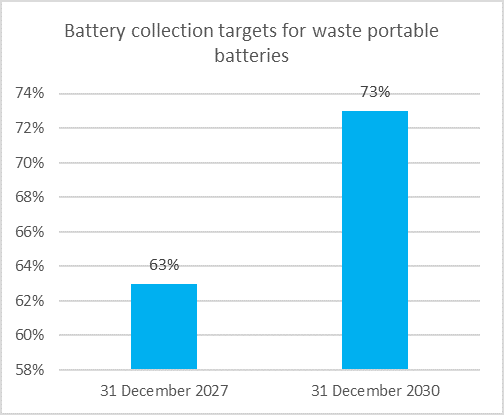

Source: European Commission; SMM
The regulation introduces an individual electronic battery passport for each industrial battery (more than 2 kWh), EV battery and LMT battery (e.g., an e-bike battery), which is required from 18 February 2027. The electronic record should include general information about the battery (the battery manufacturer and geographical location of the battery manufacturing facility) and other information like carbon footprint, responsible sourcing, recycled content and so on.
This regulation can enhance transparency along the supply and value chains for all stakeholders and aim to establish a circular market and encourage sustainable practices in the European Union. They are particularly important in the context of the growing lithium battery industry. SMM believes the UK and other European countries will adopt this regulation as they need the EU market. The new battery regulation could push up production costs of lithium batteries, which will not only affect the competitiveness of lithium batteries producers in the EU, but also OEMs.
Figure 2. Mandatory requirements of recycled materials used in new industrial, SLI and EV batteries
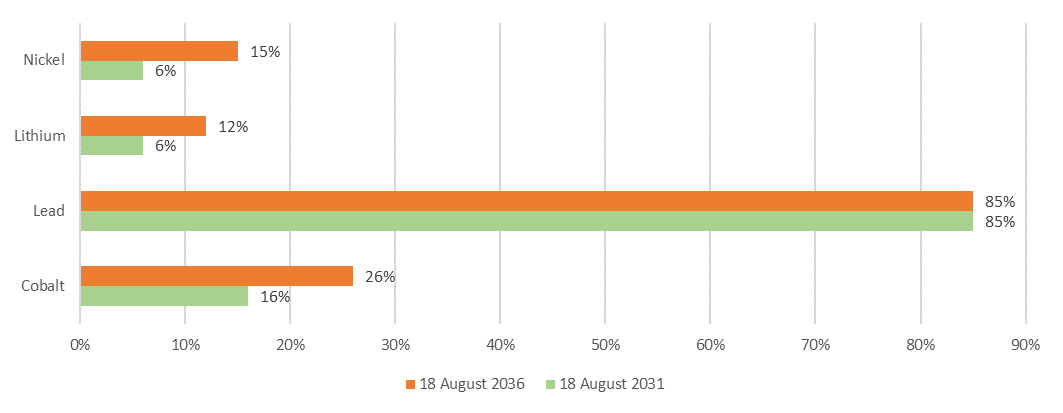
Source: European Commission
European lithium battery industry with broad prospects and uncertainties
In 2022, there are approximately 70GWh of lithium battery be produced in Europe, which is a relatively small number compared to other countries like China (545.9GWh). The location of the new projects in relation to the existing/expanded projects is shown in the figure below.
Figure 3. Battery cell existing (with green mark) and new capacities (with yellow mark) announced for 2030 in Europe
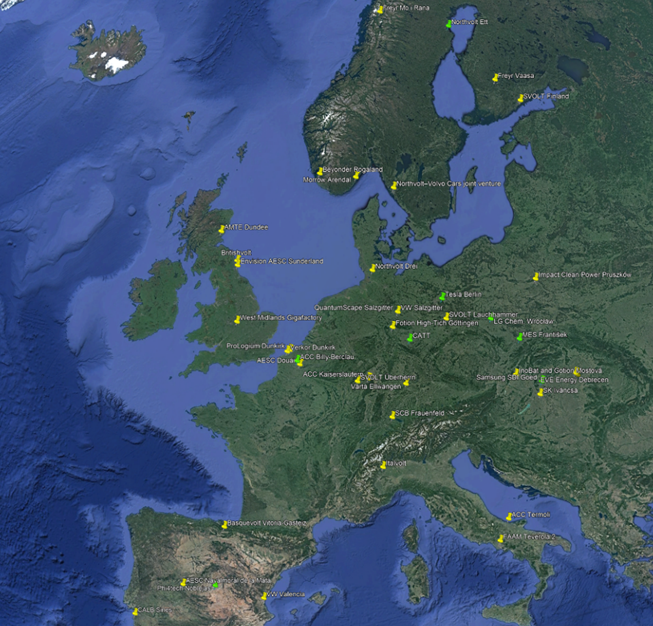
Source: SMM, Google Earth
Driven by policy and market factors, the lithium battery industry in Europe is in a rapid development stage. A significant amount of greenfield and brownfield capacity is planned to come on stream before 2030, as the following figure shows the lithium battery capacity with low risk in Europe.
Figure 4. Lithium battery capacity forecast (low-risk projects and current capacities) in Europe

Source: SMM
There is no doubt that some battery plants will succeed in strengthening the European industry. Northvolt Ett is one such example. As the first home-grown European lithium battery plant, it has already started commercial production in 2022 and has opened an expansion programme. As a successful example of capital investment in the local lithium battery industry, this is a milestone step forward. This and other successful greenfield and expansion projects are often supported by policies, subsidies or interest-free loans from the EU and local governments. The following typical projects and their brief subsidised status are from SMM analysts.
Form 1. Typical projects and their subsidised status

Source: SMM
Due to the various of barriers, several gigafactory projects are being put at risk of delay or even cancellation. According to the SMM analysis, about 41% of the planned capacity is at medium risk or high risk, as shown in the Figure 5.
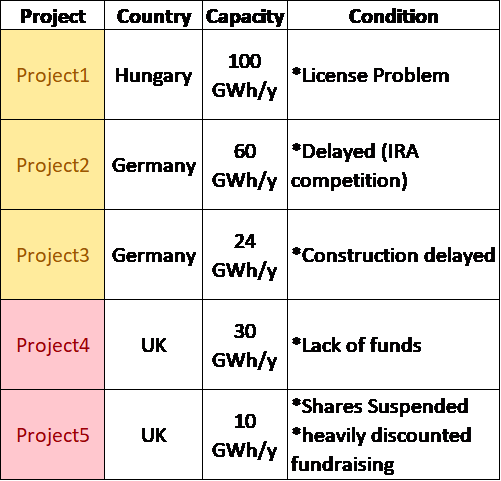
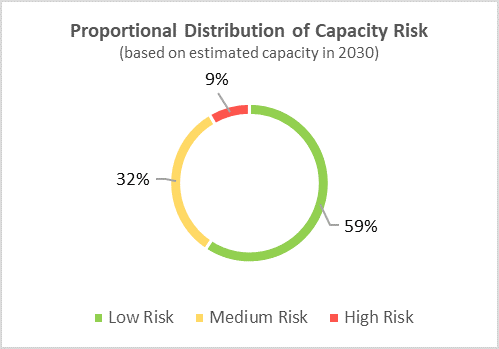
Source: SMM
In addition to those that commonly lead to a lack of better prospects for the project, the USA Inflation Reduction Act (IRA) also has a great impact on some projects in Europe. The bill provides uncapped subsidies to domestic producers and to producers using more than a certain percentage of raw materials from North America, which is stronger than similar incentives in Europe. As a result, some of the planned or even prepared lithium battery industry investment in Europe may be transferred to the USA.
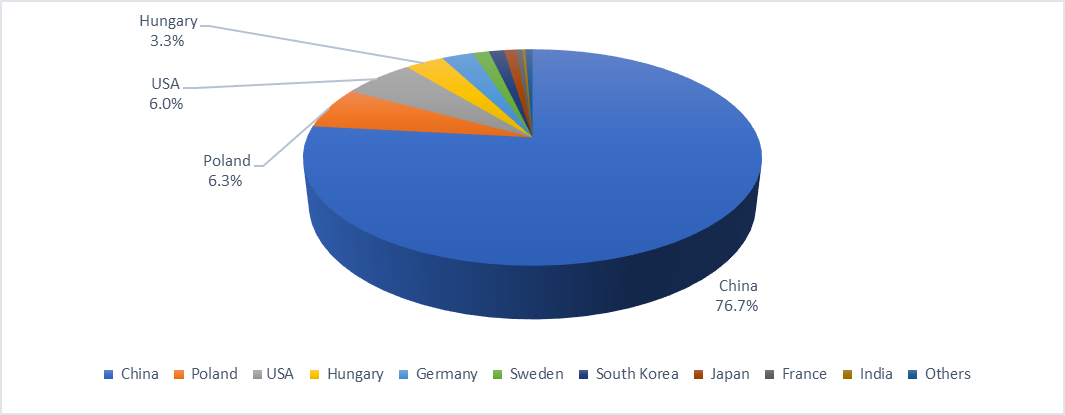
Figure 6. Share of lithium-ion battery capacity, 2022 (GWh)
Source: SMM
Europe, like most other countries, currently relies on Chinese lithium batteries and raw materials to meet the needs of the consumer market and local related industries. More than three-quarters of the world's finished lithium batteries are produced in China now. China's share of other raw materials, such as graphite, is also as high as 74% (2022). Large-scale production capacity brings strong cost competitiveness; thus China's price is the lowest among the reasonably low prices of lithium batteries in different regions of the market. This lower price and the existing capacity advantage constitute great competition for the European growing industry.
Figure 7. Reasonable lowest price per kWh of lithium batteries in 2022 in China, USA & Euro

Source: Bloomberg NEF
European Federation for Transport and Environment expects that the EU will be able to move away from its dependence on China for lithium-ion batteries and some intermediate raw materials by 2027 or later, thanks to the relevant bills. The newly introduced Critical Raw Materials Act also gives many battery industries a single source country percentage cap for raw materials. This is a key step in the EU's attempt to autonomise the whole industry chain, only whether this will lead to a further rise in costs and a weakening of product competitiveness remains to be seen over a longer period.
Conclusion
The future of the European lithium battery industry is facing both major opportunities and challenges. It is key to the EU's transition to renewable energy and away from fossil fuels. Although the EU's current production capacity is small, especially compared to China, it is seeing growth potential through various acts and policy drivers. However, the industry suffers from barriers such as a scarcity of local technology companies, underinvestment, delays, and geopolitical and regulatory challenges. The global competitiveness of European lithium battery industry has no edge compared to other first-mover competitors. European countries must effectively balance policy support, investment incentives and sustainable development practices to promote the competitiveness and co-operation of local industries.
In addition, for those investors from overseas, it is crucial to focus on integration with local industries and linkage of interests. When investing in a location, it is crucial to demonstrate the advantages of the investment to the local community and to establish a partnership based on sharing these benefits. This approach of integrating the interests of both the investors and the local community can be instrumental in addressing any concerns or scepticism that may arise beyond the technology and market dynamics. Often, this strategy proves to be a decisive factor in the success of a project.
![Analisis produksi litium sulfida kelas baterai Agustus: Akankah kuartal IV melonjak? [Analisis SMM]](https://imgqn.smm.cn/usercenter/mpqgn20251217171727.jpg)