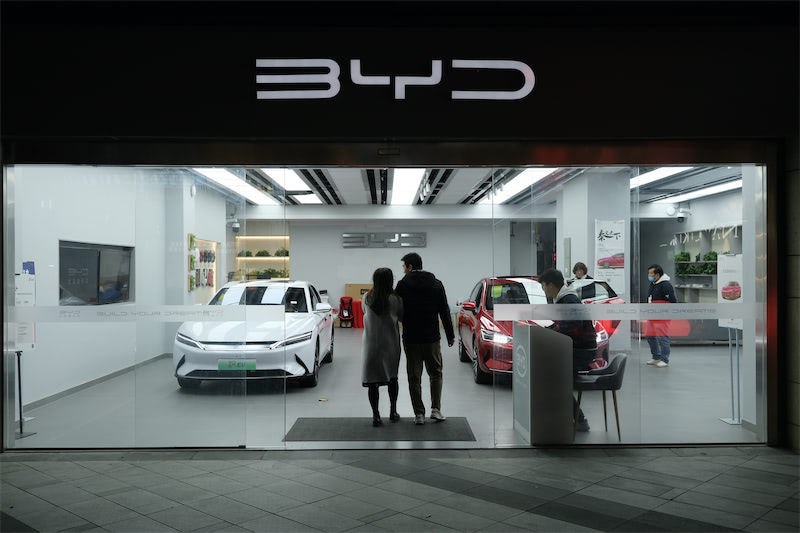
After entering 2022, the domestic battery new energy industry chain enterprises expand production, sign good news one after another. According to incomplete statistics of the battery network, in the first quarter of 2022, lithium battery enterprises represented by BYD, Xinwanda, China New Airlines and Yiwei Lithium Energy have announced a number of new construction projects one after another, with an overall investment of 209.103 billion yuan and an annual production capacity of 579GWh, which is further accelerated compared with the same period last year.

The era of TWh accelerates the emergence of 10 billion-level investment projects
A few days ago, according to the White Paper on the Development of China's New Energy vehicle Industry (2022) jointly released by EVTank, Ivy Economic Research Institute and China Battery Industry Research Institute, global sales of new energy vehicles reached 6.7 million in 2021, a substantial increase of 102.4 percent over the same period last year, of which sales in the Chinese market reached 3.548 million, an increase of 160.1 percent. Looking ahead to 2030, EVTank expects global sales of new energy vehicles to reach 47.8 million, accounting for nearly 50 per cent of new car sales that year.
According to data from the China Automobile Association, from January to February, the production and sales of new energy vehicles in China completed 820000 and 765000 respectively, an increase of 1.6 times and 1.5 times respectively over the same period last year, with a market share of 17.9%. In addition, from January to February, the installed capacity of power batteries in China accumulated 29.9GWh, an increase of 109.7% over the same period last year. Among them, the cumulative 13.1GWh of ternary batteries accounted for 43.8% of the total loading, an increase of 50.6% over the same period last year; the cumulative 16.7GWh of lithium iron phosphate batteries accounted for 55.9% of the total loading, an increase of 203.1% over the same period last year, showing a momentum of rapid growth.
There is no doubt that the rapid growth of production and sales of new energy vehicles and the rising installed capacity of power batteries have become the biggest driving force for power battery enterprises to accelerate production expansion in the first quarter. According to the above table, it can be seen that domestic power battery enterprises represented by BYD, Xinwanda, China New Airlines and Yiwei LiNeng have significantly accelerated their production expansion, among which 10 billion-level investment projects appear frequently.
On January 24, the people's Government of Xiangyang City, Hubei Province, signed a strategic cooperation agreement with BYD. BYD Xiangyang Industrial Park "Construction Land Planning permit", "Construction Project Planning permit", "Planning and Design Plan approval", "Construction Project Construction permit", "Real Estate Registration Certificate" and "five certificates" were issued together, and the industrial park officially started construction, with a total investment of 10 billion yuan. Build an annual production capacity 30GWh power battery factory.
On January 25th and 26th, the investment cooperation agreements of Guangzhou base project and Jiangmen base project of China New Aviation Power Battery and Energy Storage system were signed one after another, and a total of new 100GWh production capacity was planned.
On the afternoon of March 11, Xinwanda announced that it would invest in the construction of Xinwanda new energy production base in Zhuhai, Guangdong, with a total investment of 12 billion yuan, reaching the annual production capacity of power battery and energy storage battery 30GWh after completion of the construction. A week later, Xinwanda announced the construction of a production base for power battery and energy storage industry in Shifang, Sichuan, with an investment of 8 billion yuan to build a production base for 20GWh power battery and energy storage battery.
In addition, Yiwei Lithium Energy, Jie Wei Power and Chuneng New Energy have also announced the construction of 10 billion-class power battery projects in the first quarter, the urgency of production expansion is evident, and the TWh era will accelerate.
Overseas battery factories are eyeing covetously domestic battery factories to speed up their going out to sea.
At a time when the layout of domestic power battery enterprises is speeding up, overseas power battery enterprises are also eyeing covetously, with the gradual development of the overseas new energy vehicle market, after missing the business opportunity in the Chinese market in the early stage, Japan and South Korea power battery companies are hoping to make a comeback in Europe, North America and other places.
On March 4th, Japan's Panasonic plans to buy land in the United States to build a large power battery plant, which may produce 4680 batteries for Tesla, with an investment of billions of dollars. Subsequently, SK On also announced the signing of a memorandum of understanding with Ford and Ko ç Holding to set up a joint venture in the United States to produce electric vehicle (EV) batteries, which is scheduled to start operating by 2025 with an annual capacity of 30GWh to 45GWh. According to SKI's plan, the annual production capacity of SK On battery will be expanded to 85GWh in 2023, 220GWh in 2025, and surpass 500GWh in 2030.
On March 14, Samsung SDI and Posco also announced that they would build a pilot production line of solid-state batteries for electric vehicles covering an area of 6500 square meters in South Korea to lay out the frontier market.
On March 24th, LG New Energy will spend nearly US $1.4 billion to build a second independent electric vehicle battery plant in Arizona, with an annual capacity plan of 11GWh, which is scheduled to start production in the second half of 2024; on the same day, the company signed an agreement with American automaker Stellantis to set up a joint venture company in Canada and set up the first large-scale domestic electric vehicle battery manufacturing plant. It is reported that LG New Energy is also in the process of building the third and fourth battery plants in the United States with General Motors. Coupled with the newly released investment plan, the company has now ensured annual production capacity exceeding 200GWh in North America.
In addition, Battery Network noted that with the increasing demand in overseas markets, marching into the international market has become a new choice for domestic power battery enterprises.
On the evening of March 29, Yiwei LiNeng announced that it planned to buy real estate and build a power battery manufacturing plant in Hungary. On March 16, Guoxuan Hi-Tech announced that it planned to issue global depositary receipts abroad and list them on the Swiss Stock Exchange. It plans to increase the construction of power battery capacity and supporting industries in Europe, North America, Asia and other overseas markets. Earlier, Ningde Times also said it would enter the US market and would also consider building factories in Mexico and Canada.
It is understood that a number of domestic power battery companies, including Ningde Times, BYD, Honeycomb Energy, Yiwei Lithium Energy, Vision AESC, Funeng Technology, and so on, have set up large-scale power battery factories overseas, and some have also announced that they are about to build their own factories, thus better supporting overseas car companies and seizing market share.
Keep pace with the expansion of battery production and build upstream materials for lithium electricity
It is worth noting that with the accelerated pace of battery expansion, the prices of upstream raw materials have also begun to soar. In order to stabilize the supply of raw materials and ensure normal production, major power battery factories have also begun to directly "intervene" in the construction of material projects to speed up the layout of raw materials.
Take Ningde Times as an example, on February 20, Ningde Times or its wholly-owned subsidiary will increase RMB 280 million to Zhongke Star City in Gui'an New area for the joint venture construction of Zhongke Star City in Gui'an New area, which will produce 100000 tons of lithium battery anode materials integrated project. On the evening of February 8th, Jiayuan Science and Technology also announced that it plans to jointly invest with Ningde Times in Meixian District, Meizhou City, Guangdong Province to establish Guangdong Jiayuan Times New Energy Materials Co., Ltd., which will be used to build a high-performance electrolytic copper foil project with an annual output of 100000 tons.
Recently, most of the new energy vehicle brands at home and abroad, such as Tesla, BYD, Xiaopeng Automobile, Naha Automobile, Guangzhou Auto Ean, and so on, have announced price increases to varying degrees, and they are still fermenting. Judging from the relevant announcements of car companies, almost all point the source of this round of price increases to "rising prices of raw materials." The battery factory directly "intervenes" in the layout of upstream raw materials, which will help to lock in the supply of upstream high-quality resources, and at the same time stabilize the cyclical fluctuation of upstream resource prices.
Conclusion
In fact, the survival of the fittest in the domestic power battery market has been going on. With the increasing production and marketing of domestic new energy vehicles, automobile enterprises' requirements and standards for power batteries are also increasing, high-quality power batteries are in short supply, and head enterprises have relatively sufficient funds and strength to expand production capacity and improve product quality. at the same time, it has also led to high-quality products and demand constantly close to the head enterprises, most of the market share is seized by the head enterprises.
However, with the continuous growth of new car-building forces and the accelerated transformation of traditional car enterprises, leading to fierce competition among power battery brands and blooming technology lines, car companies have also begun to choose more power battery brands to alleviate capacity shortages and get rid of major customer restrictions; at the same time, as Japanese and Korean power battery enterprises break through and rotate their market positions, the domestic power battery market will also be full of turbulence and changes in the future.
In the White Paper on the Development of China's New Energy vehicle Industry (2022), EVTank predicts that global lithium-ion battery shipments will reach a compound growth rate of 25.6% by 2030, and total shipments will be close to 5TWh by 2030. However, at present, the technology of lithium-ion battery is not yet mature, and the next generation battery technology, including solid-state battery, will emerge in endlessly. High energy density, high safety, low cost and long cycle are still important directions in the research and development of lithium-ion battery. Therefore, it is still uncertain for EVTank to judge the competition pattern of lithium-ion battery enterprises. at present, the monopoly competition pattern of leading enterprises represented by Ningde era will be gradually improved.
In addition, in the past two years, the pace of China's power battery enterprises in opening up overseas markets has generally accelerated, although the market share has begun to expand continuously. however, in the face of the rising price of raw materials and many objective problems such as epidemic situation, war, labor cost, industrial chain integrity and so on, the road for battery enterprises to go to sea is not smooth, and it is a great test for domestic power battery enterprises to quickly integrate into the global supply chain.
![[전고체 배터리: 황화물 전해질 생산량 70톤, 1~8월]](https://imgqn.smm.cn/usercenter/Bwmed20251217171726.jpg)
![[SMM 분석] 유럽, 리튬 공급망 독립 추구하나 프로젝트에는 아시아 투자자 유치](https://imgqn.smm.cn/usercenter/nVnLo20251217171728.jpg)