Gold fell slightly in January to close at $1797.17 an ounce, down less than 1 per cent from a month earlier. Higher nominal yields, a stronger dollar and a tougher-than-expected Fed statement were the main headwinds for gold during the month. Global gold ETF inflows by tonnage were 46 tonnes ($2.7 billion), the highest level since May 2021. In the future, monetary policy and inflation will remain the key to gold prices in the short term.
Gold shows the quality of risk aversion.
International gold prices fell slightly in January, falling less than 1 per cent to $1797 an ounce. But this does not fully reflect the interesting changes that took place that month. Gold prices rose steadily amid the stock market turmoil despite rising yields and a stronger dollar, but a fall in gold prices caused by monetary policy erased previous gains in the last week of the month.
Expectations that the fed would raise interest rates by as much as 0.25 per cent and its balance sheet shrank caused the nominal yield on 10-year Treasuries to rise by nearly 30 basis points to 1.78 per cent, a disadvantage that failed to stop gold from rising. Historically, high inflation has kept real interest rates at historically low levels, prompting investors to switch to riskier, less liquid assets. But gold prices fell sharply after the Federal Open Market Committee (FOMC) (FOMC) issued a statement on Jan. 26. The statement was tougher than expected, confirming that interest rates are likely to rise in March and that no decision has been made on the size or number of rate increases this year.
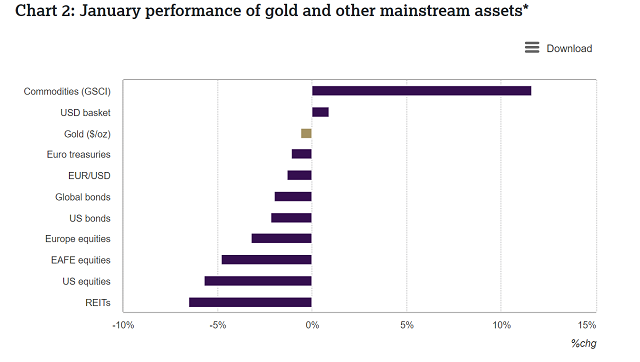
The World Gold Council's gold return attribution model (GRAM) confirms this (figure 1). It shows that the rise in Treasury yields in January was the biggest resistance, but break-even inflation could also be a major drag on gold's performance. Us 10-year break-even rates fell from about 2.6 per cent to about 2.4 per cent in January, suggesting that markets expect longer-term inflation to be more moderate. A stronger dollar is also bad for gold, with the dollar index at its highest level since 2020. However, gold performed strongly in January relative to other mainstream assets (figure 2).
Figure 1: gold yields rise in January and the dollar strengthens
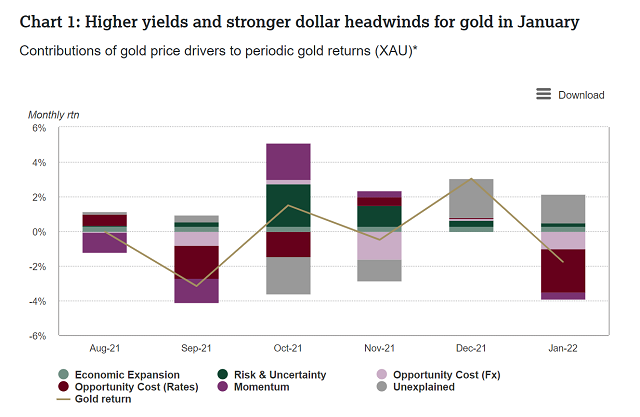
The contribution of gold price drivers to gold cyclical returns *
Gold was also boosted by some supportive factors in January. The increase in purchases of physically supported gold ETF is a significant shift in market sentiment. Globally, gold ETF inflows of 46 tonnes ($2.7 billion) in January, the highest monthly increase in holdings since May 2021, were particularly concentrated in US-listed funds. In addition, geopolitical risks are also increasing due to rising tensions between NATO members and Russia over Ukraine, which helps to maintain a high degree of uncertainty. Gold tends to be supported when geopolitical tensions escalate, which is another reason why gold can be well diversified in any portfolio.
Figure 2: performance of gold and other mainstream assets in January *
In January, the average daily trading volume of gold rebounded significantly, and the increase in trading volume of OTC and COMEX was one of the reasons for the rise in gold prices (figure 3). Daily gold trading volume rose to $139 billion in January, up 71 per cent from a month earlier and 7 per cent higher than the 2021 average. COMEX's net long position fell to 590 tonnes ($34 billion) after the Fed's statement, the lowest level since the end of September.
Figure 3: daily gold trading volume in January exceeds the 2021 average
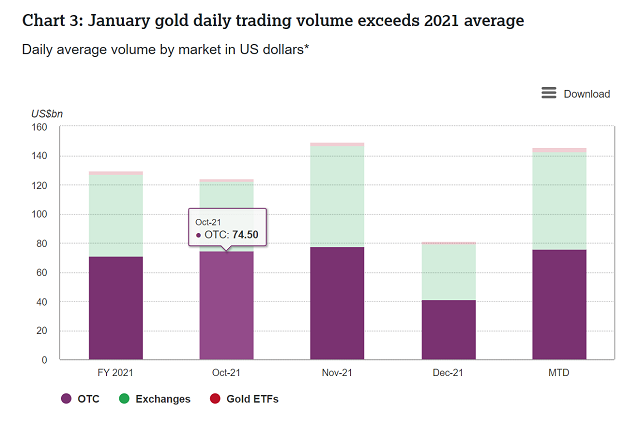
Average daily market volume (in US dollars) *
Looking ahead: interest rates and inflation will still be the key to gold prices
Gold prices rebounded in the first few days of February to a two-week high as the initial reaction to the Fed's recent announcement cooled. An analysis of previous tightening cycles shows that tightening is often not as strong as initially expected. However, the strong US jobs report in January, coupled with a sharp revision to December expectations, opened the door to more aggressive tightening measures by the Fed in the short term.
Similarly, with the Bank of England narrowly voting in early February to raise interest rates by a further 0.25 per cent instead of 0.5 per cent, this could put further pressure on the gold market in the local market. The ECB will face similar problems. With CPI rising by a record 5.1 per cent in January, the ECB is under more pressure to deal with the threat of inflation in the eurozone.
It is worth noting that not all central banks intend to raise policy interest rates in the short term. But more broadly, the World Gold Council believes that investors will continue to pay attention to the upcoming pace of interest rate hikes and the gloomy prospect of persistently high inflation. The ability of gold to move meaningfully in either direction in the short term will depend on whether investors are more worried about inflation not cooling or whether interest rates are rising faster than expected.
Similarly, the short-term technical side of gold is unclear, but a healthy upward trend in the dollar composite index and 10-year Treasury yields are likely to be a constraint. In view of the recent mixed market views on gold, the World Gold Council believes that the inflow of gold ETF and COMEX positions will be an important indicator of concern.
A Survey of the performance of the Sub-regional Gold Market
India: retail demand remained weak in January due to the re-implementation of restrictions on the COVID-19 epidemic and the cooling of spot demand during the holidays. This led to a discount of $1-$2 / oz in the local market and expanded to $2-$3 / oz at the end of the month. Local gold prices fluctuated horizontally, while expectations of changes in gold taxes in the federal budget on February 1st (which have not changed since) reduced gold purchases. However, retail demand is expected to improve in February due to a decline in COVID-19 cases and gold prices.
In January, there was an outflow of 1 tonne of gold ETF from India, mainly driven by higher yields on 10-year Indian government bonds and expectations that the Fed would take a tougher stance. As of the end of January, China's total gold holdings were 37 tons.
Sales of American gold coins: sales of American Eagle coins reached 181500 ounces ($326 million) this month, the third highest January total record (figure 4). The company sold 1.2 million ounces ($2.3 billion) in 2021, the highest annual sales since May 2009
ETF: Gold ETF added 46 tonnes ($2.7 billion) to global assets under management in January, the largest monthly inflow since May, mainly concentrated in the largest fund in North America, while European fund holdings increased slightly. This exceeds Asian capital outflows. At the end of September, global foreign exchange reserves stood at 3616 trillion euros ($209 billion).
Figure 4: sales of American Eagle coins in January reached the third highest in history.
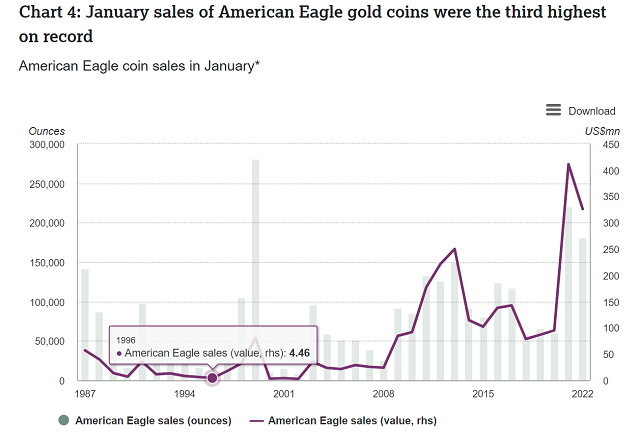
Sales of American Eagle coins in January *