Gold does not directly follow most of the most commonly used methods of valuing stocks or bonds. In the absence of coupons or dividends, the typical model based on discounted cash flow, expected return or book-to-book value ratio is difficult to properly assess the potential value of gold. To this end, the World Gold Council has developed the gold valuation framework (GVF), in order to better understand the gold valuation.
The analysis of the gold valuation framework (GVF) shows that the price performance of gold can be explained by the interaction of four key drivers:
Economic expansion: the period of economic growth is very beneficial to jewelry, technology and long-term savings.
Risk and uncertainty: market downturns usually boost investment demand for gold as a safe haven.
Opportunity cost: the price of competitive assets, especially bonds (through interest rates) and currencies, will affect investors' attitudes towards gold.
4 Trends: capital flows, position adjustments and price trends can boost or restrain gold's performance.
Inflation, supply chain concerns and epidemic uncertainty remain top priorities for investors in 2022
Inflation is an important global theme throughout 2021 and a key factor in investor decision-making in 2022. Although many central banks believe that the rise in inflation is temporary as a result of the epidemic in the first half of 2021, this consensus changed in the second half of 2021. Some central banks now acknowledge that inflation will last longer and are expected to raise interest rates in 2022. Instead, other countries, such as India and the ECB, are expected to continue to ease policy.
At the same time, the supply chain bottleneck caused by the epidemic has not been completely eliminated. It is true that governments are reluctant to respond to the recent surge in cases with formal blockades that have undermined economic growth over the past two years, but new variants could change that, with the resurgence of supply chain disruptions in industries ranging from technology to shipping, which could have a negative impact on economic growth and create additional inflationary pressures.
While the market expects interest rates to rise and the dollar to strengthen (which is bad for gold), real and nominal interest rates should remain historically low.
The analysis of the World Gold Council shows that the gold central bank has performed well in the rate-raising cycle and is an effective hedge against inflation. Coupled with healthy jewellery and central bank demand, and possible market volatility in a dramatically changing world, the strategic case for including gold in the portfolio, especially as a portfolio hedge, remains compelling.
Environmental, social and governance issues
In recent years, investors have increased their consideration of environmental, social and governance (ESG) in the investment process. For example, in a MSCI survey of 200 institutional investors with about $18 trillion in assets under management, 73 per cent plan to increase their ESG investments in 2021.
This increasing emphasis on ESG reflects the increasing pressure on enterprises to actively pay attention to and manage ESG risks. It also supports the view that good ESG performance can lead to better long-term financial performance. The wider integration of ESG objectives into the shift in investment strategy is important for gold, which investors want to be produced responsibly and can play a role in supporting ESG objectives and managing associated risks in the portfolio.
The importance of gold is increasing day by day.
Institutional investors seek alternatives to traditional investments such as stocks and bonds to achieve diversification and higher risk-adjusted returns. For example, the share of non-traditional assets such as hedge funds, private equity funds or commodities in global pension funds rose from 7 per cent in 1998 to 26 per cent in 2020-30 per cent in the United States
Gold allocation has always been in line with this shift. Investors are increasingly aware that gold is a mainstream investment. Since 2001, global investment demand has grown at an average annual rate of 15 per cent, while the price of gold has risen almost sevenfold over the same period. An analysis by the World Gold Council shows that risk-adjusted returns will increase by adding 4% to 15% of the average investment portfolio assumed over the past decade, depending on composition and region.
Figure 1: gold allocation can improve the risk-adjusted return of the global average hypothetical portfolio
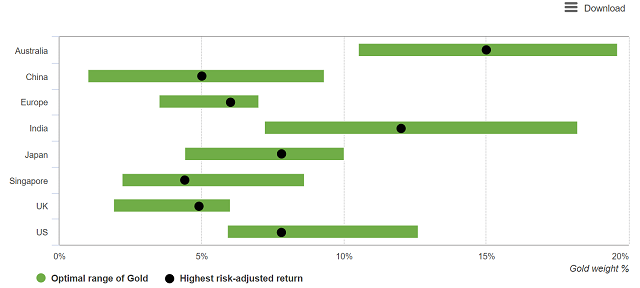
The effective frontier gold allocation range of the average investment portfolio by region. Solid bars are the best gold range for an average hypothetical portfolio in each region. This indicator represents the gold allocation with the highest risk-adjusted return.
Supported by key structural changes, gold has performed strongly in recent decades
The following five structural changes have helped drive gold's performance:
1 monetary policy
Persistently low interest rates reduce the opportunity cost of holding gold and highlight that gold is a real source of long-term returns, especially compared with historically high negative-yielding debt.
2 the demand of the central bank
The surge in interest in gold by central banks around the world has prompted other investors to consider the active nature of gold. Gold is usually used as foreign exchange reserves to improve safety and diversify investments.
(3) Market risk
The global financial crisis has prompted a renewed focus on risk management and an appreciation of unrelated, liquid assets such as gold. Now trade tensions and concerns about the economic and political outlook have prompted investors to re-examine gold as a traditional hedging tool.
4 market access threshold
Gold-backed ETF facilitates access to the gold market, greatly boosts investor interest in gold as a strategic investment, reduces total holding costs, and improves efficiency.
5 growth in emerging markets
Economic expansion in emerging markets has increased and diversified gold's consumer and investor base.